
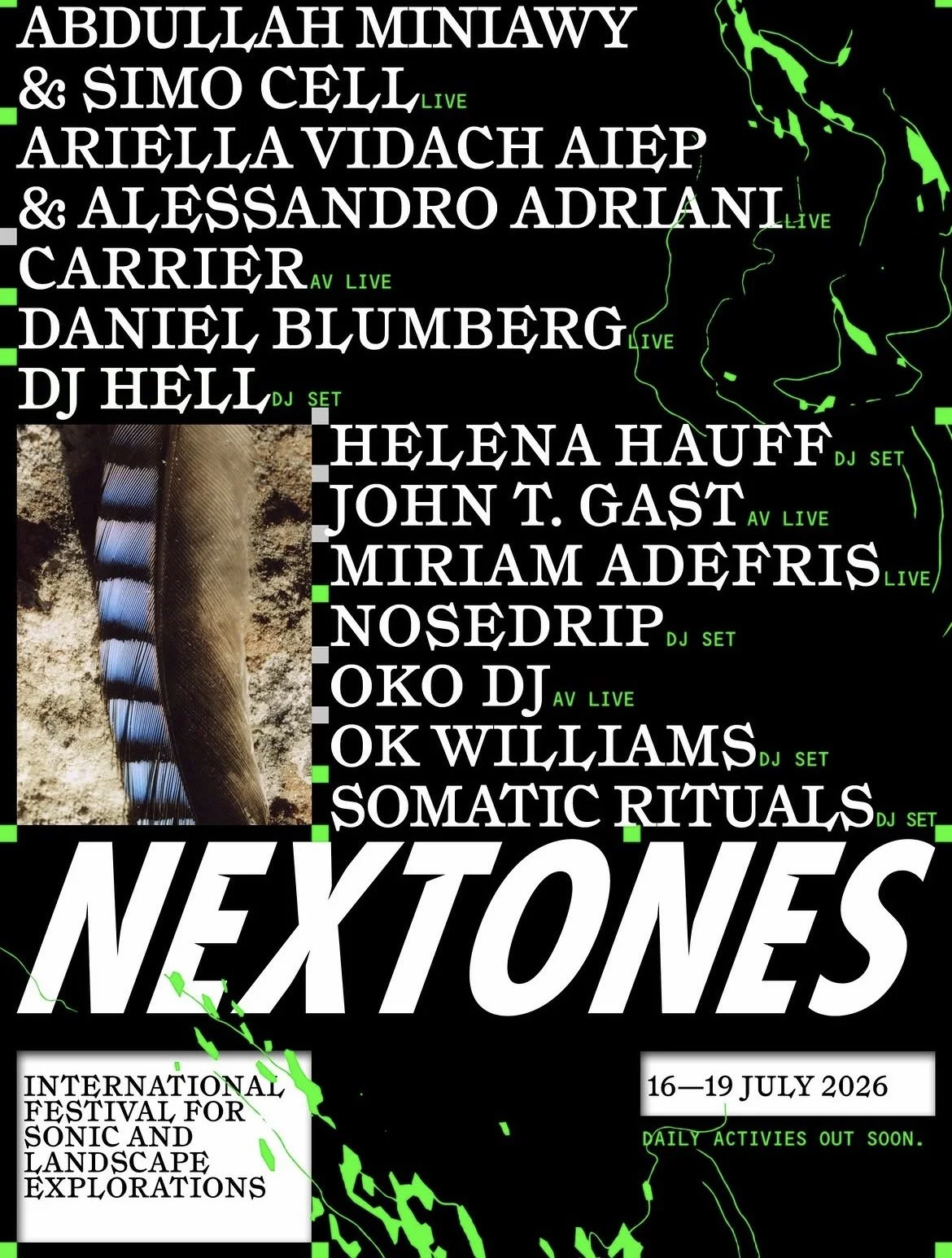
NEXTONES’ SONIC AND VISUAL LANDSCAPE ACTIVATION OR THE CATHEDRAL MINDSET VS THE ALGORHYTHMIC MINDSET.
diary/ essay/ conversation with AKASHA
1. Returning to the quarry: diary of a temporary community
Are there any questions, however driven by sincere interest, that exude more performativity than "what festival are you doing this year?" — I don't think so.
My marxist self starts its filippic inside my head giving me scorching itches immediately as I look for a non-existing notification on the phone to avoid answering. Staying silent is not for everyone, especially if you’re sensitive to peer pressure as I may be sometimes. It takes a split second to get a festival name wrong, or, before you know it, find yourself trapped in the company of the entire Milanese clubbing-bubble crowd in some remote location, in captivity. I might not be a travel agent, but this sounds more like a Stephen King plot than an ideal vacation… You might find yourself ruining your bank account over several Aperol Spritz (i.e. tokens), for your character build. All of this to share the company of some gorpcore dressed kings and queens, fairies and satyrs looking as if out of Mad Max, acting as if out of Mamma Mia!.
The festival experience has always been a crossroads of contradictions.
Even more so in years when, on top of extreme weather events, we have to shoulder an algorithmic and commodifying approach to communal experiences. Mushrooming out and undermining the sacred prayer which is the act of listening itself: technofascists are intruding on psychedelic research, trying their best to convince us there’s no alternative to AI, while profiting and reducing everything to an infinite scroll with embedded playlist logics. They are the ultimate virus that permeates and objectifies everything.
According to the Zhuangzi, human civilization originally existed in a state of spontaneous, unmediated connection with the world, a "primordial wholeness" (and in fact this is what we crave for in search for the next communal experience). In this view, artificial rituals and music were not divinely ordained, but rather, as the text argues, an artificial construction that arose when this natural, pre-linguistic harmony was lost (see unity in Dao).
Year 2026, July, sound is thus transmuted from a mysterious communicating system and magical/ spiritual phaenomena into a dystopian but levigate iphone store pristine quality laboratory, a collection of behavioural record data, making everything just a bit more dissociating. For many, in fact, the only way to navigate these waters is to add like to like…
Fortunately, Nextones tries its best to dissolve some of the aforementioned contradictions (better forget your phone in the tent). As part of a much broader showcase dedicated to the territory, every year Nextones draws some of the most interesting names in tout court experimental music scene (clubbing, neo-classical, folk, ambient etc.) to a location that defies logic: a system of quarries now turned into theaters. This geologically sedimented stroke of luck is augmented through video mapping, acting now as a magnifying glass, now as a fractal scanner. It is a space that facilitates psychonautic immersion, a marble reverberating site turned into a listening device. Contained as it is, the valley is some sort of cochlea in mother nature’s ear located at the northern edge of the Italian boot.
I will return to Nextones a year after my first time, eager to rediscover the irresistible playful atmosphere of the camping area accompanied by RBL radio’s selectors (nostalgia for high school occupations or a desire for neo-paganism?). The counterpart to the rock theater lies down towards the river; living there for a few days is a dream in itself. Are dreaming and music festivals–at least in their intent—an outpost of myth in a world facing a deficit, even of the miraculous? There is an expression dear to the center of the empire, "cathedral mindset," born from the wonder of how European cathedrals arose: the mentality of those who possess patience and design for posterity. Places like the Val d'Ossola needed this attitude, but declined under “feminine” care rather than “masculine” colonial and extractive control, which I’ll call “algorhythmic mindset”.
2. Geographies of care: sound as sediment analysis
If the algorithmic approach parasitizes reality by reducing it to a two-dimensional playlist, Nextones responds with the three-dimensionality of matter, community and the site-specific. The Val d'Ossola is mapped, monitored, and adorned through a metapoietic scanning where sound acts as a chemical reagent. Listening becomes amphibious, liquid, and subterranean, dispersing the mass of "bubble" bodies into a sacred and fragmented geography:
Acoustic Hydromancy: The underwater listening experience of Hydromantique at the Terme di Premia tears electronic music away from the dancefloor, pushing it toward a uterine and fluctuating dimension.
The Resonance of the Geological Wound: The acoustic guitar of Shane Parish in the Orridi di Uriezzo and the scores of Laura Masotto at the Oratorio di San Marco do not seek violent amplification, but rather an intimate dialogue with sacred and natural space.
Magical-Esoteric Hybridization: In the medieval village of Ghesc, Kenichi Iwasa's artistic residency (alongside Charlie Hope) materializes in a handmade hybrid instrument, halfway between a flute and a horn. It is acoustic archaeology awakening the ghosts of the place through ambient field recordings.
Everything then converges into the belly of Tones Teatro Natura: from the audiovisual hypnosis of Carrier and the drifts of OKO DJ, to the clash between club culture and Middle Eastern mysticism by Abdullah Miniawy & Simo Cell, sealed by the ritual choreographies of Alessandro Adriani and Ariella Vidach. The festival program is a geological score with its many sites behaving as organ pipes.
3. The visual esoteric code, punctum-contra-punctum/ pixel-contra-granite, a conversation with AKASHA:
The peak and total dissolution of the threshold of this clash and conflict between the cathedral mindset (the deep time of stone) and the algorhythmic mindset (the instantaneous nature of data) plays out on the vertical walls of the quarry through video mapping. To understand how digital code can become esoteric without devolving into the technological decorativism of a tech fair, I spoke with my friend and collaborator Riccardo Franco Loiri (aka Akasha), the visual mind behind the festival’s aesthetics.
LORENZO: The esoteric code and the Deep Time of stone: "In my introduction, I define your work for Nextones as a 'visual esoteric code.' There is an obvious short circuit when the instantaneous flow of digital code touches the monumental geological stillness of the quarry. How do you design a video mapping that isn't just technological decoration, but rather a sediment analysis and a 'fractal scanning' capable of entering a dialogue with the deep time of the rock?"
RICCARDO: I really appreciate the phrase ‘visual esoteric code’. When I put these three words together, they resonate in my mind with a mixture that I’m not sure whether to describe as consonant or dissonant (after all, as John Cage once told us, these terms have long since lost their traditional distinction).
‘Code’ is, in itself, something both exoteric and esoteric at the same time. ‘Exo-’, because it is something manifest, mathematical, and reproducible. ‘Esoteric’, because at the same time, talking about code in the ‘agentified’ year 2026 feels almost like speaking Ancient Greek, and our present prefers the natural language of LLMs and Gemini summaries to strings, nodes and parameters.
The immateriality of code is something I have always regarded as highly esoteric and alchemical. I adore this possibility of mixing mathematical rules, painterly gestures and visual inspirations all into a single cauldron, often drawing from it magical potions that I myself cannot fully comprehend at first, forcing me to repeat and revisit the process, delving deeper each time. This sense of wonder evoked by the technique itself continues to fascinate me every time.
To return to your question, when designing the mapping for the quarry, I start precisely with the material itself: the granite of the former Roncino quarry, now Tones Teatro Natura, the immovable, demiurgic driving force behind the festival itself.
Our first reflection begins with the rock itself, which takes centre stage across the entire valley. Heading towards Premia, you can admire the magnificent peaks of the Lepontine Alps and the rock faces of the Val Formazza and the Valle Antigorio. These valleys are dotted with wonders: from the gorges of Uriezzo (and Alvera, less well-known but equally fascinating) to the Marmitte dei Giganti, from the Balmafregia crag to the megaliths of Montecrestese, references to the two main elements that characterise the area ( namely Stone and Water ) can be found everywhere.
Stone is my favourite subject. I have carried out dozens of 3D scans of all these (and many other) magical places in the area, using photogrammetry and Gaussian splatting techniques, to bring organic reality into the code and breathe digital life into it. Just as in a spagyric process - to continue the alchemical metaphor – I ‘extract’, then break down and reassemble the material, which, from scanned rock, becomes rock projected onto rock: a texture inseparable from its screen, filtered, illuminated and obscured by the light of the projectors. The core of my work for Nextones draws precisely on the body of material I have collected in the valley over the years, to which are added other abstract or concrete elements that layer themselves within the projections like rock sediments. And then there is the water. The natural counterpart of the rock, its mould and negative, the sculptor and chiseller of the stone itself. The water that has so often flowed over the ground at Tones, lending an enchanted atmosphere to the entire location, filtering the light from spotlights and projectors and creating unimaginable reflections and plays of refraction. For me, water becomes fluid, movements of advection and attraction, an iridescent and viscous substance that permeates every corner of the quarry, lights and reflections, caustic effects born of the deliberate interplay between beams of light and projections.
L: Cathedral Mindset vs. Algorhythmic Mindset: "Mainstream electronic festivals overuse the blinding, front-facing LED wall—a device typical of the algorhythmic mindset that isolates the performer and objectifies the audience's gaze. At Nextones, the light warps and adapts to the stone. Do you think your metapoietic visual approach can be considered a form of 'cathedral mindset'—meaning a design process that requires care, patience, and respect for the anthropogenic environment, opposed to the colonial approach of major commercial events?"
R: It is certainly a process that requires a lengthy planning phase, a great deal of patience and a detailed study of the venue. I have nothing against LED screens; in fact, I sometimes find that they create a sense of thrilling disorientation (I look at a screen – I see beyond it) when set within certain natural locations with a strikingly different atmosphere. And yet, yes, I agree, it often has an isolating effect on the scene itself (the stage, according to Greek theatre, is not merely the floor of the stage but the entire space around and behind it, often encompassing a building), distorting the unique relationship that develops between the performers, the venue and the audience.
The problems associated with the design of Nextones’ projections (and not only that) are due precisely to its unnatural configuration for a standard stage: slopes, fractures in the rock and irregularities make symmetry in lighting design and projections practically impossible. Yet it is precisely this organic quality that lends it its uniqueness.
This ‘cathedral-like’ process is also evident in the improvements we strive to make year on year with the production team: from the possibility of climbing up to a higher terrace on the rock face to position a light beam, to the optimisation of video mapping and stage logistics.
One last related fact that interests me greatly is that the quarry was, in the past, a symbolic site of production, of man’s control over nature, of extractivism in the strictest sense of the term, which today serves as a venue for music, performances and the arts. The underlying ‘cathedral thinking’ is to dismantle, year by year, the old logic of production; to view the excavations in the rock as the ghost of the rock itself before the arrival of humankind, its open wound; and to restore that place to a dialogue with the nature that surrounds it and which, day by day, is reclaiming it.
L: Local Mythologies and Chthonic Codes: "The Val d'Ossola is a territory thick with alpine folklore, ancient stone villages, weird churches and chthonic myths. In creating your visual code for this edition, did you draw any inspiration from the local mythologies of the valley—treating the rock projections almost as contemporary ghost stories—or did you strictly rely on the physical, material feedback of the granite?"
R: I have a boundless passion for mysteries and Gnostic themes, and this valley is brimming with them. The whole of the Val d’Ossola is steeped in legends linking spirits to storms, landslides, avalanches and boulders tumbling from on high, almost as if the landscape were driven by invisible, vengeful presences. I recall the story of the witches of Morasco, who used magic to bring down giant boulders upon the villagers who opposed them, but who were saved by the intervention of Sant’Anna who embedded those boulders in the mountain. And there is also a story linked to the night-time processions of the dead through the Formazza Valley, the epicentre of the Walser culture in the area, which has given rise to many tales of goblins, woodland spirits and devils.This whole body of legends has intrigued me ever since the first edition of the festival I attended, revealing an area steeped in the ghosts of the past and indissoluble ties with nature - something I constantly strive to convey in the dreamlike and symbolic visions I project.
Even more than the world of medieval legends, however, I am fascinated by the Neolithic remains in the area. In Montecrestese in particular, there are two very distinctive megalithic sites, nestled amongst the vegetation (one of which is right opposite a quarry), in the villages of Croppola and Castelluccio. Both feature circles of menhirs and an ancient dry-stone structure with an underground chamber (ipogeo), probably used as a site for stargazing and as a tomb - a symbol of just how inhabited and steeped in spirituality these areas were as far back as 2500 BC.
I have a vast archive of 3D scans and photographs of Neolithic architecture from across Europe that I have produced myself, to which I have added these incredible memories of the Ossola region’s past, which resonate within the visuals of the quarry.
L: Artificial Intelligence as a Geological Specter: "Today, AI and generative flows are often used to create two-dimensional, hyper-real synthetic worlds. In the context of Tones Teatro Natura, did you try to use these digital tools to bring out the hidden 'ghosts' or memories of the stone, or did you conceive them as an alien, non-human organism temporarily dropped into the Val d'Ossola?”
R: Both, I’d say. I’ve been using AI for many years and constantly swing between a feeling of oversaturation and a wild, childlike enthusiasm when I explore the tools it offers me. In the last edition, I used a custom-trained model to create the visuals for British Murder Boys, aiming to forge connections between the band’s Afro-based ritualistic imagery and the spirituality of the Ossola rocks. This year I’m designing new models with a similar aim for the shows by Simo Cell and Somatic Rituals, building unimaginable bridges between ritual cultures from around the world, symbolic lyricism and the subterranean forces of nature. What guides me is always the allure of the symbol combined with the material and a subtle occult layer that permeates my work.