Élie Autin
Continuing and contrasting Nietzsche’s thesis of the Apollonian and Dionysian as a sort of Western take on the Taoist Yin and Yang, the American scholar Camille Paglia defines the former as a dichotomy. In her theory of art and culture, the Apollonian represents the light and structured, in opposition to the Dionysian as dark and hedonistic. For Paglia the latter is associated with the female, as a force of chaos, in opposition to the male rationality. If we – in line with modernist thinking – see the rational as a virtue, this could be interpreted as a misogynist. However, in a world that appears ever more irrational, one might as well argue that the rational itself is an illusion, and that one should embrace the chaos.
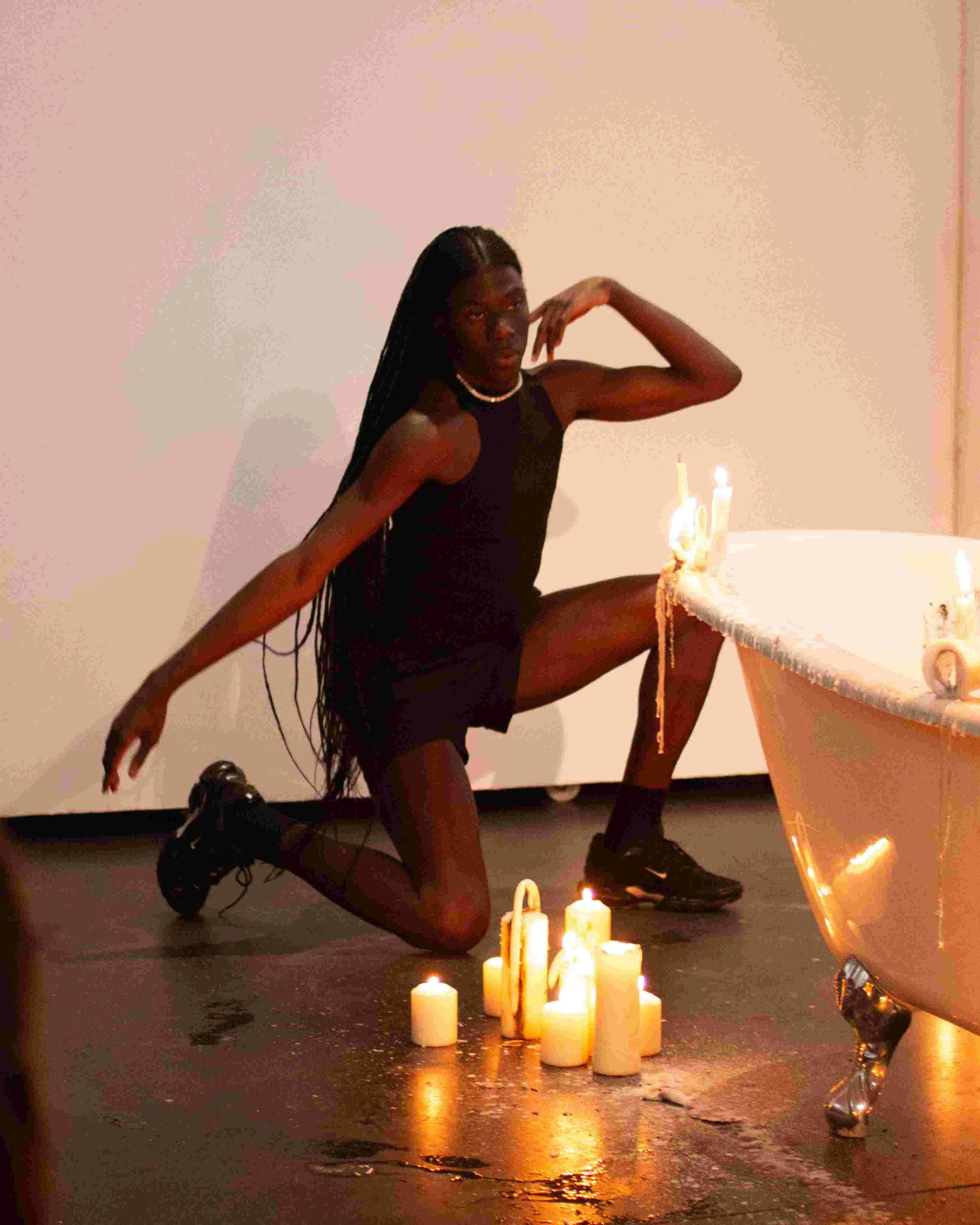
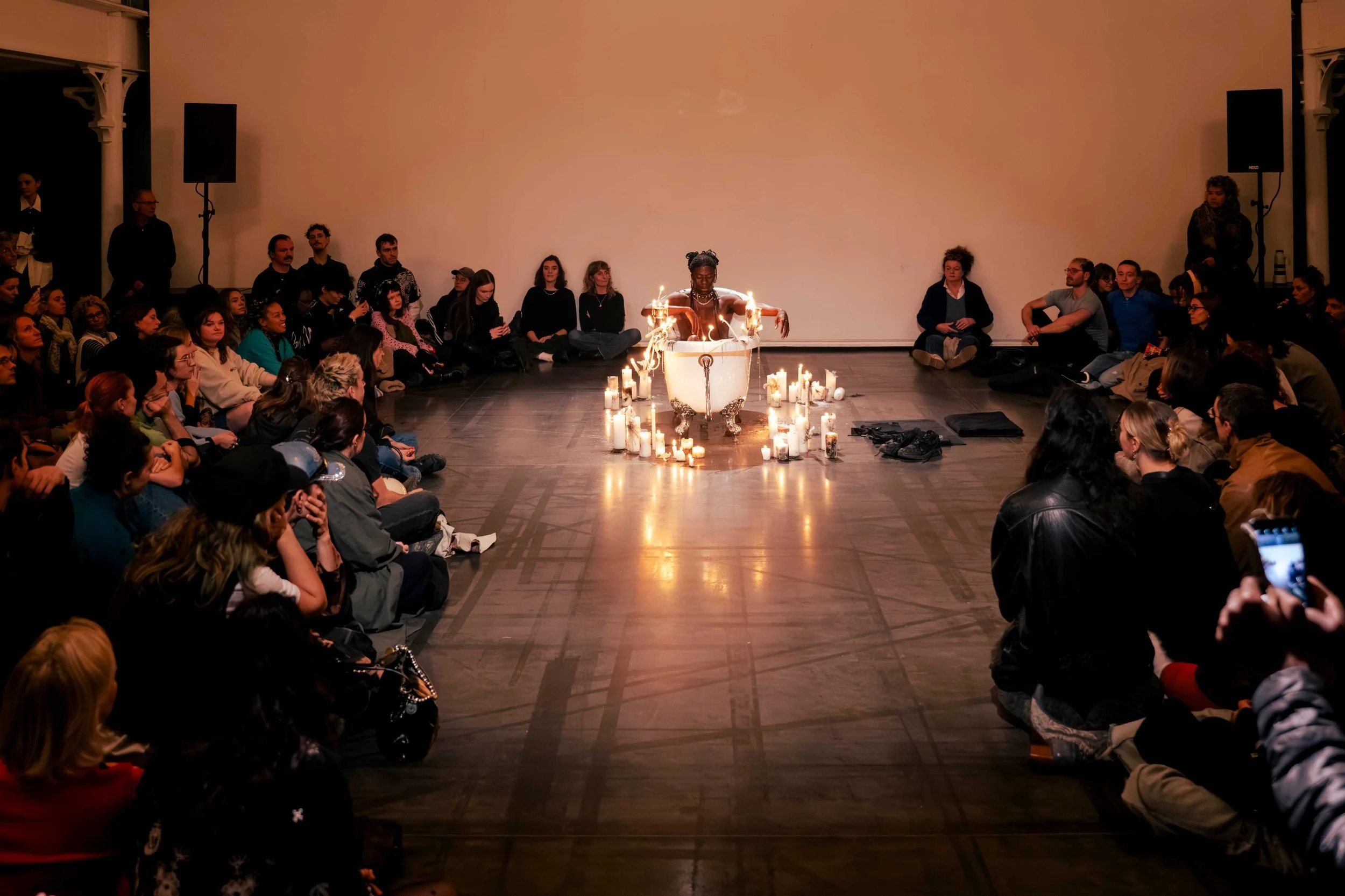
In her performance Antichambre, Élie Autin embraces the Dionysian in full form. It’s dark, chthonic, and bordering on scary, all the while it’s also rewarding, and truly beautiful. Baroque music, heavy incents, smoke, dance, and taste come together in an empowering drama. Through this hedonistic celebration of female chaos, Autin makes her audience question the concepts of history, value, and in the end, truth.
Your performance Antichambre holds a broad number of references to the Roman God Bacchus [Greek: Dionysus] and his female followers, to Napoleon’s wife Josephine, and to your own personal experiences. What made you want to draw lines between these different moments, spaces and mythologies?
I wanted to draw artistic lines between these different poles, as opposition to how some male, authors, drawers, writers et cetera, have come to define history and art history, and its representation of femineity and women. Often, they are positioned as submissive, crazy, objects of desire, in a manner which depose them of their agency. After delving deeper into some of these specific figures, you mention, and their specificity, I wanted to rewrite their histories, emphasizing their dignity, power, and joy.
In today’s society, I find it important to look at the individual and collective work in the inscription, transmission and commemoration of histories in general, without “forgetting” certain narratives and voices. I see this as a counter-act to the far-right policy makers eagerness to erase and deny the stories that do not fit their own perception of history. Bringing together these various stories of women, for me become a way of highlighting what is typically erased and forgotten, and in this manner trying to prevent it from happening again.
The historical and mythological backdrop of your work was further enhanced by the accompanying soundtrack which featured classical epics from Western orchestra tradition. What motivated this choice?
I would say the musical selection depart from two points. Firstly, when I started to work on
Antichambre, it was in the specific context of a project I was doing for an art space in Zurich.
The space had a succession of rooms linked by a central corridor, and when I received the plan and pictures, I quickly thought of a castle. And whenever I have found myself in a castle (which is rare unfortunately), I love to listen some baroque music. So, I wanted to recreate this fantasy of living in a castle/temple.
On the other hand, the music is also a reference to my cultural heritage in a geographical context. I predominately grew up in France and continued from there to Switzerland. This has shaped and defined my taste and my references, and I’m attracted to these Western canonical pieces.
The music accompanying Antichambre, holds a good balance between the baroque, the serious, the dramatic, the funny, and the aesthetic, and frames what I wanted to express through this specific performance.
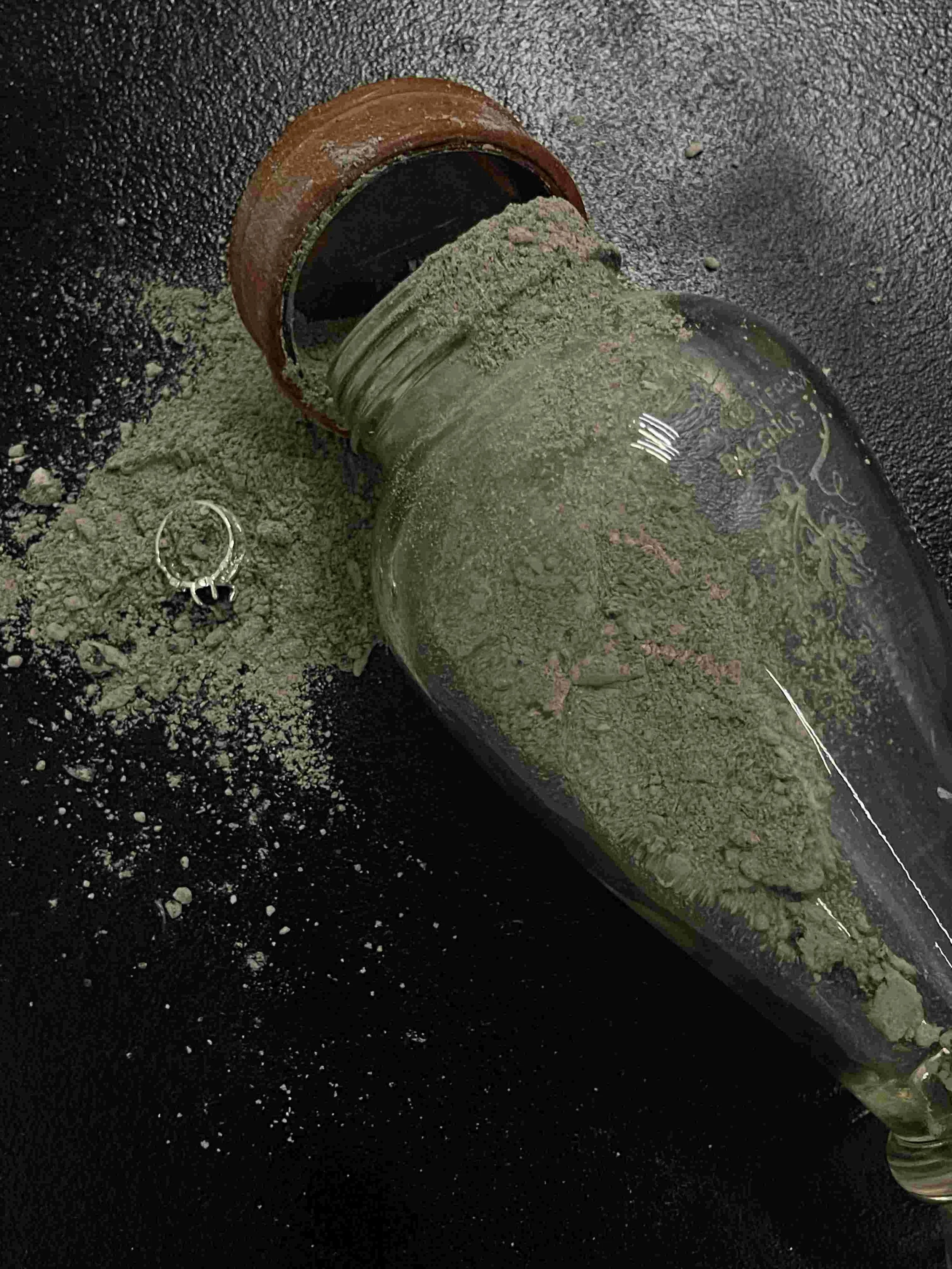
“Bringing together these various stories of women, for me become a way of highlighting what is typically erased and forgotten, and in this manner trying to prevent it from happening again.”
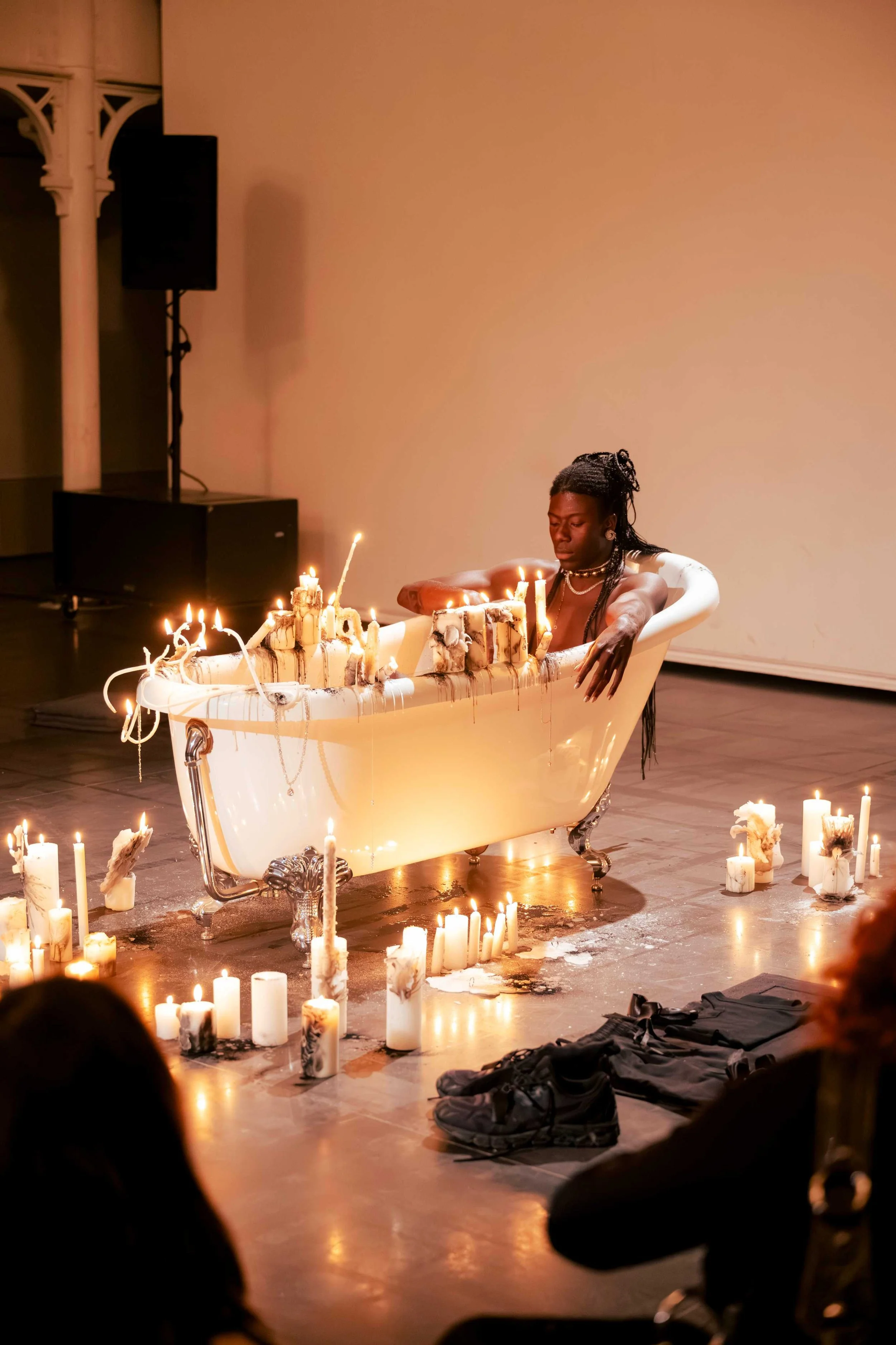
A reoccurring element in your work see to be pushing the boundaries of your own (dis)comfort, an example being the first five to ten minutes of Antichambre where you are seated in a hot tub surrounded by candles, clearly sweating. Apart from being a tradition within performance art, this bodily action can be perceived as both vulnerable and powerful. In what way do you see this pushing of your own body as a performative tool?
To be totally honest, my performance for Art Emergence, curated by Flora Fettah, Assia Ugobor and Lamia Zanna, was the first time that the temperature of the bathtub was that warm. It was interesting to see that usually I charge myself and my character from other external elements (sounds of the audience, crackling candles, et cetera) and this time it was more internal inputs, my feelings of the story that I wanted to tell, and my physical sensations in contact to the hot water. So, this version of Antichambre, was, let’s say, an up-lifted one.
Applying sound, smell, and taste – in addition to the visual – Antichambre evokes all senses. How does the construction of the scene, beyond your performing body, play into the development of your work?
I’m usually approach my work from a spatial situation. The spaces can already exist as they are, or I invent them with a scenography concepts. From there, I imagine and sometimes draw, what my body could do into the landscape that I’m thinking about or that I already saw.
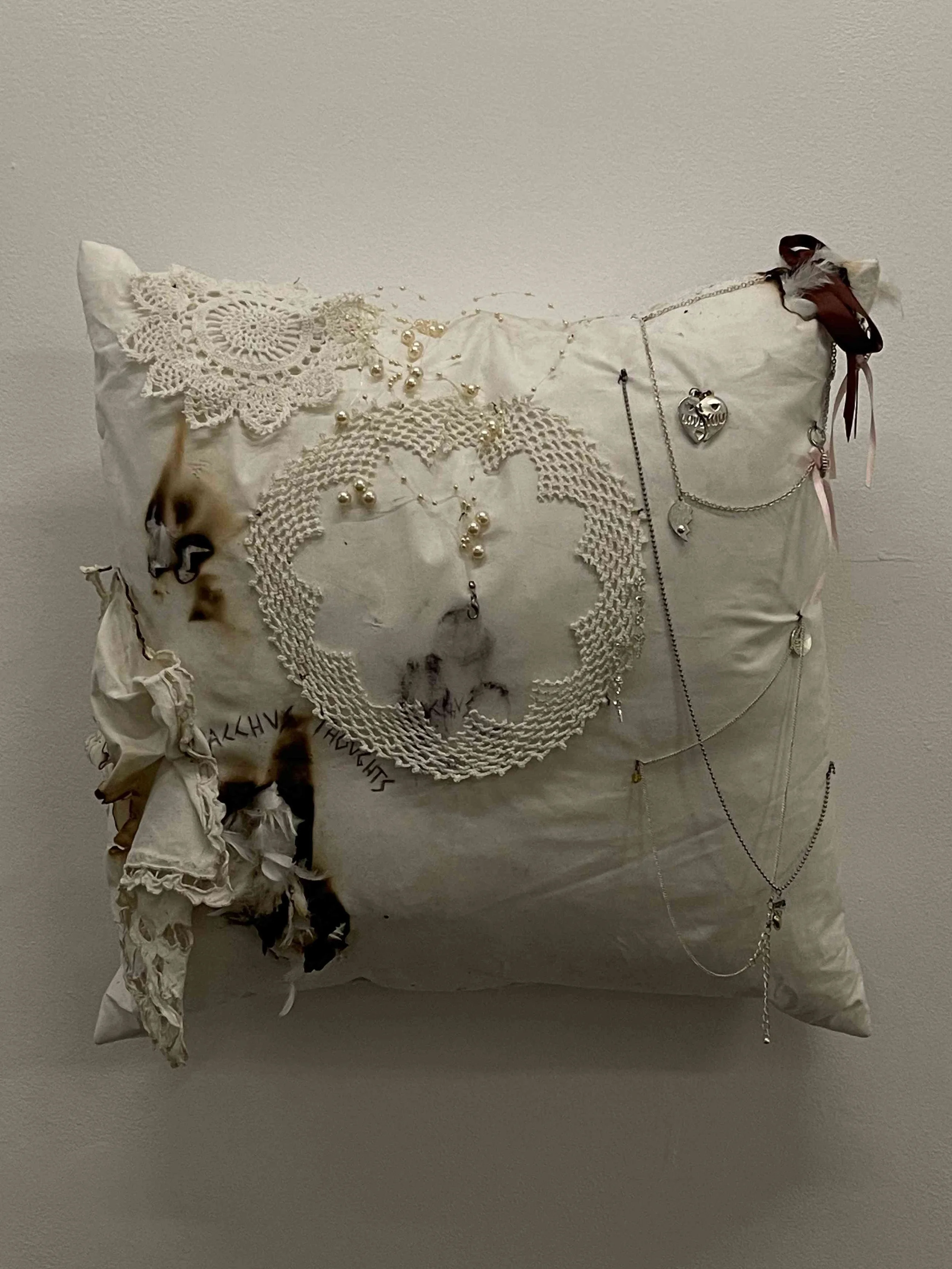
For Antichambre, imaging the space as a castle became a starting point, from which I associated freely. I started imaging a bathroom, and drew a bathtub, then a bedroom with a pillow. The idea of the castle also made me think of smells. The result was an exhibition, that also became the scenography of a multisensorial performance including sound, scents, and tastes.
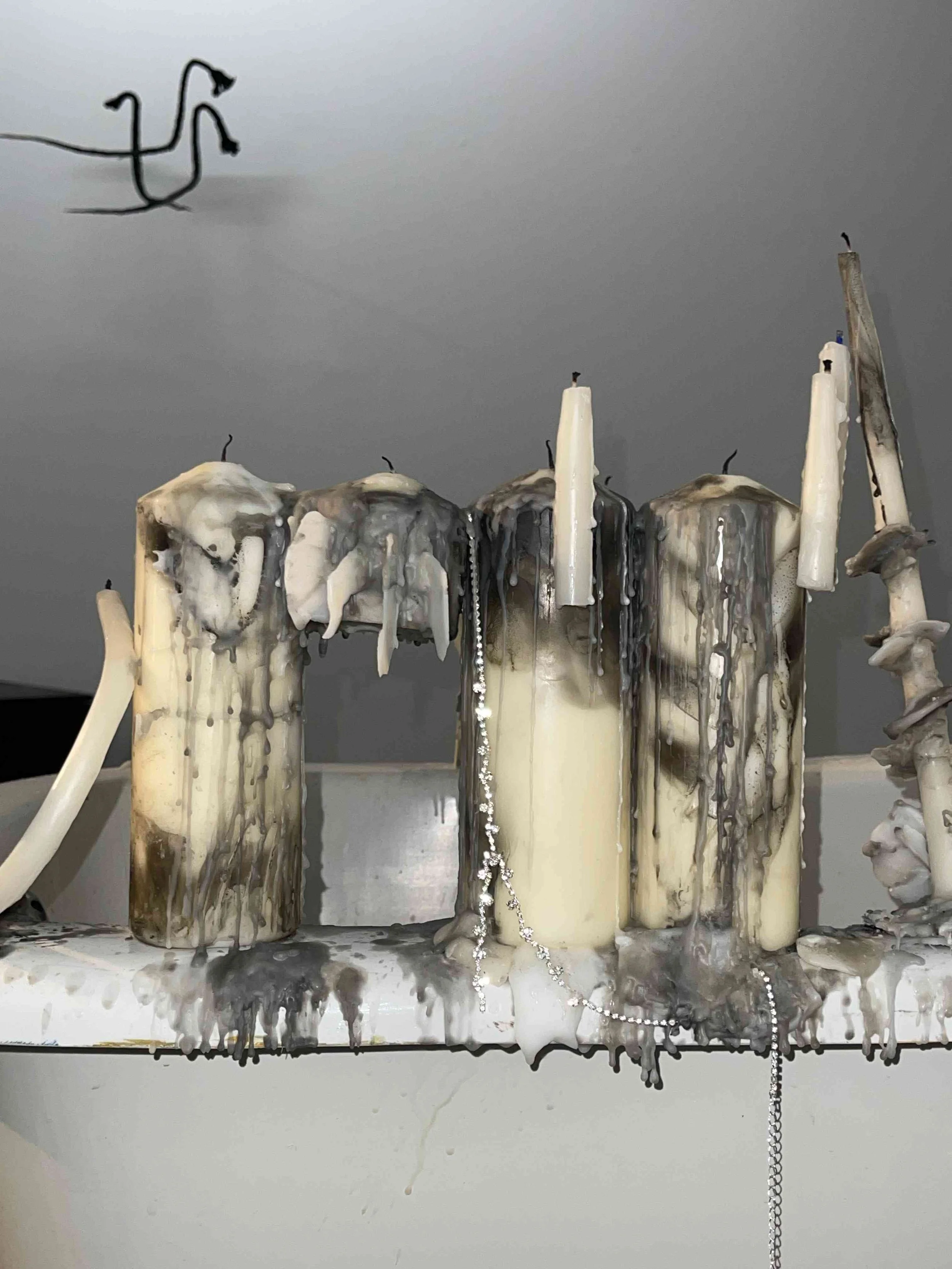
In addition to your performative work, you also work with sculpture and installation. In what way does these different forms of expression relate to one-another in your practice?
Not coming from the visual arts, it’s funny for me to observe how this visual art forms, has entered my artistic reflections, visions and thoughts. I would say that for now my visual art pieces, my dance and performative presentations and research are all more or less related to mythological figures that I bring to contemporary contexts that interest me.
I could also add that my first dance piece Presage, also was accompanied by two installations and a sonor piece, that I made after on invitation of Matthias Sohr and CIRCUIT – Centre d’art contemporain Lausanne for a duo show with Vidya Gastaldon. Antichambre started as a solo show, initiated by Antonia Truninger and Julia Hegi, to whom I’m eternally grateful. Here, the performance emerged as an additional element to the vernissage and finissage of the exhibition. In both cases, the visual and the performative go together and intertwine. I see them as equally important forces in my practice.
This summer and fall your work was featured in the third edition of Jardin d’Hiver, Decorama, at Musée Cantonal Des Beaux-Arts Lausanne. In her introduction to the exhibition, curator Elise Lammer describes it as a constellation of artists that employ ornaments and decoration to challenge concepts of taste, class and gender. What did you present in the exhibition, and how did you work with the overall topic of the show?
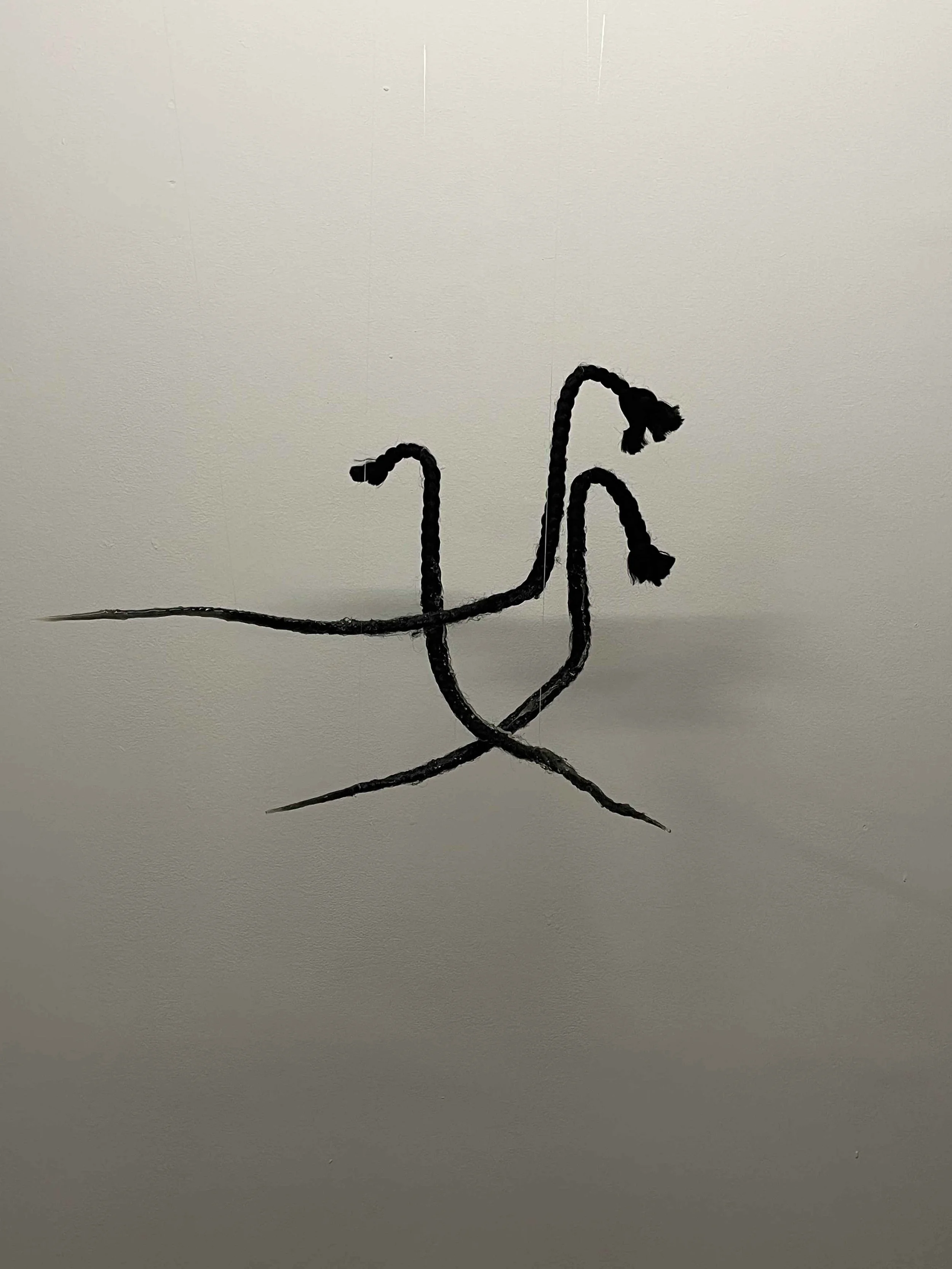
For this occasion, I decided to present Les gardiennes in an extended version, where I added some new guardians alongside the existing ones that I showed at CIRCUIT – Centre d’Art Contemporain Lausanne. My work emerges as slowly, and time is an important factor to me. To be able to evaluate and reflect on what I add, or take away, from any installation is essential.
Each of the exhibited guardians have their own bows, where the ornamental parts are quite subtle. Here, I added epoxy drops at the end of each the tree branches, some mixed with glitter. All the guardians also have their own personal set of braids.
Photography: © Laura Lafon Cadilhac
Due to their individual hair styles and bows, each sculpture in Les guardiennes appear as individuals as well as members of a collective. What draws your interest towards the relationship between the collective and the individual?
I’m impressed by the potential of collective initiatives, how protests, parties, and collective texts impact society, whilst also infusing with people on a more personal level. In line with this, I’m curious as to how we through imagination may reinvent and foster new forms of collectivity and ways of living together.
Photography: © Laura Lafon Cadilhac
Interview by UNA GJERDE
What to read next