Mathis Altmann
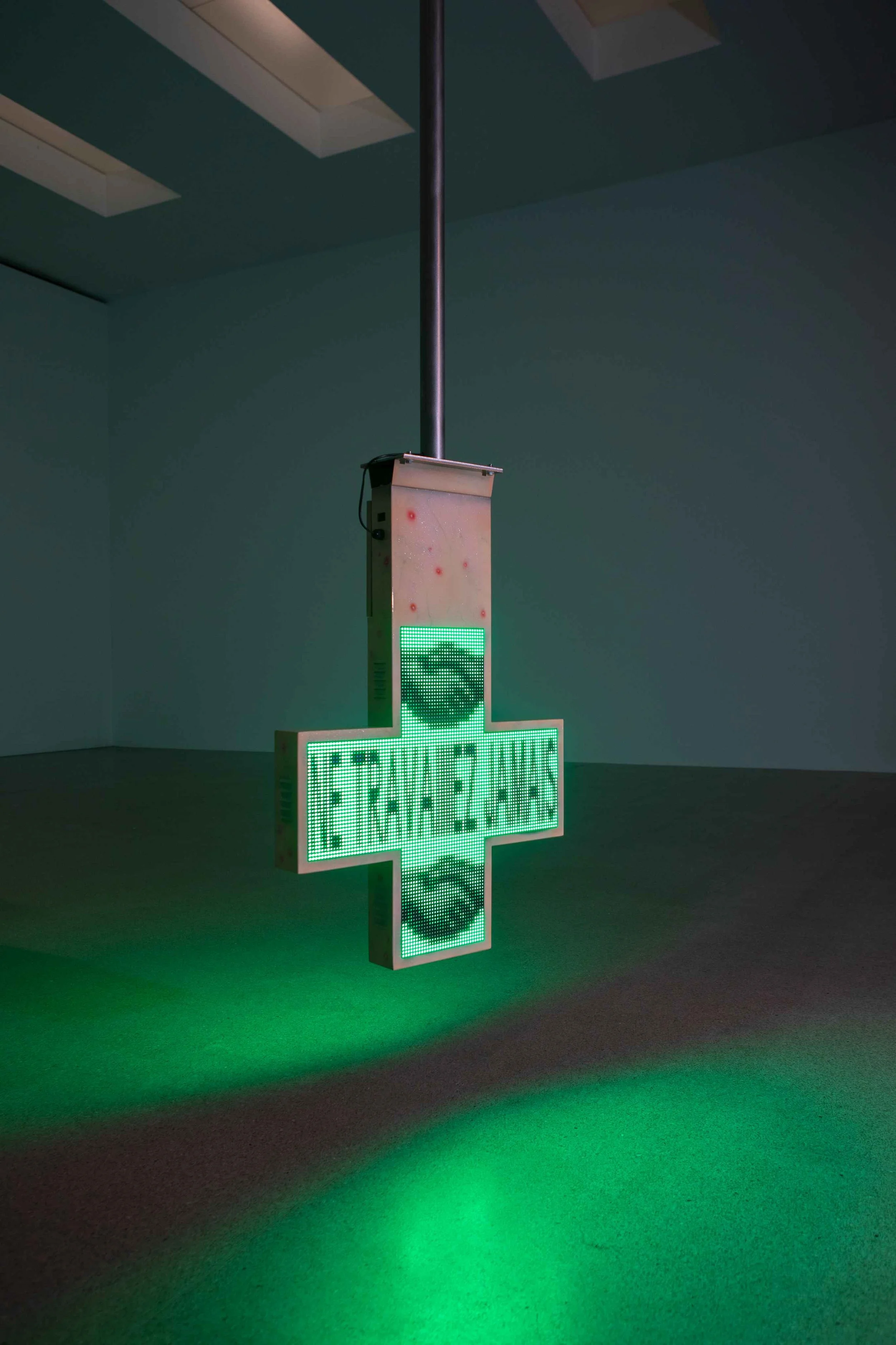
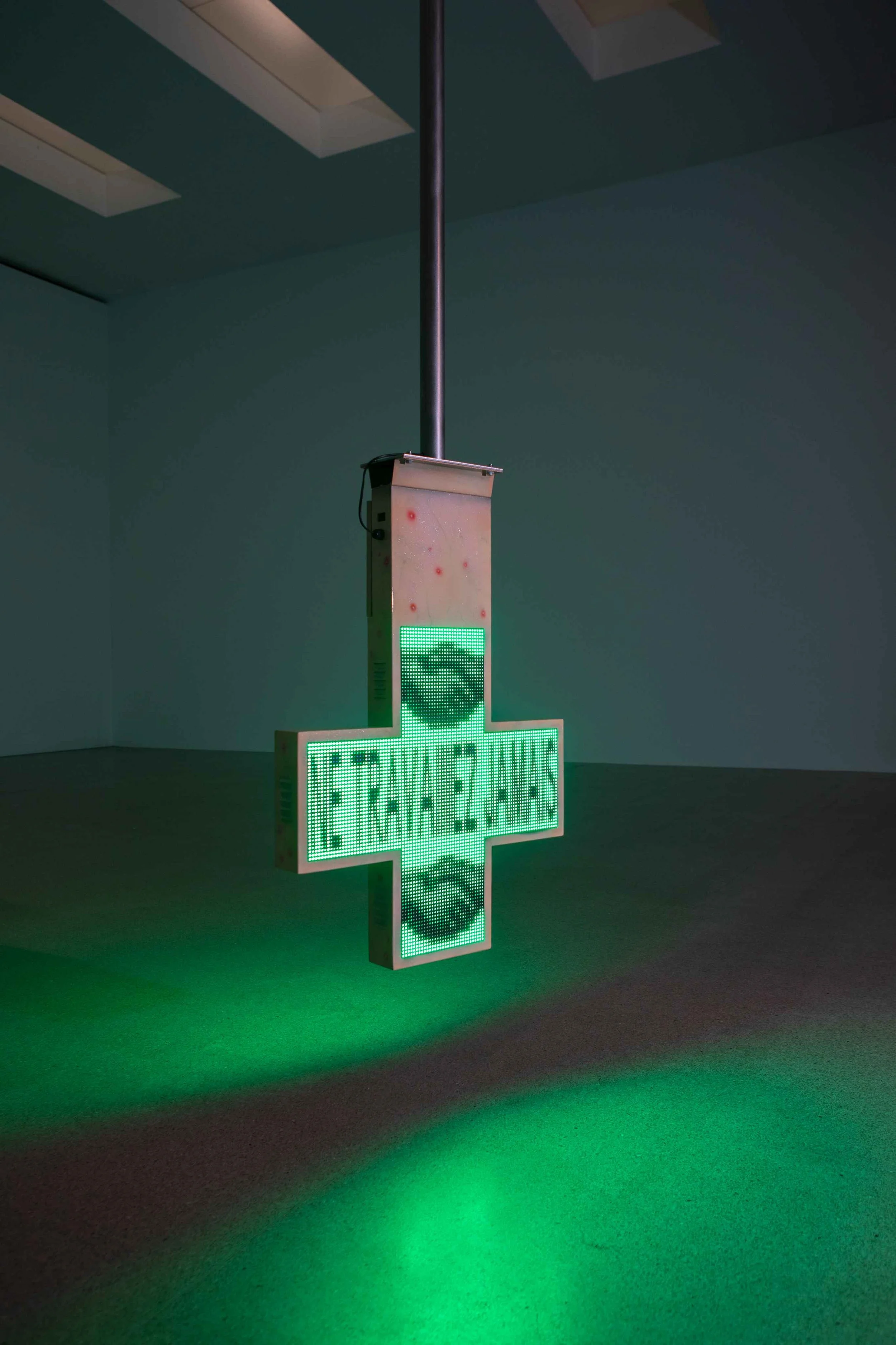
Devine Powerlifestyles, 2023
LED pharmacy cross, acrylic on aluminum, rotary mechanism
video loop: 16:51
600 x 82 x 10 cm
Private collection
Photo: Studio Mathis Altmann
Coming across the work of Mathis Altmann the notion of the pharmakon is one of the first things that come to mind. Linguistically, one of his most iconic works represents a pharmacy sign – a pharma icon [pharmakon] – but also beyond this, Altmann’s work become pharmakons in their representation of both the poisons and the remedies of our time. In his Necropolitics, Achille Mbembe argues that war is the pharmakon of modernity; we do not want war, per se, however the economy-as-it-is is completely intertwined, and dependent on, the continued production of arms, and their use. The same could be said for drugs, and money, or literally anything that we ‘need’, that will nevertheless come back to haunt us.
Altmann’s works are on the one hand blunt in their critique of neoliberal capitalism, on the other there’s an obvious aestheticization of the subject matter, making them attractive commodities. It’s appalling and appealing, revealing the hypocrisy that also very much exists within the arts. One may argue this is symptomatic for a lot of contemporary art; however, it is seldom to come across an artist who manages this balancing act as successfully as Altmann. Displaying the certain uncertainty of the time in which we are living, he does not shy away from the darkness; but where others easily fall into apathy or dystopia, Altmann pulls through to imagine different realities.
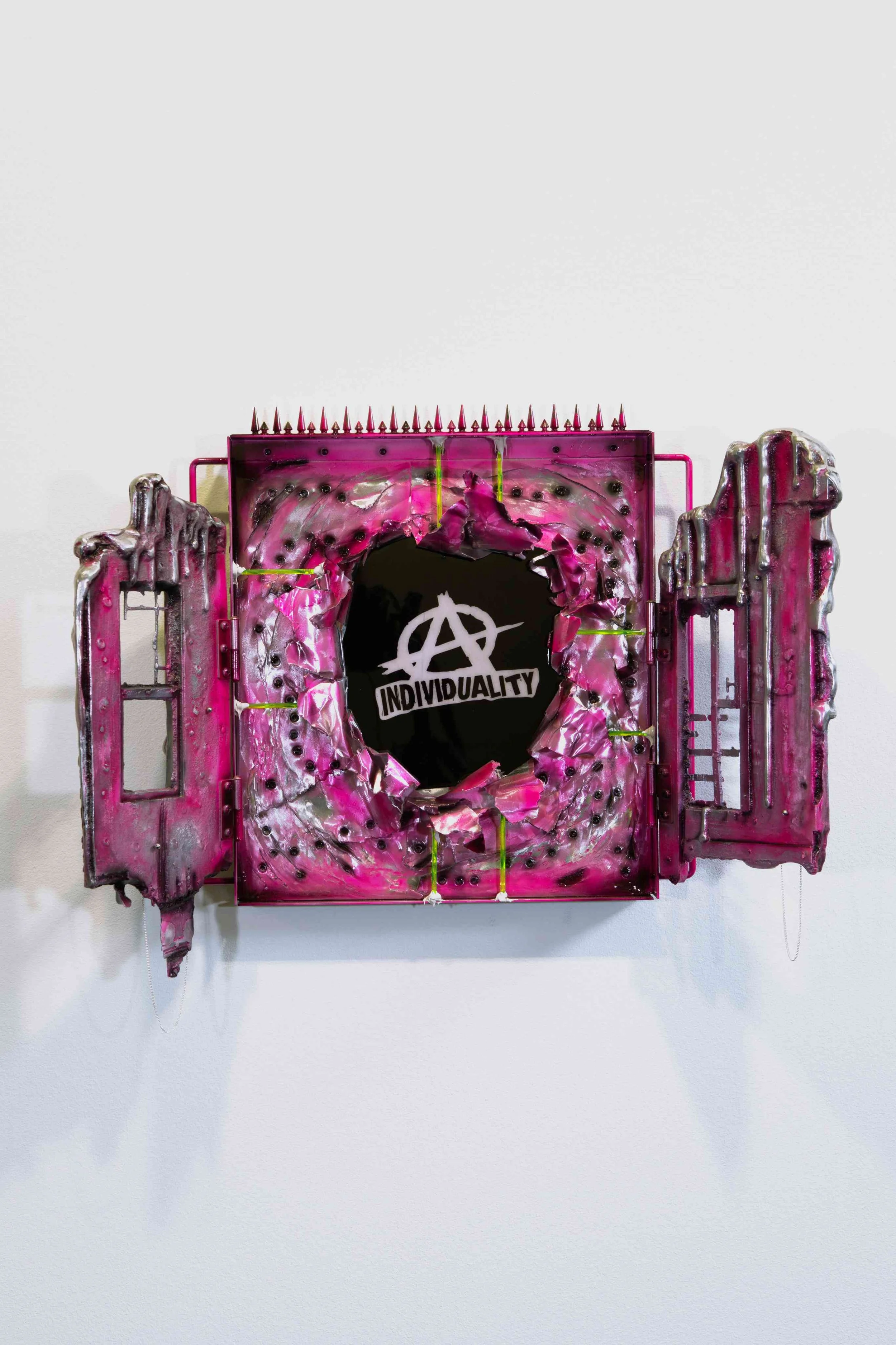
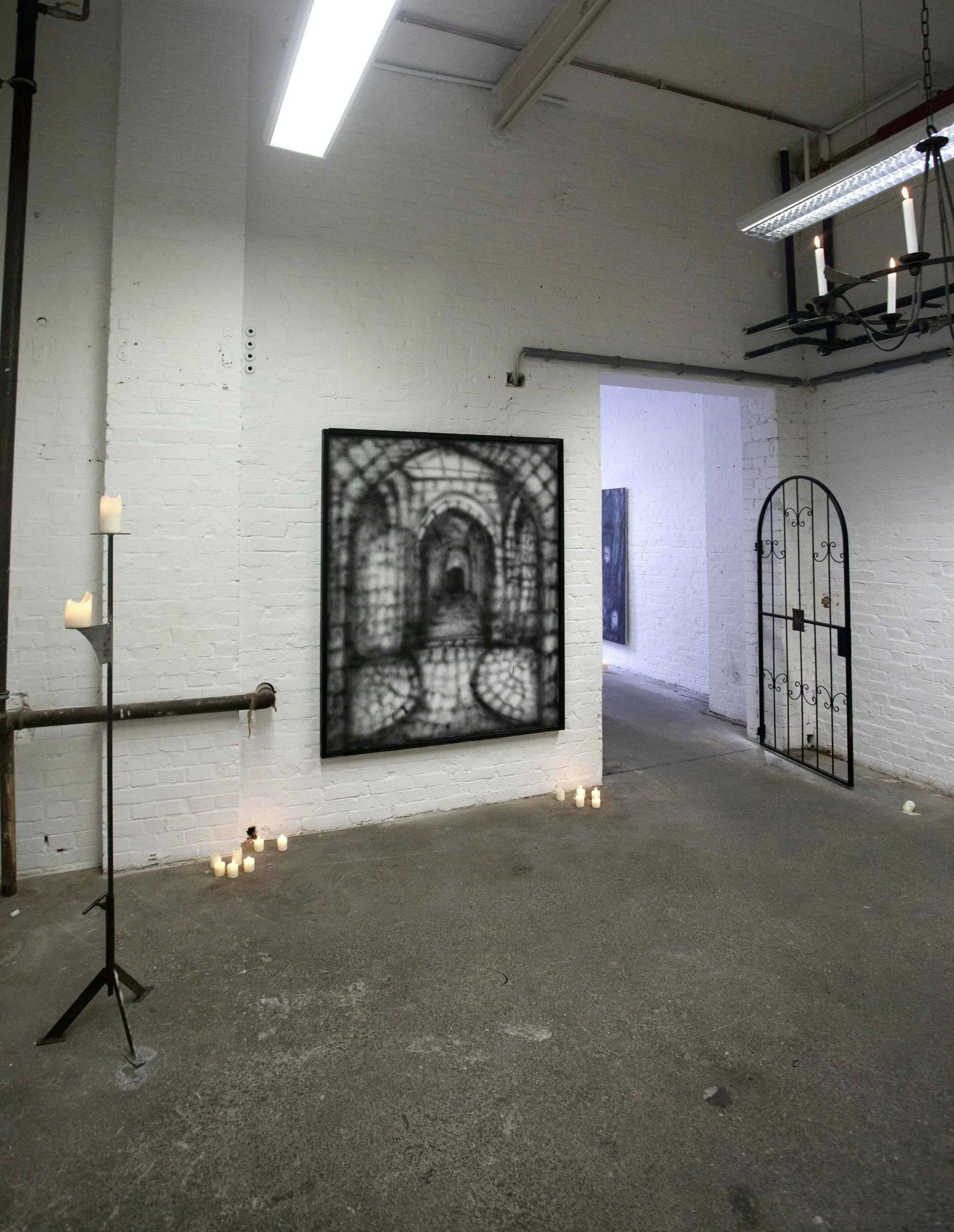
Individuality, 2023
Aluminium, airbrush, piercings, sterling silver chains, studs, photoprint, resin, acrylic
Courtesy the artist and Fitzpatrick Gallery
Photo: Studio Mathis Altmann
Your hanging sculpture Devine Powerlifestyles is immediately eye catching. What inspired you to make a work departing from the (in)famous pharmacy sign?
I think it began around 2018 during trips to Paris. Especially there, LED pharmacy crosses line the streets and punctuate the urban landscape with their seductive flickering lights and animations. I started imagining them as what they technically are—video screens—and wondered how they might function if I reprogrammed them with my own content and footage.
Much of my work already involves illuminated elements. I use a wide range of light sources within my pieces—LEDs, light bulbs, mini CCTV cameras, video screens, and projections. These works are often installed in dimly lit exhibition spaces where they also operate as light sculptures. In that sense, transitioning to LED pharmacy crosses felt natural. Their luminance is powerful, especially indoors, and they have the ability to bathe their surroundings in light.
I’m also drawn to the philosophical concept of the pharmakon, with its inherent ambiguity: oscillating between remedy and poison, possibility and impossibility, the promise of a solution and the risk of a new problem. The green pharmacy cross which was introduced in the early 20th century and what became a standard in the western world doesn't inherently encompass the complex, dual nature of the pharmakon unless interpreted philosophically, but I want to treat it as a contemporary placeholder for the pharmakon—an object we encounter casually in urban environments, yet capable of holding deeper paradoxes. I find that beautiful.
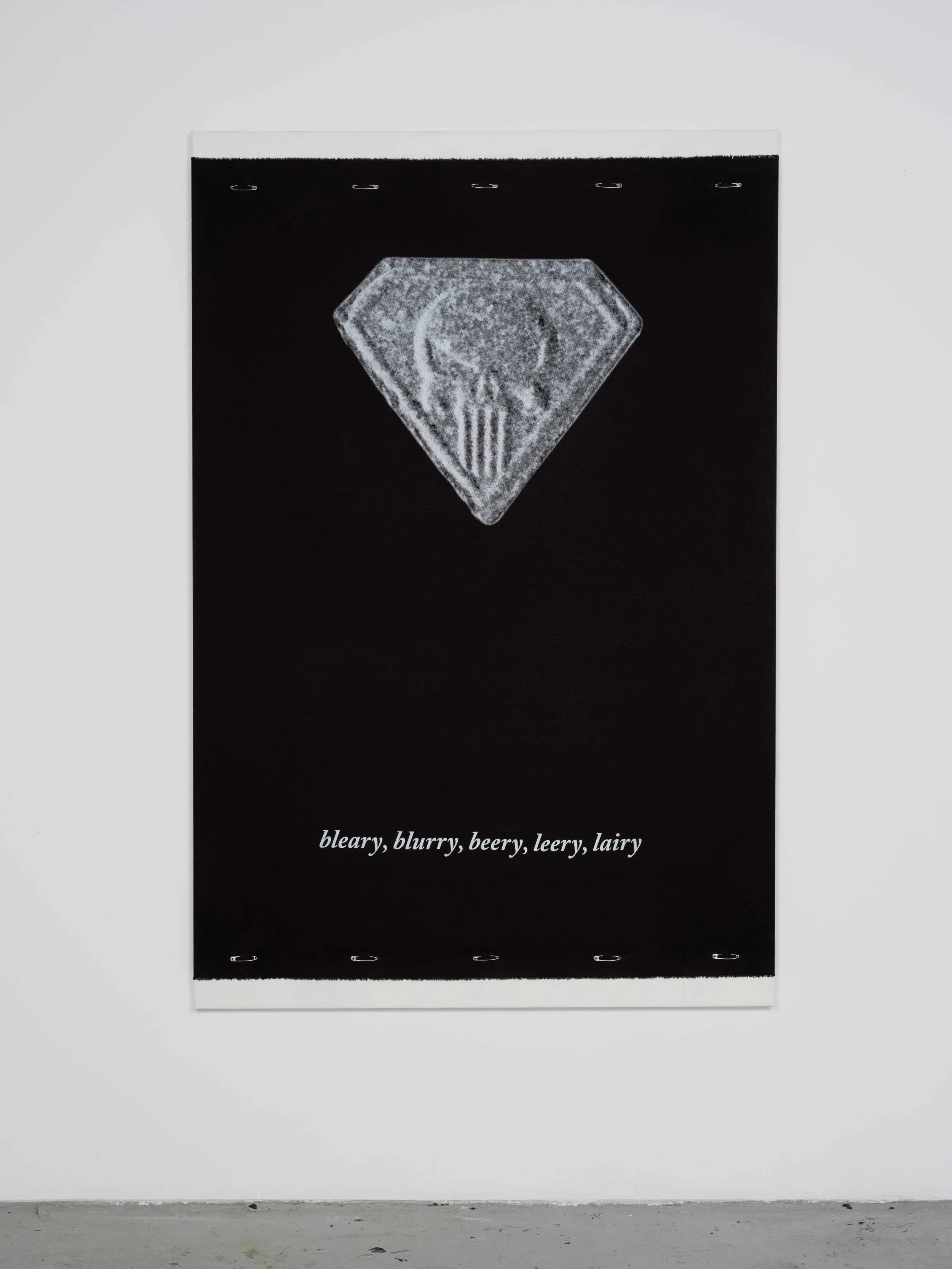
Punisher, 2025
Silkscreen on cotton mounted on canvas, safety pins
165 x 110 cm
Photo Mathis Altmann
Courtesy the artist and Fitzpatrick Gallery
Within the 13-minute light loop of the work there’s a direct reference to Guy Debord’s graffiti in Rue de la Seine, which reads «Ne travaillez jamais» [never work]. Why did you want to include this specific phrase?
I was particularly interested how «Ne travaillez jamais» shifts from a graffiti into a pharmaceutical animation. It appears within a reprogrammed default pharmacy animation, which is still on display on today’s pharmacy crosses. You can observe it in Paris if you’re patient enough. It just says „conceil“ (advice) instead of my hijacked Guy Debord version. I also need to point out the pharmacy cross is hanging upside down like a tortured body, painted in a flesh tone and covered in some kind of rash and pimples. It’s an outbreak and it taps into the abject. To read «Ne travaillez jamais» in this constellation also probes how this iconic counter cultural phrase functions within an advertisement display. It becomes a spectacle again and questions the cyclical cooption of rebellion attempts over time.
As context, the video animation Divine Powerlifestyles is dedicated to the hyperactive syndromes of labour, or so-called “new work“, what I usually investigate, typically observed within entrepreneurial circles of a globalised meritocracy, while simultaneously reflecting the conditions of artistic production today. It contrasts these dynamics with states of idleness, procrastination, and “doing nothing,” positioning them as gestures of resistance and echoing ideas of the Situationists, but it also goes back to Paul Lafargue’s 1880s radical text called «The Right To Be Lazy».
The conceptual foundation of the video animation draws on Max Weber’s The Protestant Ethic and the Spirit of Capitalism, in which Weber argued that Protestant moral values fostered the rise and expansion of capitalism, establishing a modern cult of labour, where work itself became a means of salvation due to diligence. I was interested how this notion translates into our contemporary life, reflecting the ascetic, hard-work lifestyles characteristic of today’s hustle culture.
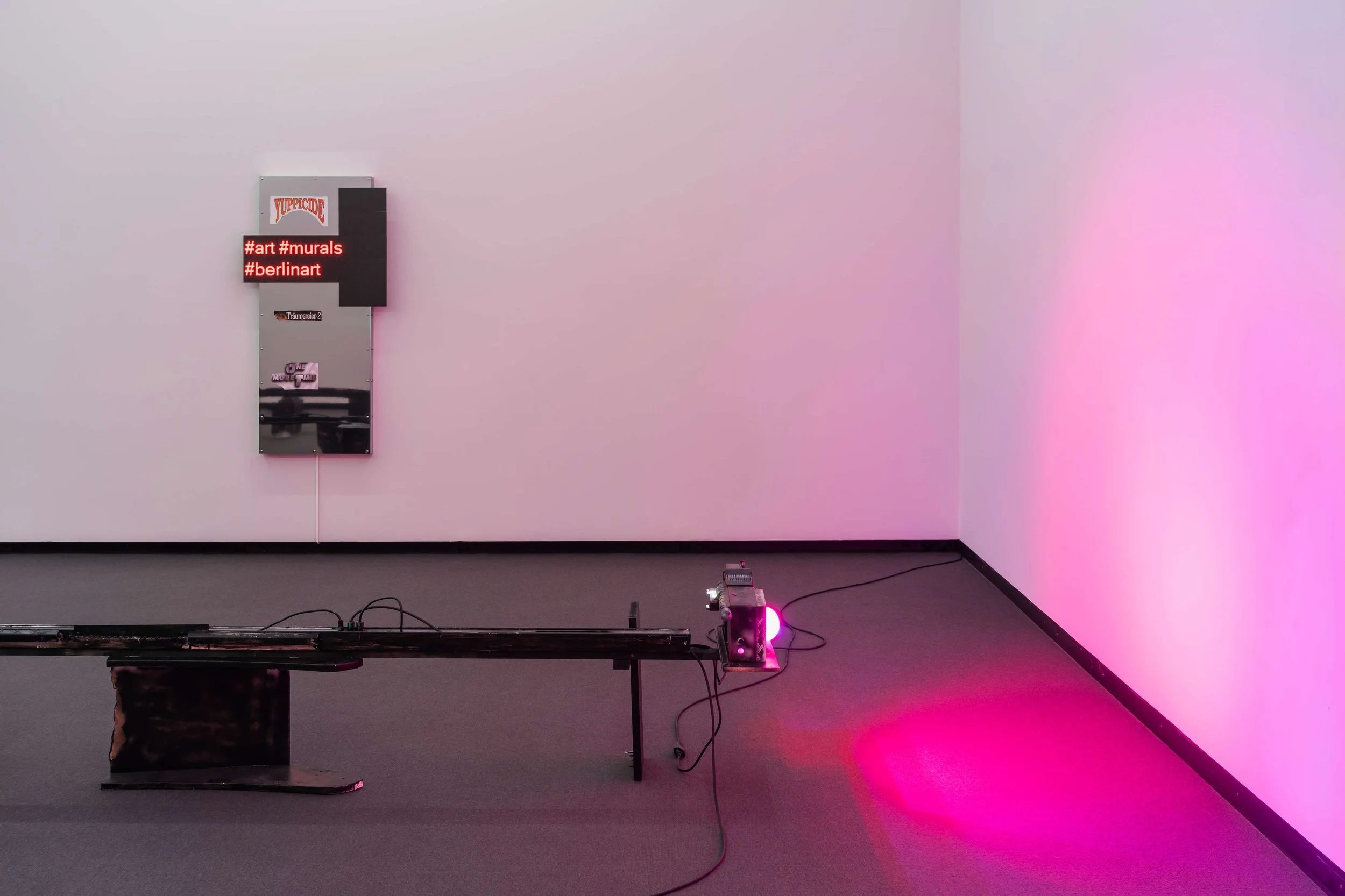
Amalgamate, Kunstmuseum Winterthur, 2021 (installation view)
Photo: Gunnar Meier
Accompanied by the wall-hanged sculpture Individuality, the total installation that you showed with Fitzpatrick gallery for Paris Internationale, made me associate to the self-absorbed focus on optimization that has come to dominate not only how we perceive ourselves, and our surroundings, but also enforce us with the expectation that we should continuously strive for something better. Do you think we are expecting too much, from ourselves and life?
In the case of the wall sculpture Individuality, the piece belongs to an ongoing series I have been developing since 2019. Works from this series are typically installed as singular objects within more expansive solo exhibitions, where they function almost like contemporary altar-pieces. They are constructed from a stock of Victorian dollhouse façades I’ve collected over the years, materials I had previously used around 2017 for another sculptural series. The wing-like doors are cast in aluminum.
For this particular work, I came across the Individuality illustration online in low resolution and retraced it so it could be incorporated into the sculpture. The image struck me because it translates a kind of punk nihilism into the sphere of libertarian self-mythology, which resonates with the self-proclaimed ideals and contradictions of my own generation.
Notions of self-optimisation form another red thread running through my work. It is the doctrine of self-discipline that ultimately becomes self-exploitation, a condition in which the subject is continually pressured to remain productive. Franco “Bifo” Berardi’s The Soul at Work (2009), a book that significantly shaped my artistic development, examines these dynamics in depth. In it, he argues that escaping semiocapitalism requires a withdrawal from hyper-productivity and a return to a certain slowness—put simply.
I often extract videos related to various forms of self-optimisation, many of which carry an unintended comedic tone. These clips are highly present within the infosphere, and I usually pull them directly from my social media feeds. I use them mostly in their raw form, though sometimes I edit them for my video works. I also frequently transcribe their spoken lines to repurpose them as a kind of cut-up poetry.
This material is shaped by geolocation, algorithms, and the circulation patterns of the people one follows on platforms like Instagram. It may appear mundane but it reveals the aspirations and self-images among majorities and can contribute to a broader understanding of the cultural moment.
Other material I work with also comes in the form of print magazines. Most recently, I’ve been drawing heavily from hardcore bodybuilding publications. These magazines are saturated with extreme optimisation rhetoric and packed with vividly designed advertisements for supplements, steroids, and guidance on ultra–high-calorie diets. Its self-optimisation pushed into overdrive.
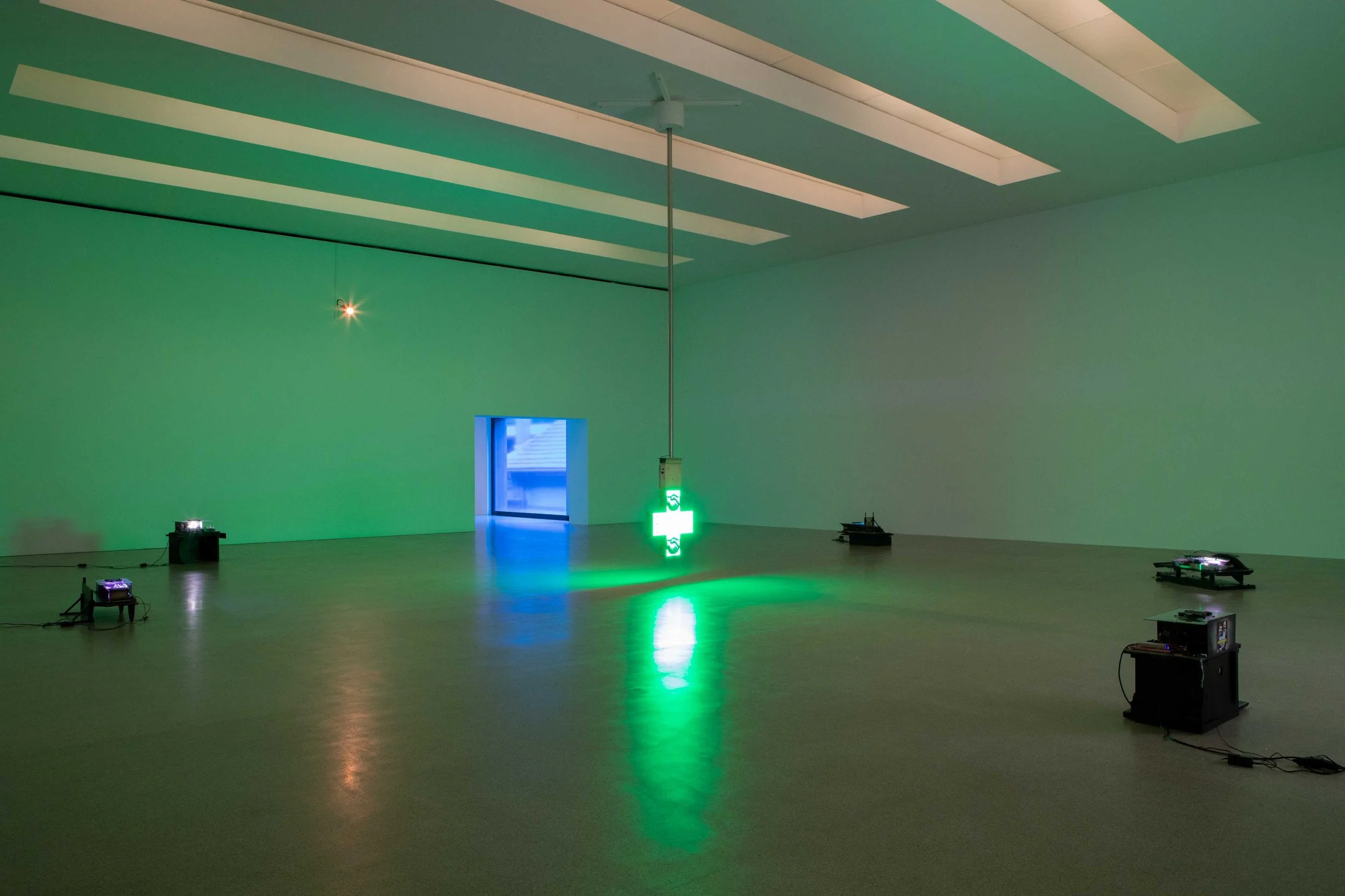
Individuality, Kunsthaus Biel Centre d’art Bienne (KBCB), 2023 (installation view)
Photo: Studio Mathis Altmann
Concepts of work and labor appear as reoccurring topics in your work. How do you see today’s labor market?
As an artist, I don’t work under classical labour conditions, but I’ve held many jobs since my teenage years. During those summers I even worked on assembly lines. One job involved assembling pressure tools for submarines.
I think my perspective on entrepreneurial labor conditions are more distinct. Being an artist often means navigating the same imperatives entrepreneurs face. During my time in Los Angeles in the 2010s, this was particularly clear. Unlike Europe, there is barely any public funding; artists rely heavily on the art market, side hustles, or come from privileged backgrounds.
It was an eye-opening lesson, and it even fed into my work. Artists were expected to operate like start-up founders launching a new venture. Self-performance was part of the daily routine, and people expected you to have an elevator pitch ready. Life felt accelerated and oversaturated. L.A.’s sheer scale—long commutes, time lost in transit—added to that sense of constant motion. There were even discussions about cutting down on sleep to squeeze more productive hours out of the day. Yet despite all this effort, there was always something to miss. I think this changed a lot post-pandemic.
This atmosphere reflected a very specific millennial promise: a self-made, self-proclaimed free-spirited life amplified by the height of globalization. The drive to be everywhere at once often led to psychological strain—burnouts that people tried to manage through performative wellness routines or through the commodified health industry, including pharmaceuticals. It created a distinct psychosphere that has always fascinated me.
These conditions inform many of the ideas about labour that run through my work. One example is my light-sign series “wewontwork”, a détournement of the famous WeWork logo. At the time, WeWork was spreading across L.A. and the rest of the US and later globally—almost like the McDonald’s logo of the new-work ideology—becoming another emblem of that culture I observed and wanted to question. This even continued during my time in Berlin in the beginning of 2020 where I was able to witness similar conditions.
Now being back in Zurich for good, the entrepreneurial grind is not as obvious as described in the above, here people are more engaged in the service industry, the backbone of Switzerland’s economy.
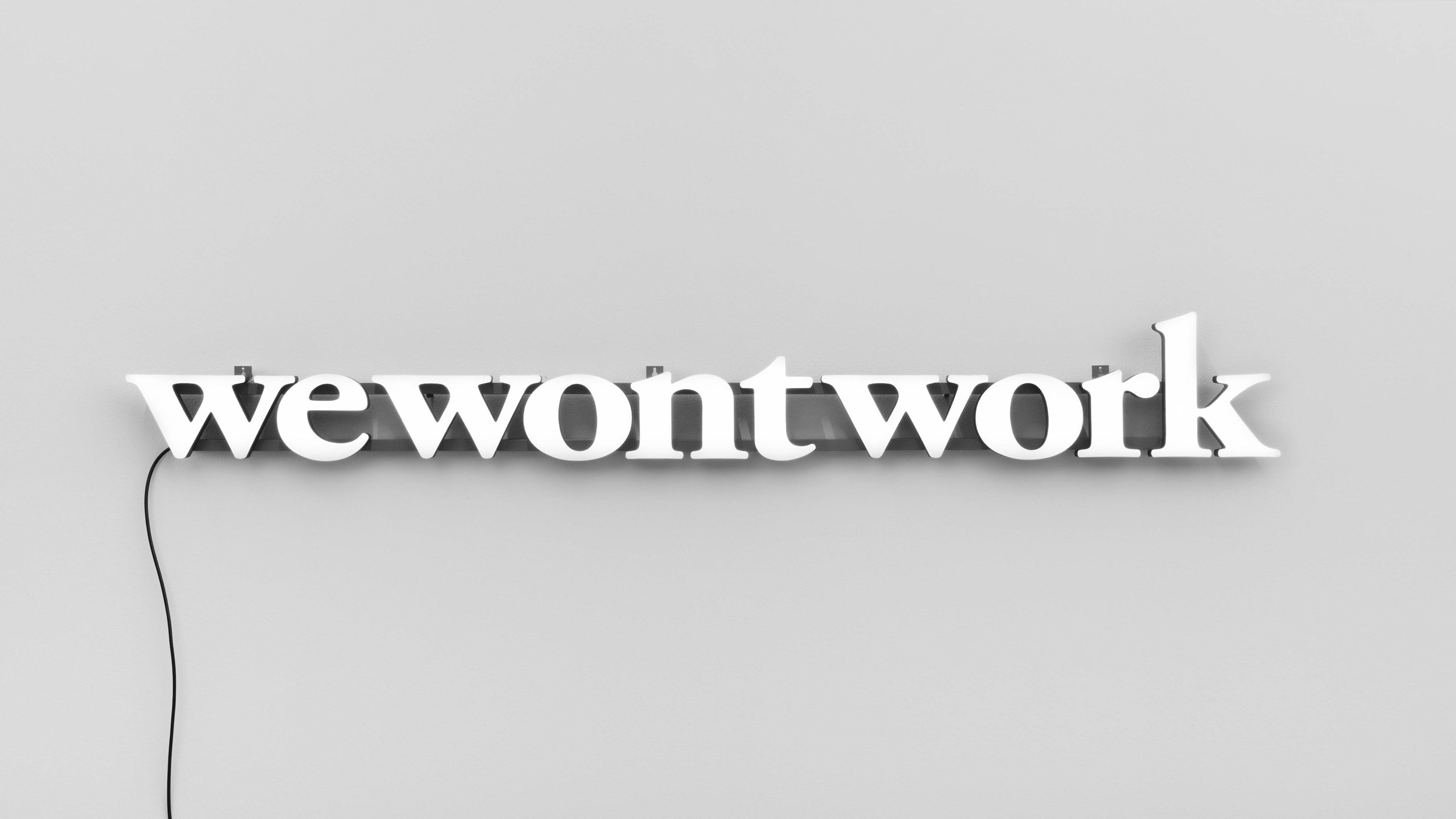
wewontwork, 2020
LED lighting, acrylic, powder coated steel
23 x 200 x 10 cm
Edition of 2 plus 1 AP
Photo: Marjorie Brunet Plaza
Private collection
Working in the cultural industries, and maybe art in particular, resemble a double-edged sword – on the one hand ‘making it’ in this field indicates a form of social, cultural and/or financial privilege, on the other hand the work predictability is super precarious. How do you perceive the working conditions in the arts today?
Unfortunately, there are no real “working conditions” in the arts. Most artists are self-dependent and operate entirely on their own. The art world has almost no rules, which makes it difficult to navigate and very unpredictable, but this absence of structure is also what makes it attractive to certain players. There are good initiatives around fair wages in institutions and guidelines for hourly compensation, but in practice these are not reliable enough to build a livelihood on. As an artist, you can always choose to sacrifice yourself to maintain the bare minimum conditions for your practice. You can push this a long way, but the moment a family or other responsibilities come into play, your perspective shifts drastically. Suddenly you’re required to earn a stable living, month by month, something that is extremely difficult to achieve by being “just” an artist, especially since only a very small percentage actually make enough to live solely from their work. And that’s without even mentioning the current harsh market conditions.
In reality, I think it will be more and more necessary for a lot of artists to pursue a side hustle to cover basic costs. Everything beyond that is a bonus, something you use to shape and sustain the practice you want and not to serve expectations with.
The art market itself is heavily inflated. Prices for certain contemporary and even young artists have risen so absurdly that some collectors and patrons just have been flicked off. They became very conscious what to acquire, they still buy but it takes time and they scaled down their investments to a certain degree after watching the value of their former costly investments collapsed. It’s cyclical and it’s usually driven by greed and short-sightedness, and it ended up affecting the entire community, in my opinion. The market will correct itself-this is a natural consequence of unchecked growth and this transitional moment may actually open up space for new and more experimental artistic approaches that are not tailored to market demands. Simply said: just work that will be fun again, and work that is allowed to fail compared to flat mediated bullet proof arguments. A lot of things will also happen removed from the big platforms of major institutions, galleries or fairs.
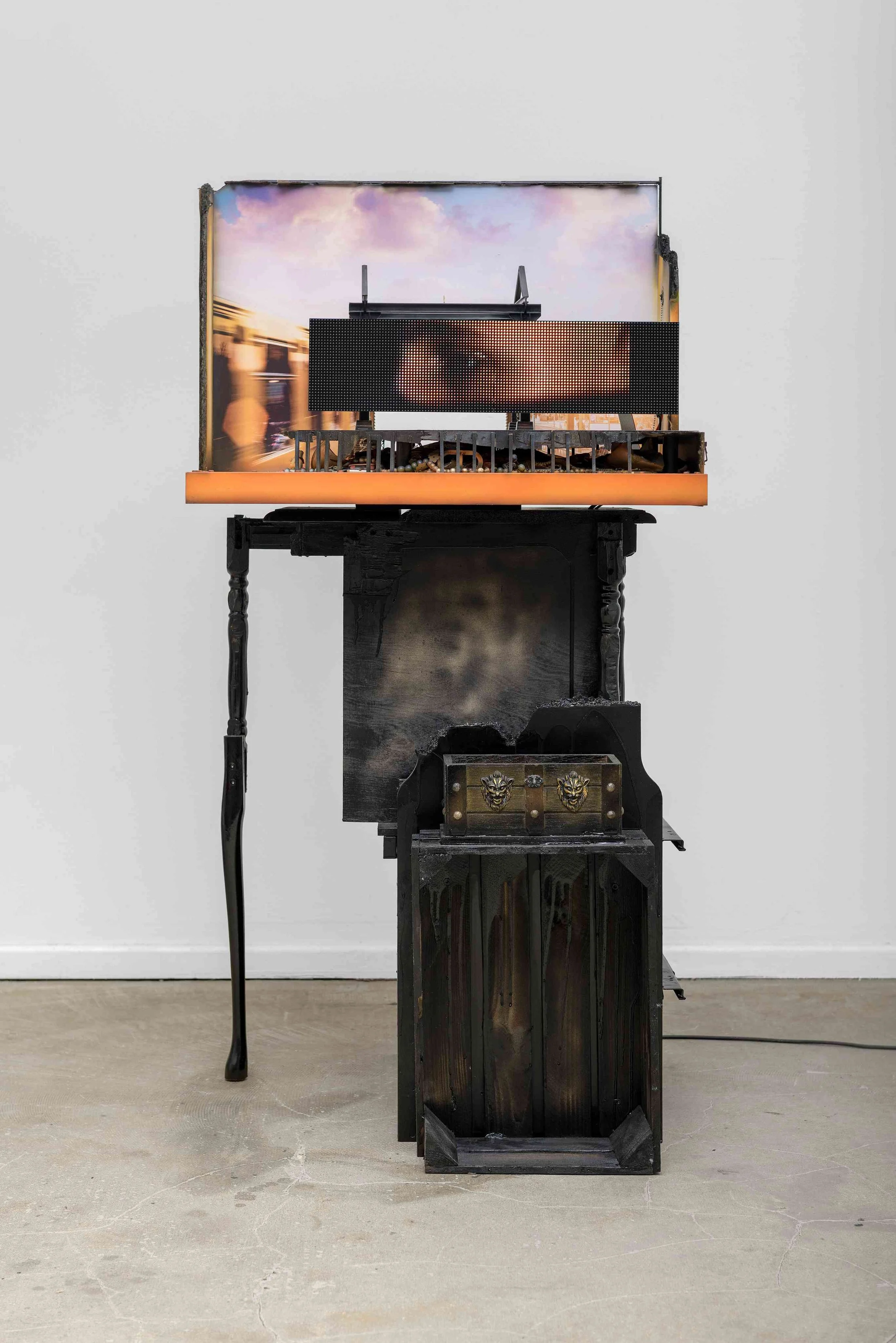
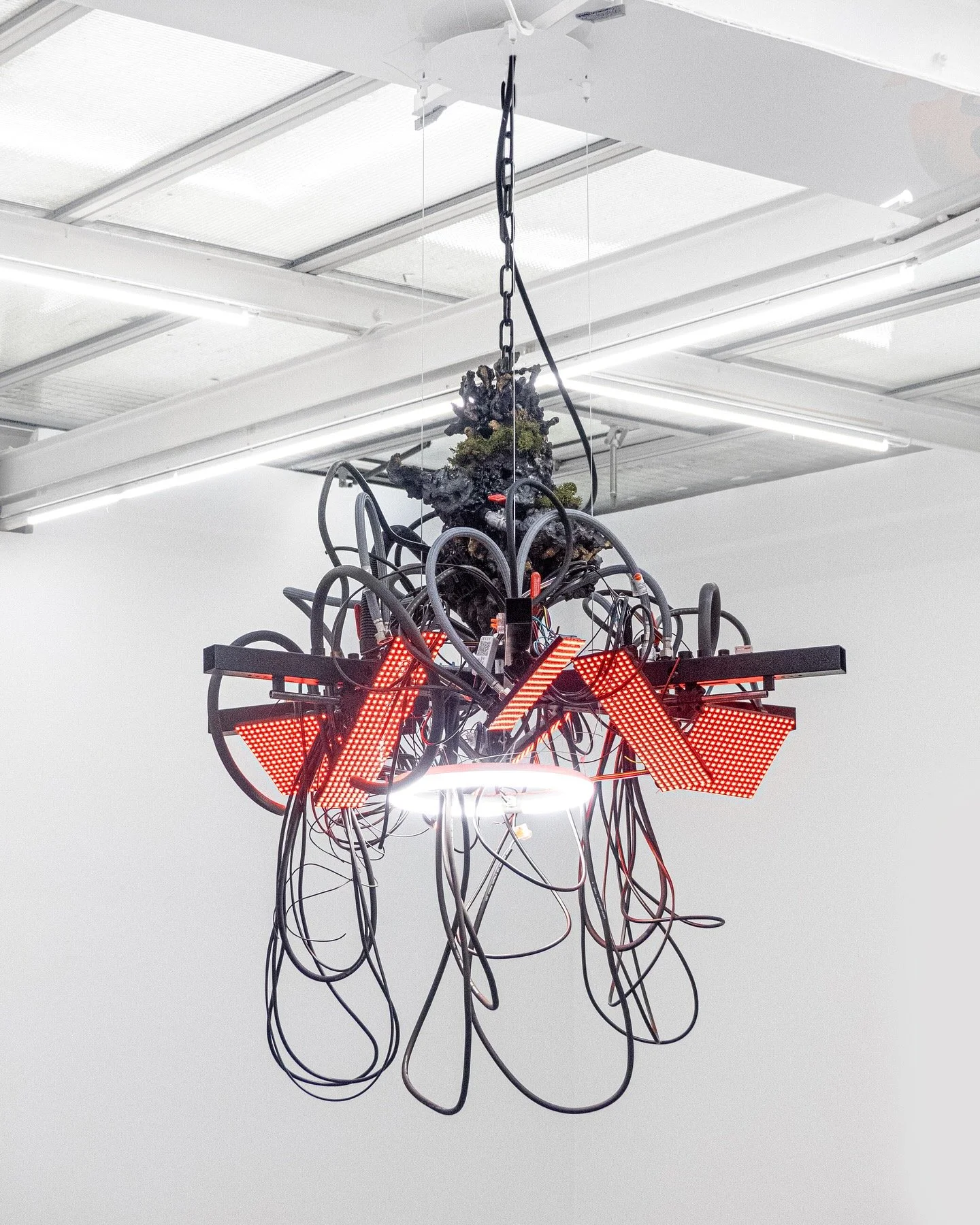
Mid-City, 2023
Wood, metal, plastic, LED-Matrix panel, ink-jet prints, paint, airbrush
Video loop: 13:24 min
130 x 68 x 55 cm
Private collection
Photo: Julian Blum
“This atmosphere reflected a very specific millennial promise: a self-made, self-proclaimed free-spirited life amplified by the height of globalization. The drive to be everywhere at once often led to psychological strain—burnouts that people tried to manage through performative wellness routines or through the commodified health industry, including pharmaceuticals. It created a distinct psychosphere that has always fascinated me.”
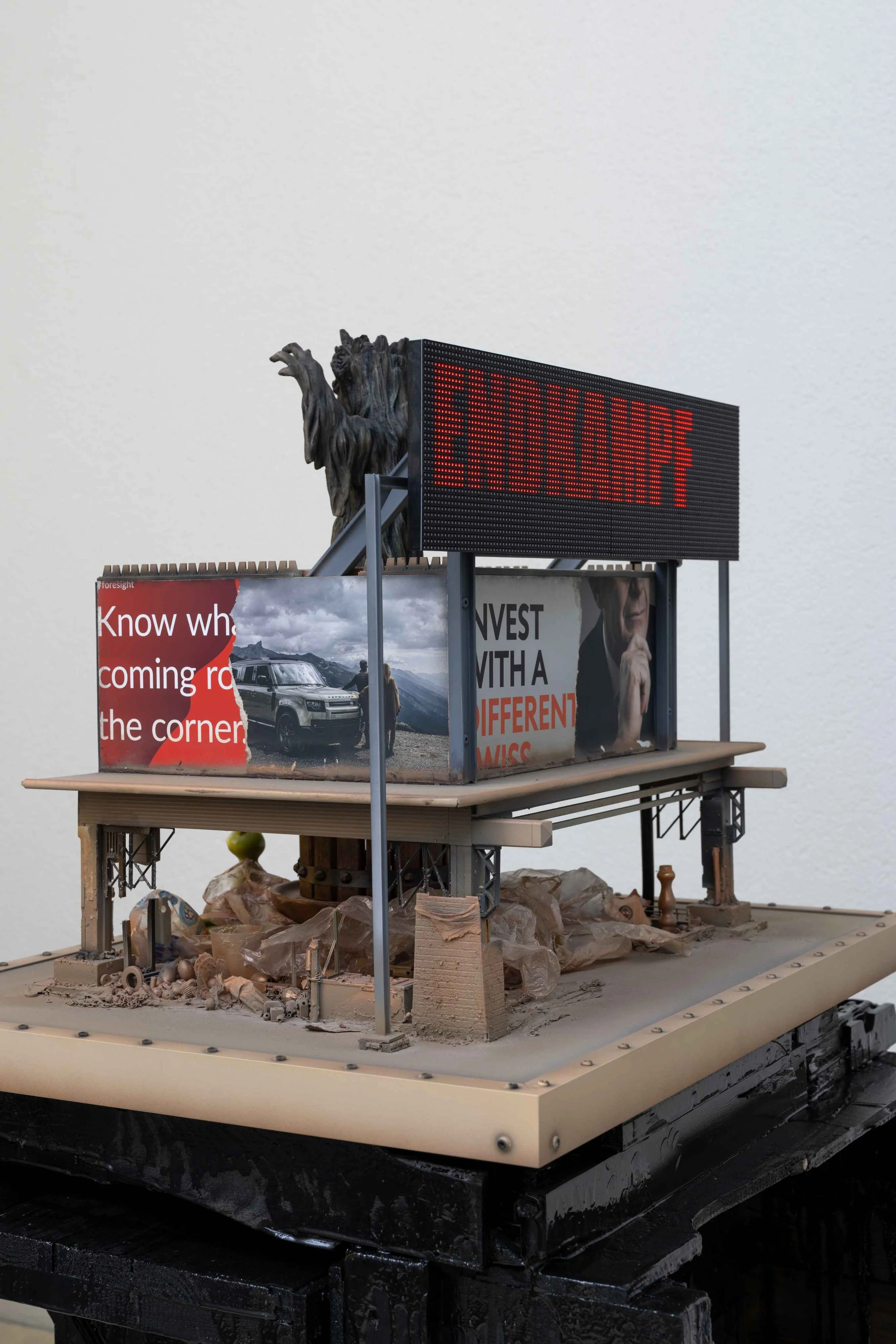
BetterMe - BatterMe
Wood, aluminum, plastic, paint, resin, plaster, airbrush, LED-Matrix panel, toy figurines, ceramic, photo prints
Video loop: 4:55 min
132 x 70 x 80 cm
Courtesy the artist and Fitzpatrick Gallery
Photo: Studio Mathis Altmann
With a practice so closely tied to capitalist critique, do you believe the current decline of liberal values and democracy can lead to its end? Are we living through hyper-capitalism, or have we simply merged into something else?
Neoliberal conditions are reaching their end, or have already dissipated, because we are now confronted with a rising wave of neo-conservatism and reactionary right-wing politics. Traditional values have become fashionable again: nationalism, patriotism, faith, family, patriarchy, borders, identity—the list is long. At the same time, a new war-machine is operating at high velocity, infiltrating everyday life with propaganda and with new (or resurrected) role models and images of supposed enemies. I’m actually not that pessimistic and I see these conditions as cyclical. Now we need to have a long breath and not to fall into simplistic binaries.
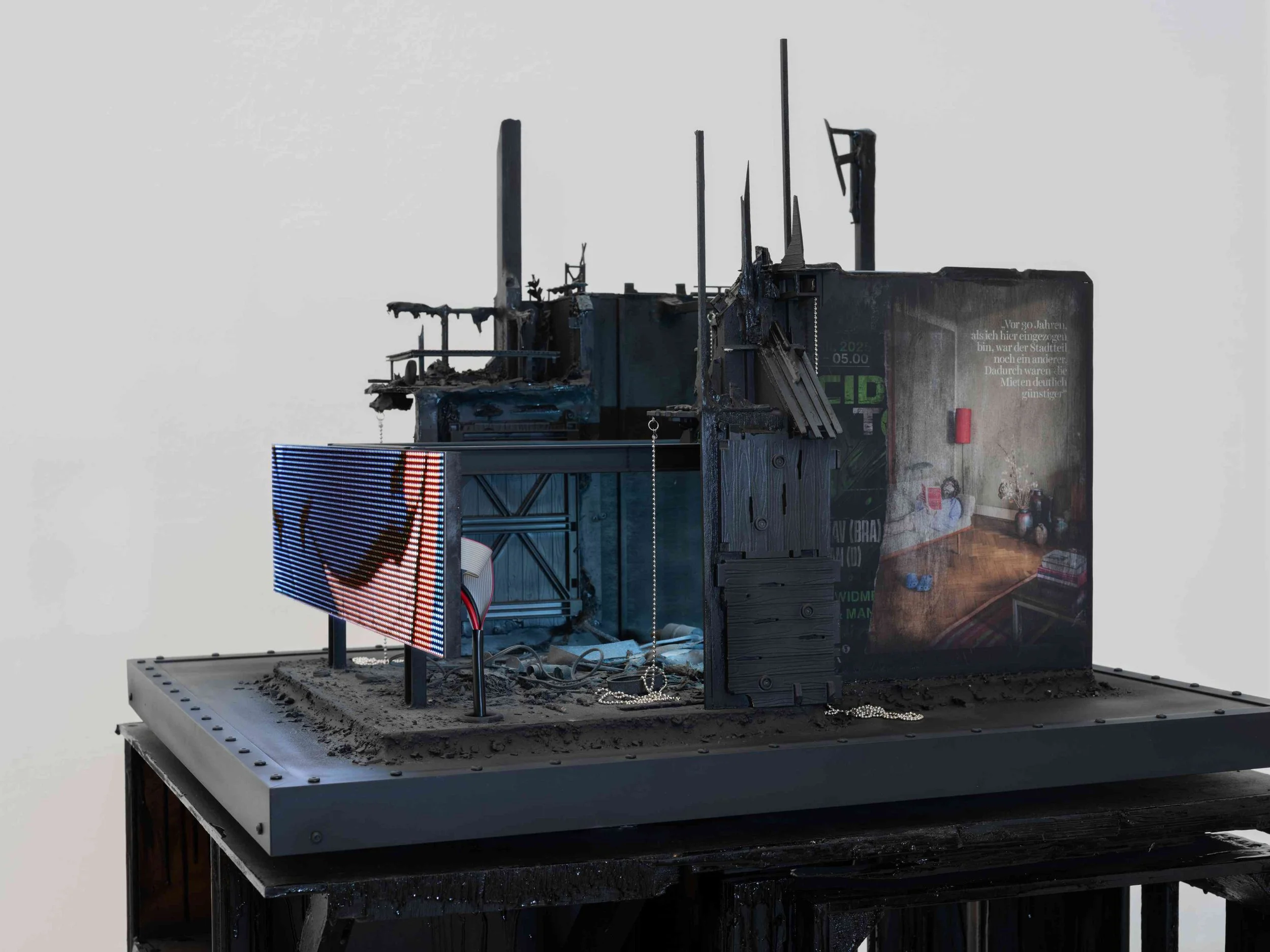
Mid-City V (Harder than Hard), 2025
Wood, aluminum, plastics, airbrush, photo prints, LED-Matrix panel, COB-LED, medical plaster, resin
Video loop: 11:09
135 x 75.5 x 65.5 cm
Photo: Studio Mathis Altmann
Courtesy the artist and Fitzpatrick Gallery
The collapse of capitalism, as we know it, could indeed provide a certain cathartic moment, and following your latent optimism, the change on the horizon might not be only for the worse. How do you see your practice developing in light of these political and societal alterations?
I believe that art, in all its facets, must continue. Especially now, when culture is often the first thing placed under scrutiny. We are its gatekeepers, and artists have a responsibility to keep their tools sharp so they can provide pungent responds to what surrounds and affects us. This moment calls for a certain refusal to be pulled into nostalgic mourning for the past, because this is precisely the trap neo-conservatism sets for us.
Instead, let us maintain a practice that remains alive, thought-provoking, and ready to tap into the powers of laughter once again. That’s something I’m longing for at least.

Total Distress, 2022
LED matrix, stainless steel, airbrush, textile, chains
178 x 77 x 12 cm
Private collection
Photo Romain Darnaud
Interview by UNA GJERDE
What to read next