Alessandro Aprile
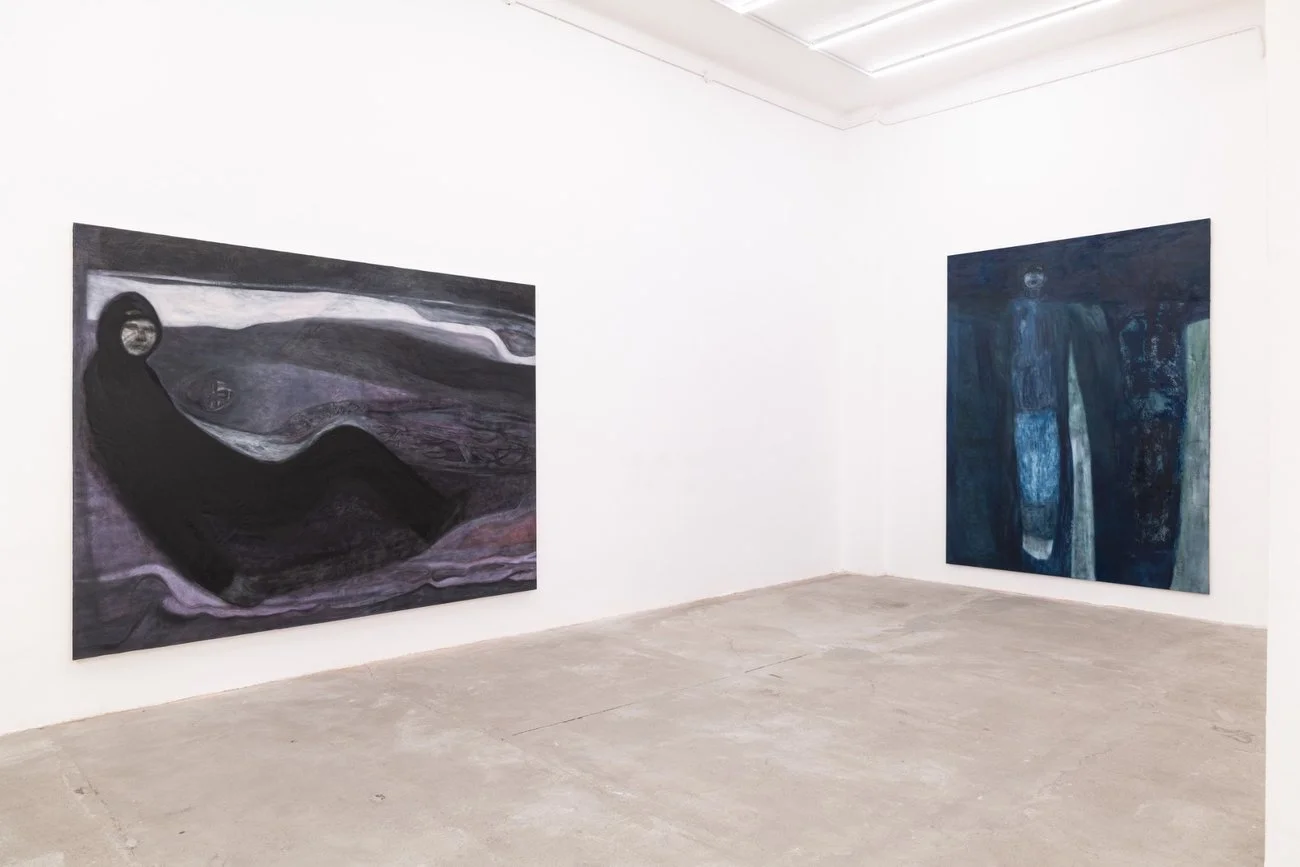
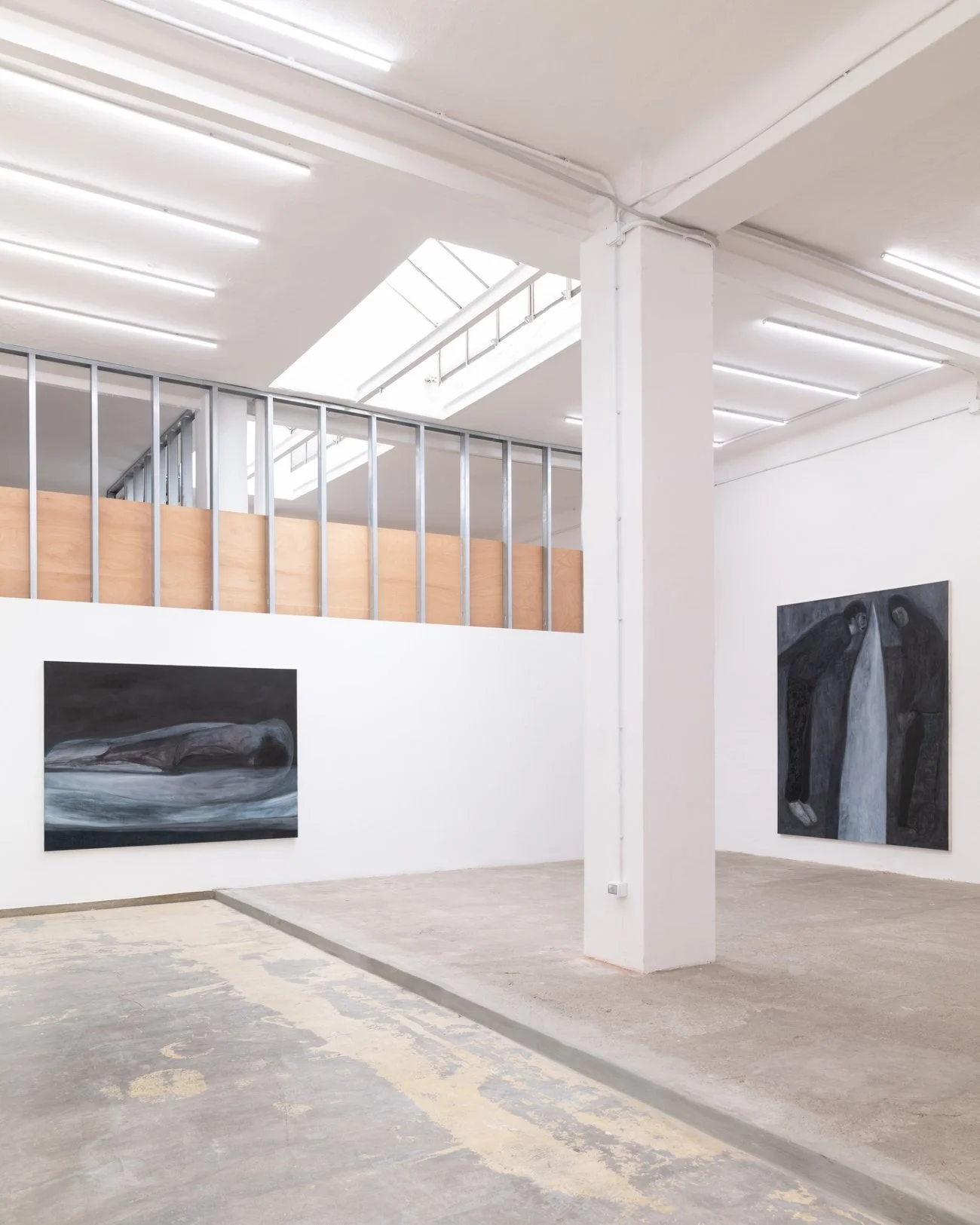
On his first solo exhibition, “Abissura” at MATTA, this interview with Alessandro Aprile unfolds within a space that seems to resist orientation, where bodies emerge, dissolve, and reconfigure under a constant, unseen pressure. His paintings inhabit a threshold: between presence and disappearance, control and collapse. Rather than depicting stable forms, Aprile constructs images as perceptual events, continually negotiating their own creation. As reflected in the exhibition’s conceptual framework, the viewer is drawn into a condition where even the act of looking becomes uncertain. Born in 1999 in Modica, Alessandro Aprile lives and works in Bologna. His practice is driven by a persistent attempt to elude fixed rules and pictorial limits, testing each device he employs to generate scenarios charged with tension. The monotype acts as a catalyst: an initial gesture that interrupts and destabilizes the pictorial surface. Space, in his work, is inseparable from the scale of the canvas and the proportional relationship between subject and background, often suggesting an image on the verge of collapse.
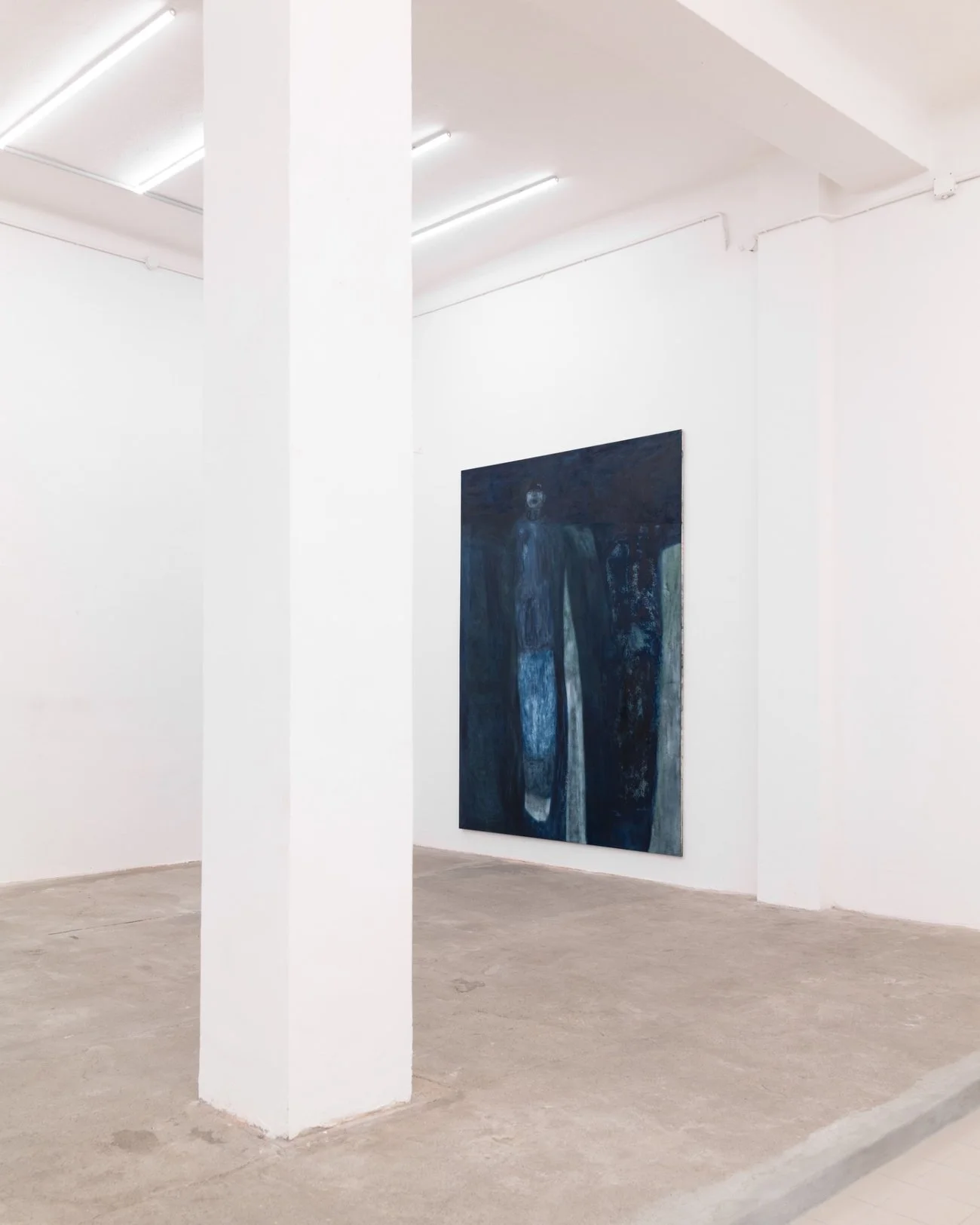
The exhibition text describes a space without coordinates, with no horizon or points of reference, an unsettling state of suspension where even the viewer's gaze seems unstable. Looking at the works, this sensation translates into bodies that do not orient themselves but seem to emerge from a sort of pressure, as if under a constant force that offers no relief. These forms also evolve from more defined shapes into almost ghostly presences. How do you describe your painting process and the construction of the image, both as a physical and perceptual experience, and as a possible existential condition?
I would describe it as a constant attempt to bring certain sensations and states to the surface. The monotype represents the starting point of this process, an initial mark capable of catching the still-untouched pictorial surface off guard. The subjects that emerge from my canvases are not figures with specific identity but rather manifestations of the same state of mind; for this reason, in this solo exhibition, each painting carries something unique while sharing specific atmospheres.
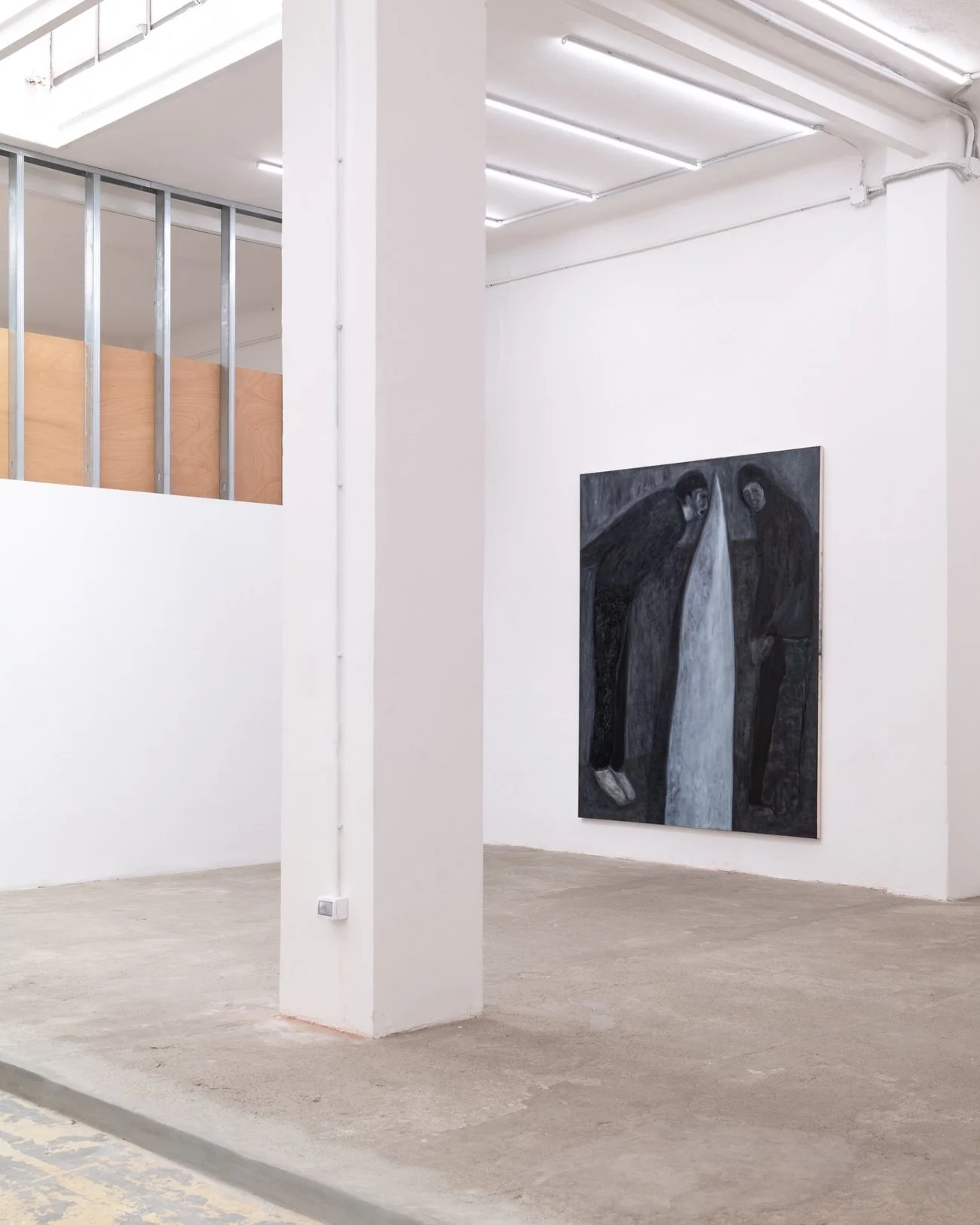
Vertical elements cut through some of the compositions, suggesting a threshold or perhaps a crossing point. At the same time, there never appears to be a true passage. What do these vertical forms mean to you?
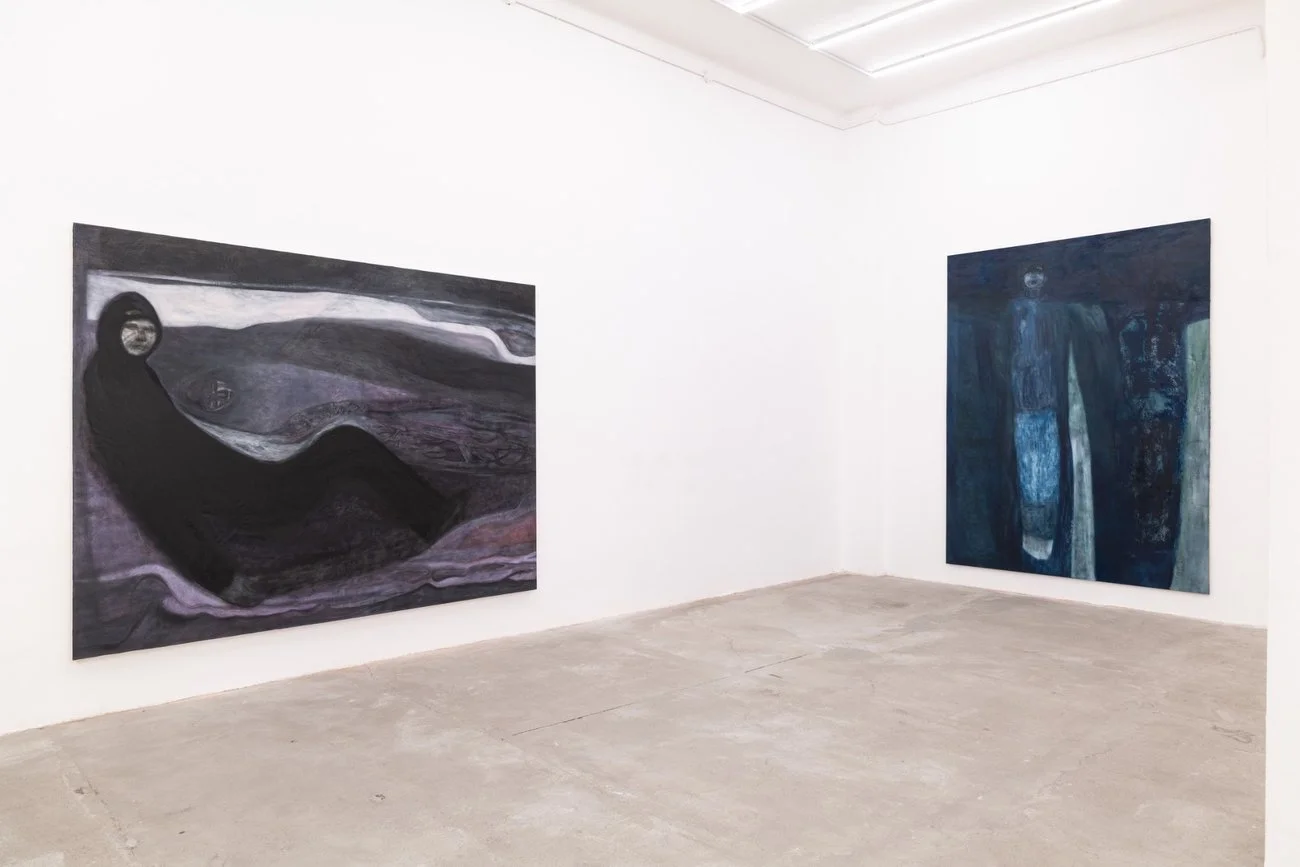
These vertical elements stem from a desire to create ambiguity within the painting. The fact that a threshold or a point of passage, despite being open, can represent both a physical and a mental obstacle is a condition I was seeking to capture within these works. In “Monoliti”, for example, the element that visually separates the two figures is, for me, both an impediment and a passageway in terms of communication. These forms recur in almost all the compositions, but in different ways, as in the case of “One of the Two”, where the element appears horizontally.
The subjects in your paintings often seem to dissolve into the landscape, losing their distinct contours. How do you deal with this ambiguity between the subject and its setting? What drives you to explore that uncertain space where boundaries fade away?
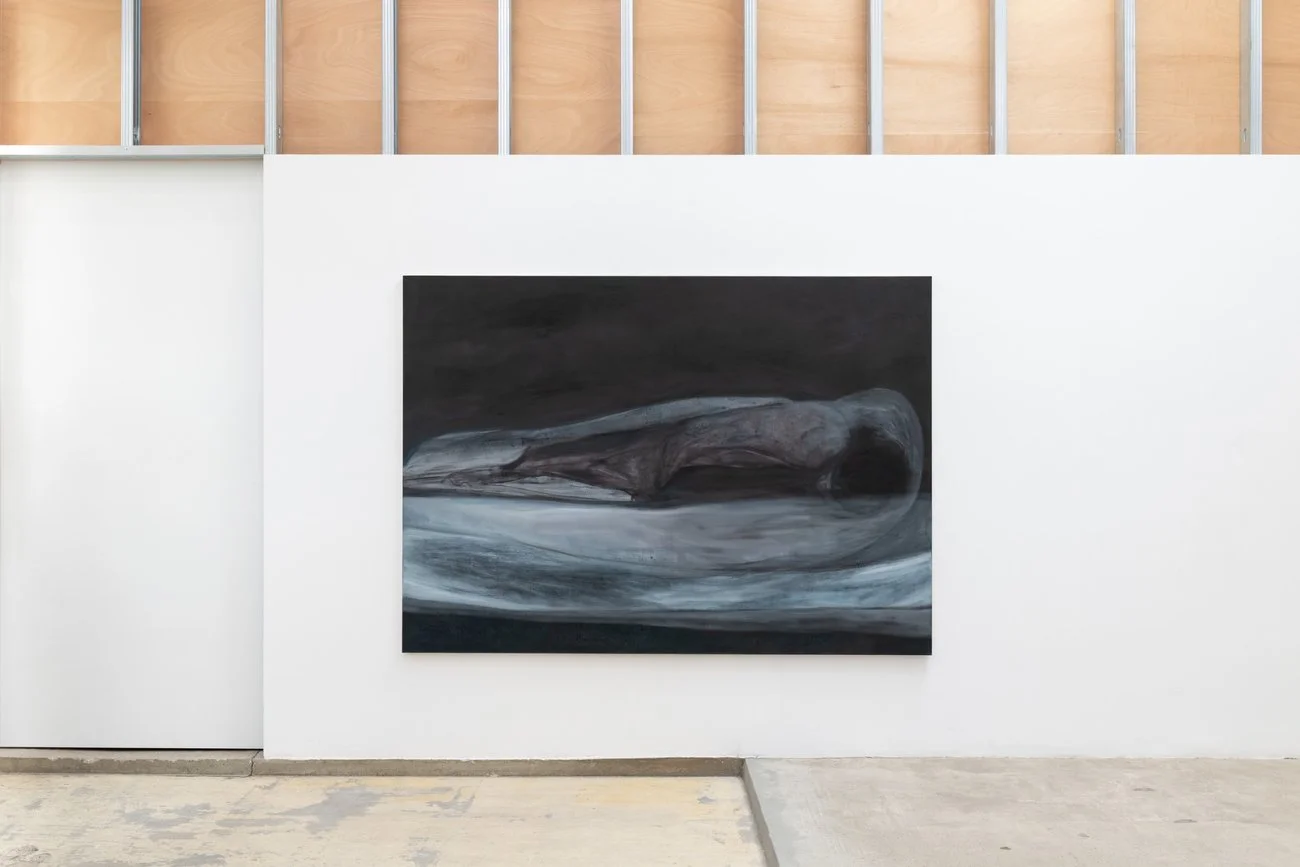
What if, instead, they were emerging into the landscape? What if, rather than losing their contours, they were taking them on? Linking back to my previous answer, the ambiguity is repeated here too. Whether it is inwards or, conversely, outwards, what really interests me is moving within this threshold alongside the subjects and the surrounding environment, trying to record what is happening.
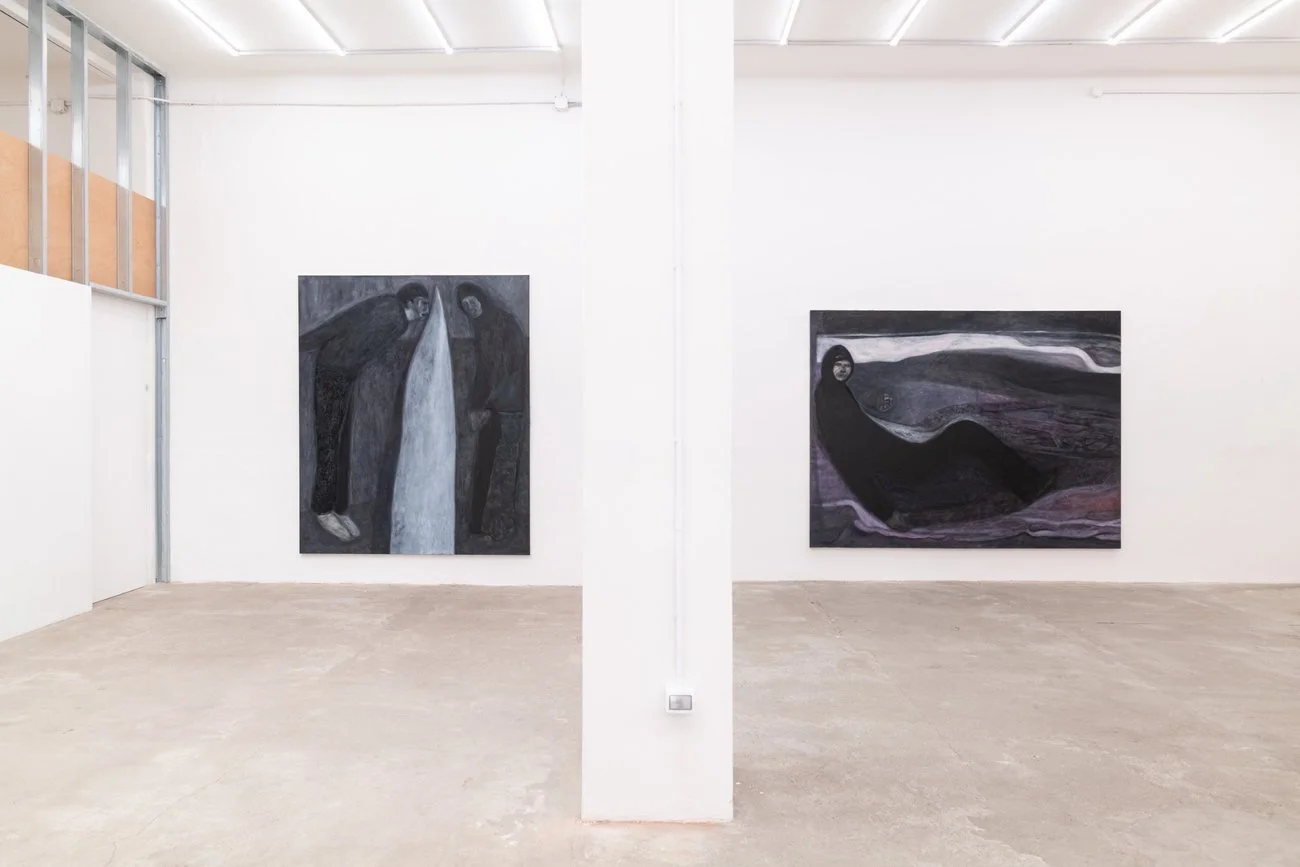
“The subjects that emerge from my canvases are not figures with specific identities but rather manifestations of the same state of mind.”
Your painting process appears to be one of sedimentation, where images emerge gradually through layering rather than clear definition. The forms seem to surface slowly, resisting dispersion. How does time feature in your work, both during the painting process and in the overall construction of the piece?
My relationship with time has changed significantly during the creation of these works. Now I devote much more time to each work and, in my painting process, paradoxically, the only moment when I have a clear definition of what I want is the instant before the painting begins. From the very next moment, this image tends to unravel, and others emerge which I gradually follow, until I arrive at the one that most closely resembles the sensation I am seeking.
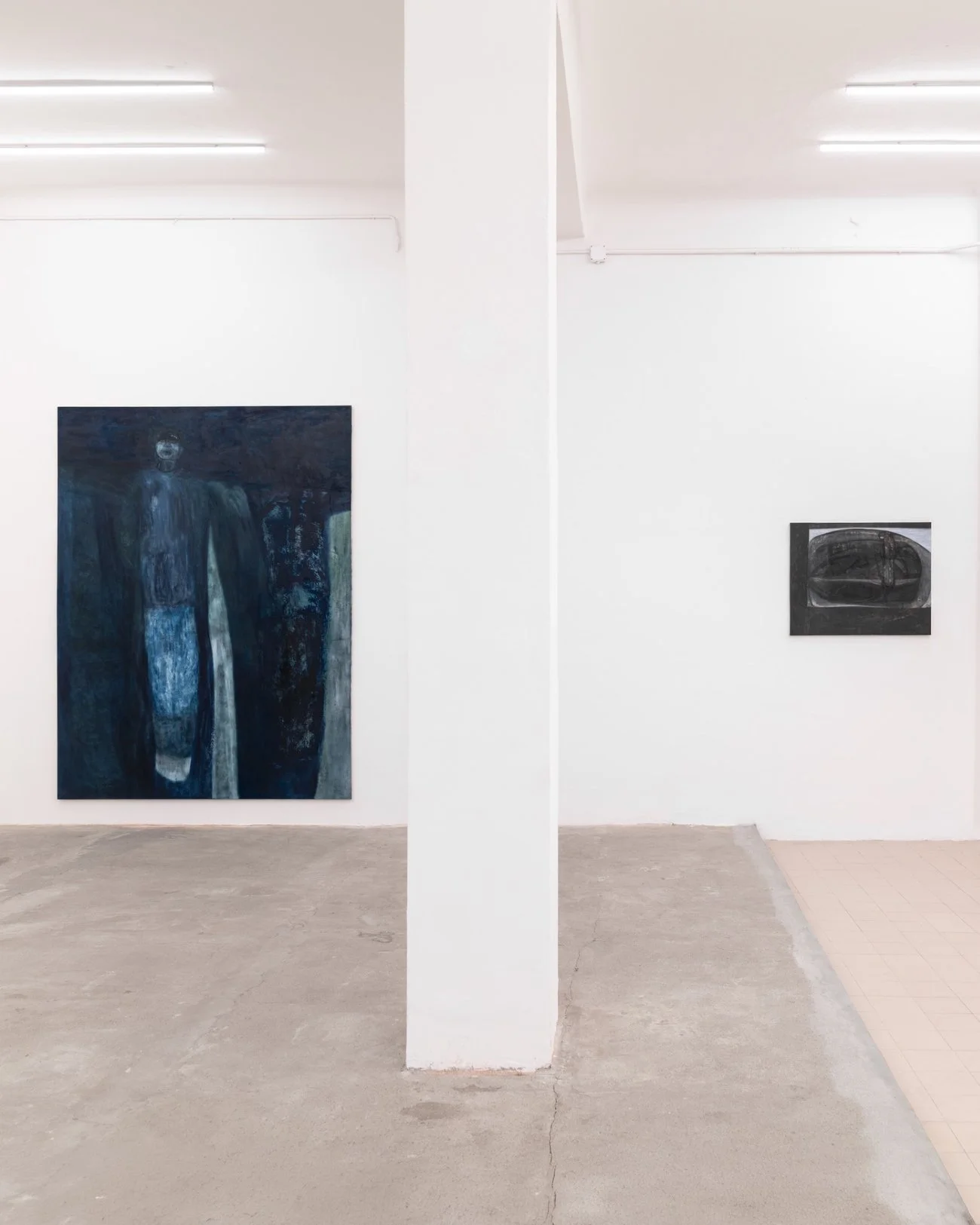
The chromatic expressionism in your work is contained, based on dark, deep tones with subtle variations. How would you describe your relationship with colour?
Over the last two years, I have studied black as a colour extensively; it was the main subject of the thesis with which I concluded my academic studies, so the choice of dark tones certainly stems from this and is also a direct consequence of what I wanted to convey in this exhibition. In some paintings, there are more than six black pigments, with different characteristics and variations that are not so subtle. I would not, therefore, describe my relationship with colour as ‘restrained’; on closer inspection, the colour palette is broader than a first glance might suggest.
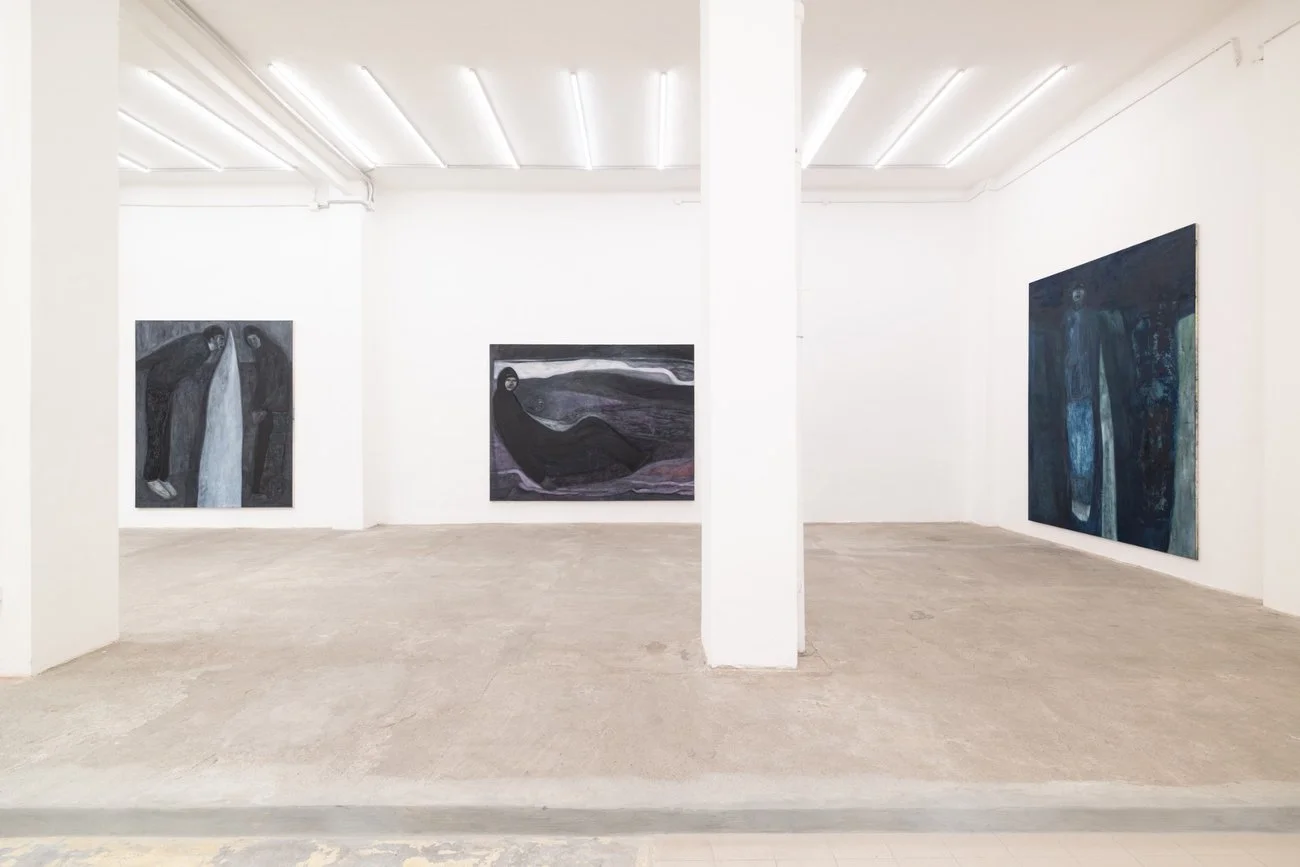
“I would not, therefore, describe my relationship with colour as ‘restrained’; on closer inspection, the colour palette is broader than a first glance might suggest.
”
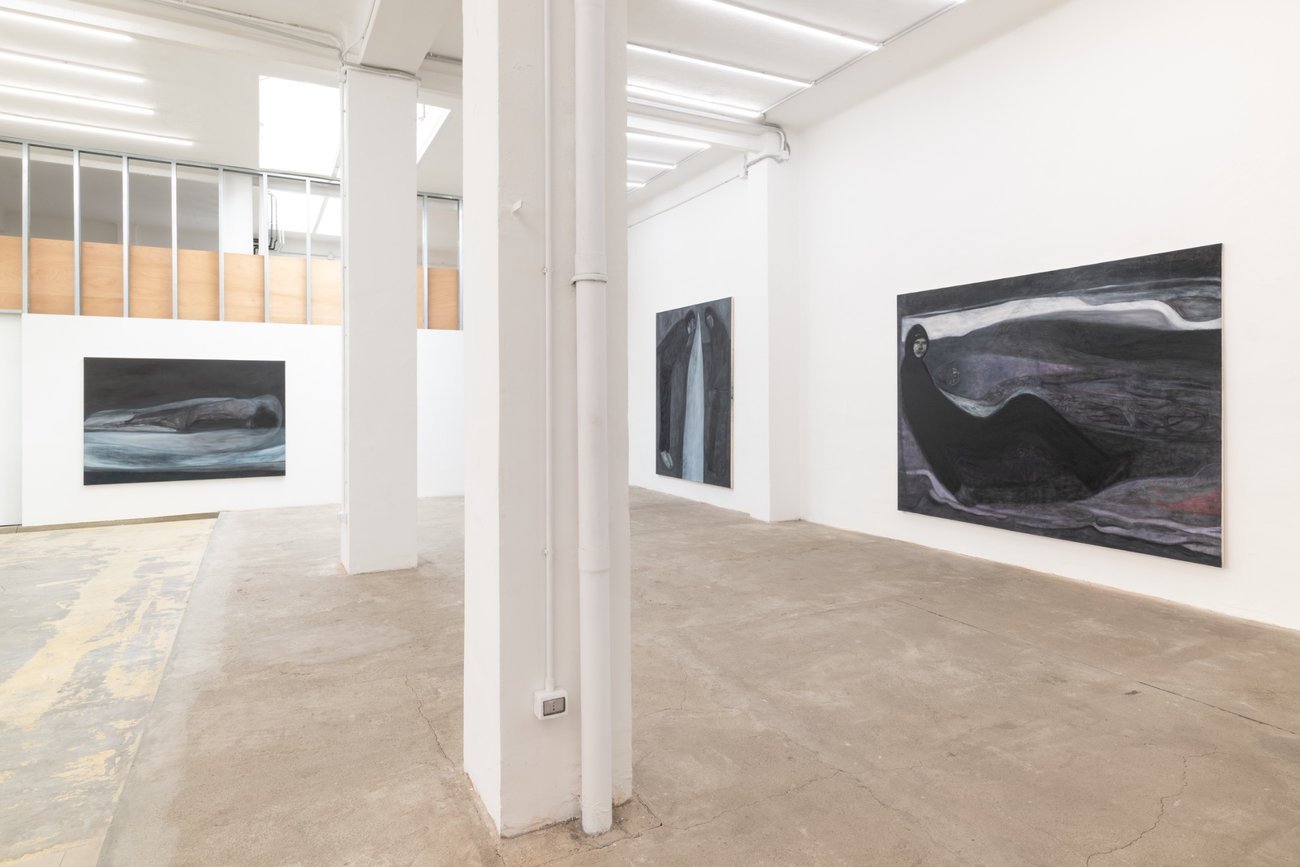
The space and the works interact in a state of suspension, yet they remain alive and present: the void is filled also by the large scale of the canvas. How did you conceive the dialogue between your works and the space?
What I was most keen to convey was precisely a state of constant suspension. To achieve this, immediately after seeing the space for the first time, I thought only of an exhibition featuring large-scale paintings. I wanted presences capable of towering over the viewer, leaving them no breathing space. It is no coincidence, in fact, that all the subjects were conceived as slightly larger than a 1:1 scale.
Photography Luisa Porta
Courtesy of MATTA
Interview by Aurora Piedigrossi
What to read next