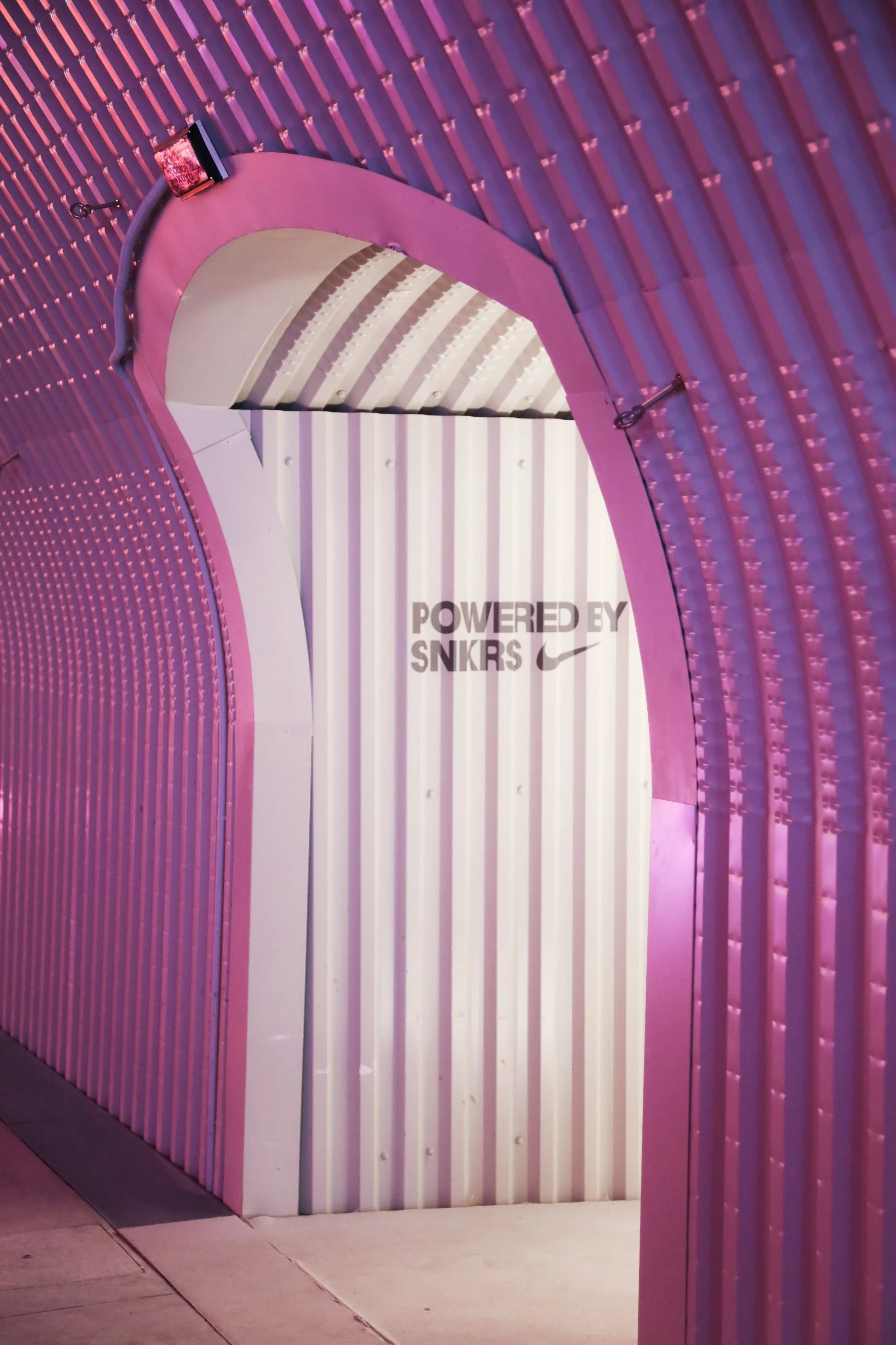
Dolce XOXO powered by SNKRS
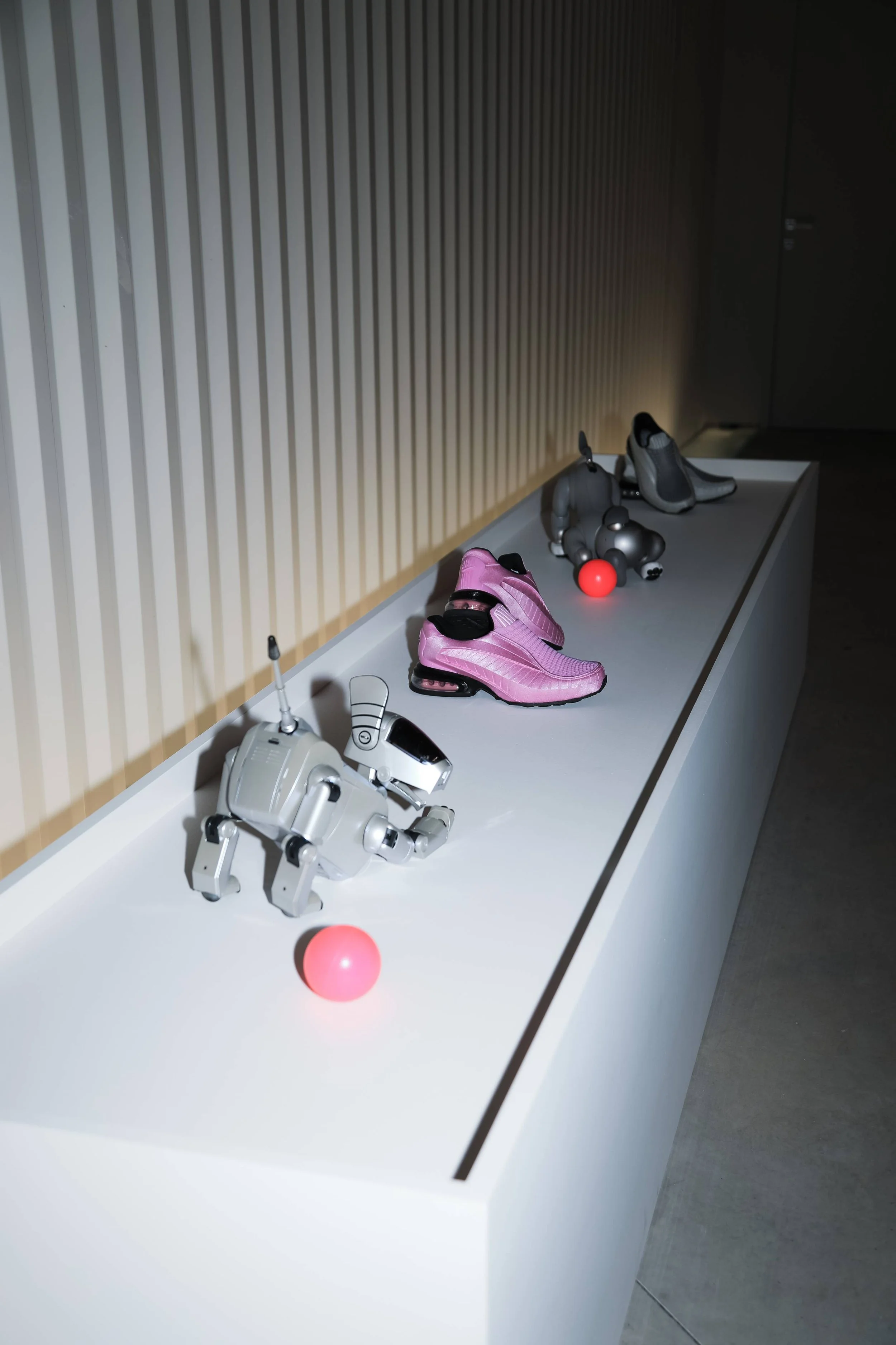
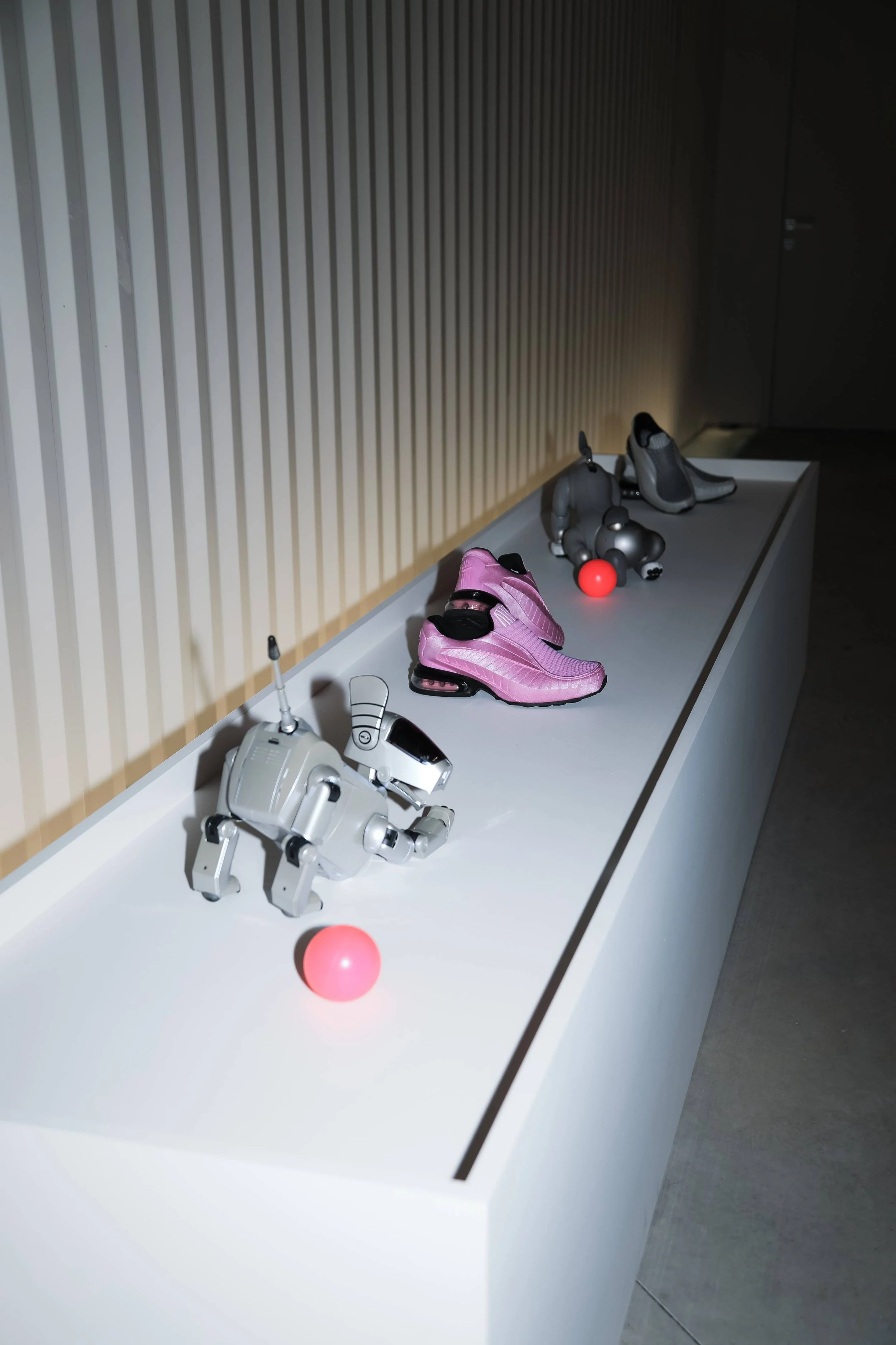
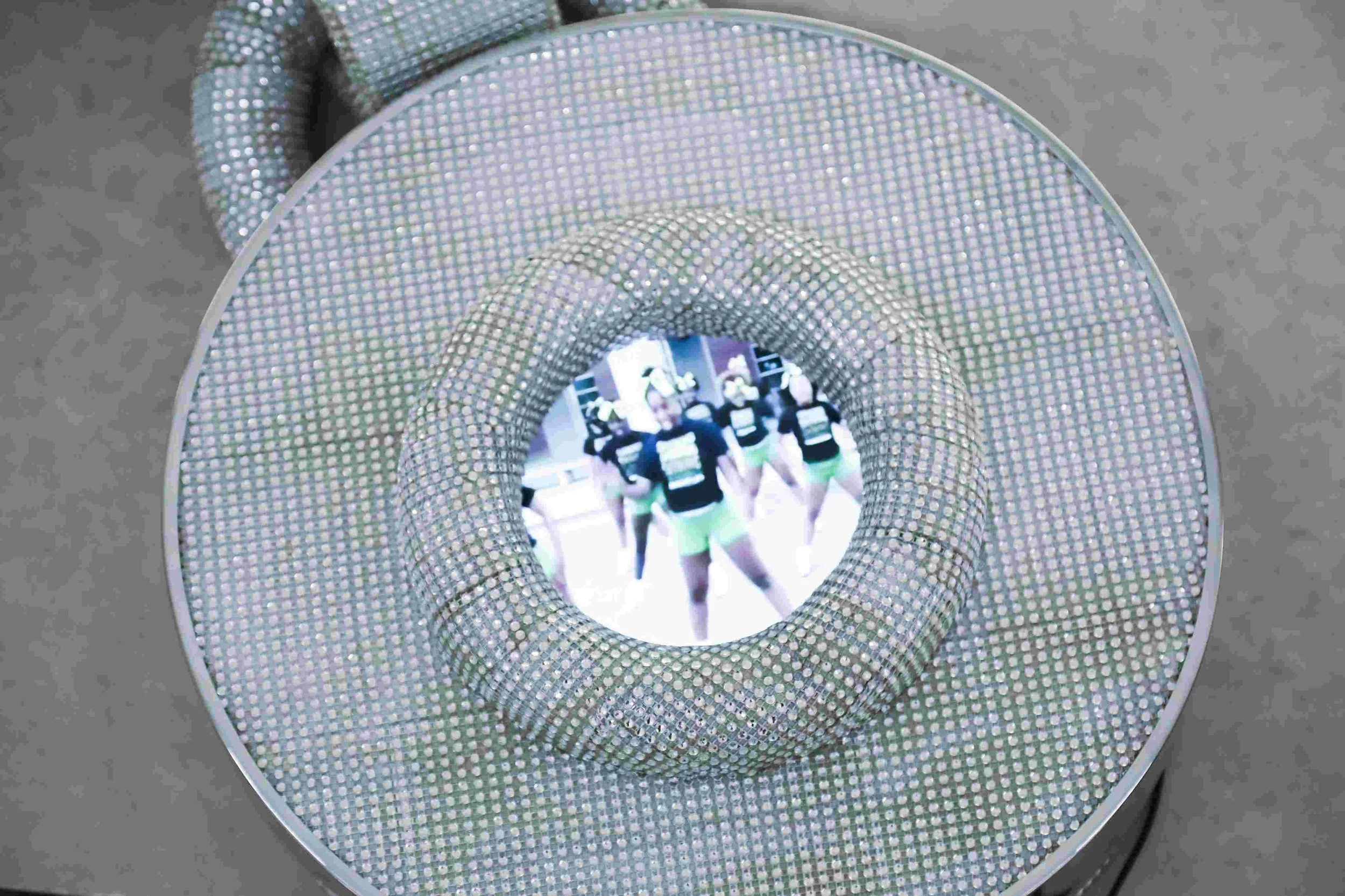
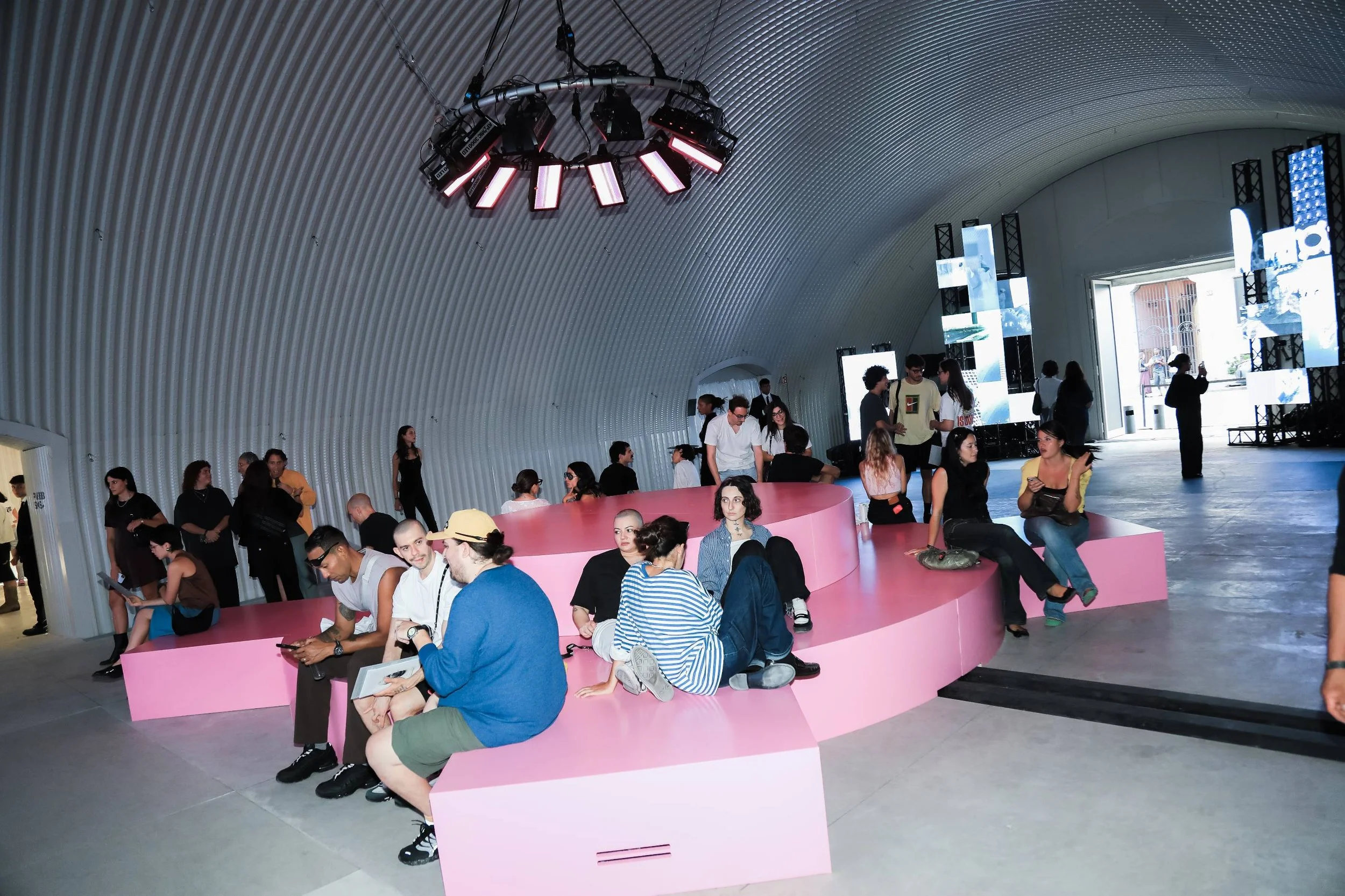
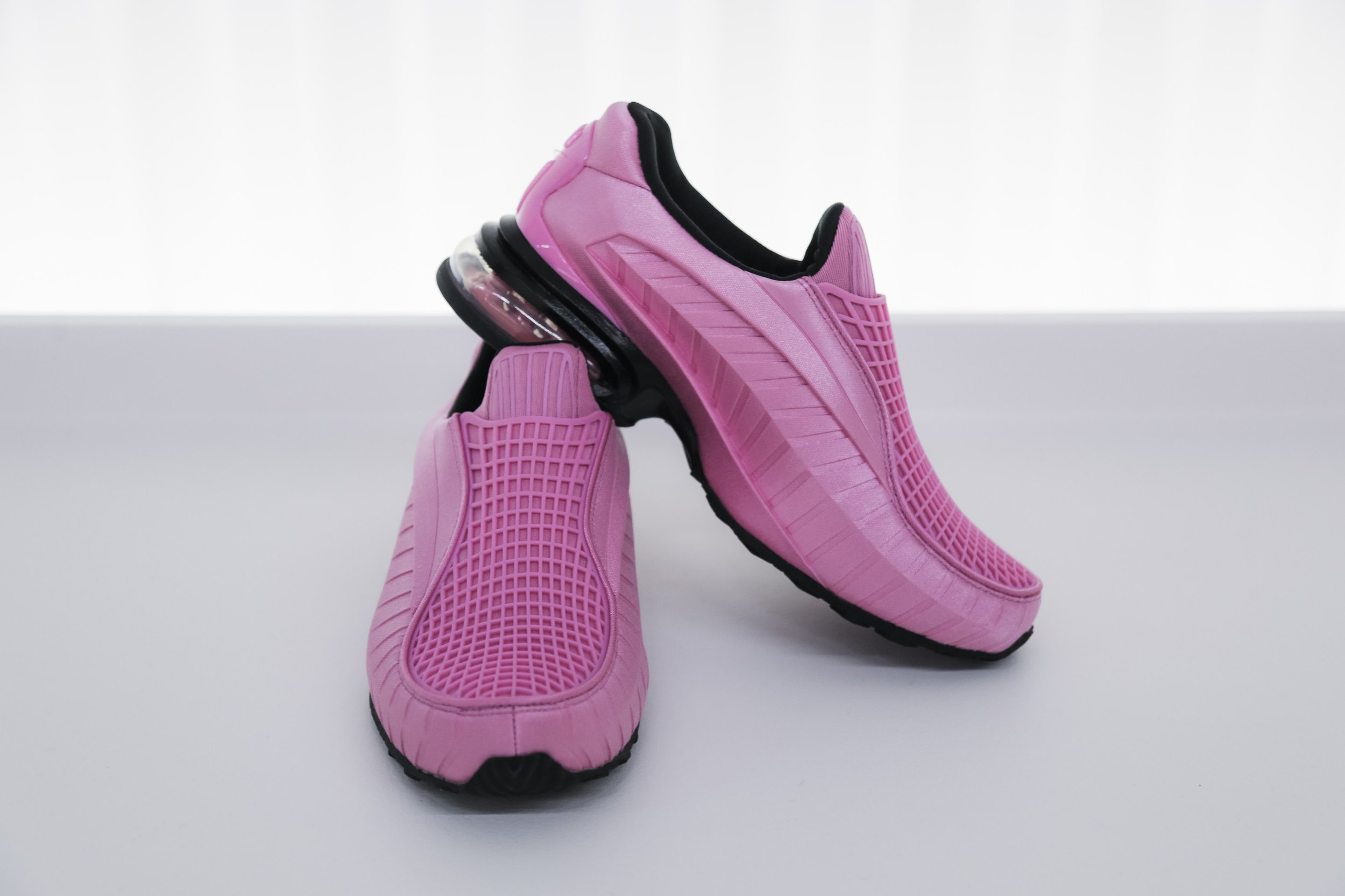
There is a version of the 2000s that belongs only to the people who lived it through a screen: glitter cursors, gas station sunglasses, webcams pointed at bedroom walls. On September 12, Nike SNKRS gave that memory a physical address. Dolce XOXO took over Via Sammartini 72 in Milan with an exhibition built around the Air Max Dolce and eleven artists who grew up inside that visual world. COEVAL spent the afternoon with five of them. Tudor Ciurescu talked about Icarus and an AI trained only on his own images. Common Index explained how 23 cameras and four Raspberry Pi turn a room into a time loop. Forniture Pallotta described the flavour of a chrome heart. Sara Sadik unpacked the word Beurcore. Agnese of Due000 Contemporary Archive told us which pair of boots will never leave her building.
@renoiterrible
Sara Sadik
@sarasadikofficiel
You coined Beurcore because nothing else described your work. Ten years on, has the word escaped you?
A bit, in the sense that I created this word so that the people who were going to talk about my work would talk about it the way I wanted, with this word. But then it was used a lot, and my work changed a bit, because Beurcore is about the culture of French-Maghrebi people and community, and some of my work is about other backgrounds. So at some point it was not always related to the work I was doing. But I am coming back to it, so I would say it is becoming about Beurcore again.
Your characters strive for moral and physical transformation, usually inside a gaming engine. What transformation does a sneaker promise, and do you believe it?
It is a complicated question. I am not sure about transformation, but I only wear sneakers, so my answer will be about shoes, and specifically sneakers, because that is the only thing I wear. I put a lot of care and thought into the shoes I want to wear, because for me they really represent the identity of the people who wear them. It is the first thing I look at in people. So I am not sure it is about transformation. For me shoes represent the identity and personality of the person wearing them.
So they make the outfit.
Always. Everything else is black and kept simple, so I let my shoes do the talking. That is where I put my thought, and that is where my personality lives.
Dolce XOXO is a Milan event about an internet generation. How does Beurcore translate outside France, if it translates at all?
I would say it does not. My work in Beurcore is really specific to a group of people, to a community, and to the French context. But my work is about really universal subjects that everyone can relate to, so in this sense it is quite universal: everyone can understand my work. There are layers to it, though, the layers related to the Beurcore concept, which only a few people can read, and I like that. It is kind of a secret, kind of a for us type of thing. So this specific part of my work does not translate everywhere for everyone. But I am super happy this project is shown here, because the universal subject in it is having a safe space for men, brotherhood, something everyone can relate to, or at least understand.
Can you explain where the word comes from?
Beurcore is made with the term Beur, which means French people from a Maghrebi, mostly Algerian, background. It is a super old word. It is slang, the inverted version of Rebeu, which is the inverted version of Arabe. So Arabe became Rebeu, became Beur. It is a construction that has moved. It is a word that was used and reused by different parties, sometimes to stigmatise, then reappropriated. So it is a really strong word, but an old one. For the older generation, my uncles, my mom, it is their word. As the generation relating to Beur was becoming old, the word changed too. And now a new word has come up, and again it is kind of the same story: it was created to stigmatise these people and then reappropriated. It is French Arabic, exactly the same as Beur, but directly understandable because it is in English. If I say French Arabic, a lot more people can understand it. But there is still French in it, so you understand it is also specific to a territory.
Last question, about your videos. You depict young men in your films and you appear in them yourself. Who are you playing this time?
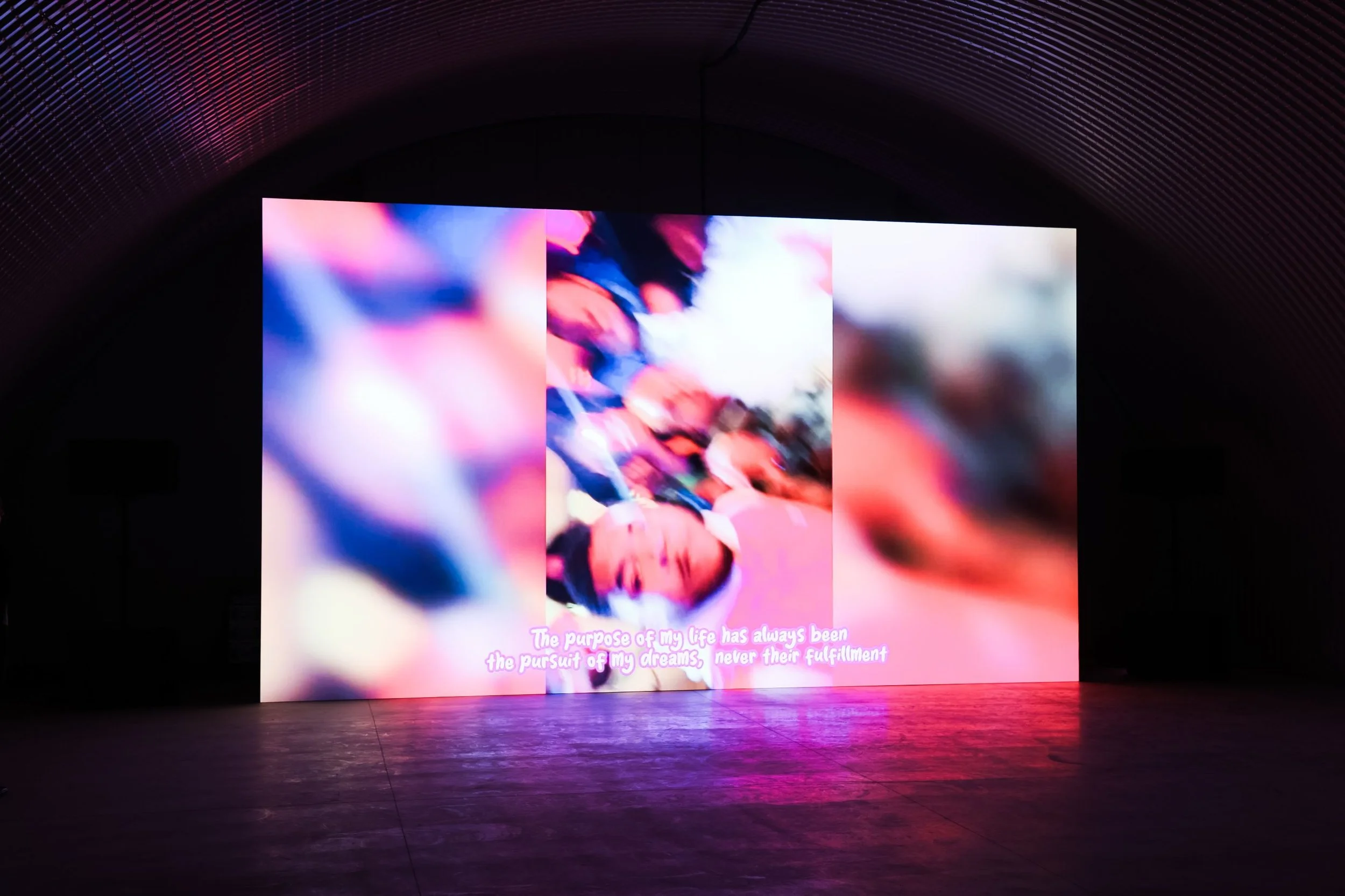
In the video I am presenting, I am the manager of the hookah lounge, so I have quite an important role within the film. As in a lot of my movies, I play a character who brings in the fictional part of the story. But this is only in my videos, because in real life I am more of an introvert. I do not like being represented. The difference between how I represent myself in my work and in real life is really the opposite. Even the way I dress: in the movie I am in full pink, in real life I am in all black from head to toe. So you can see both versions of how I represent myself.
Tell us about the film.
The film is about this hookah lounge, and I am the manager and the creator of it. In the story, I am the one who created this space for all these young men and teenagers to gather, to be together in this safe space. At some point in the fiction I create a championship, because I want to give the key of the hookah lounge to one of them. It is a lot about legacy. I have done my part, I created this space for you guys, it is now your space, and I want to give you the key, because it is yours, and then you can pass it on to the next generation. So I create the championship, there is a winner at the end, and I give him the key of the Xenon Palace. And then the story continues outside the work.
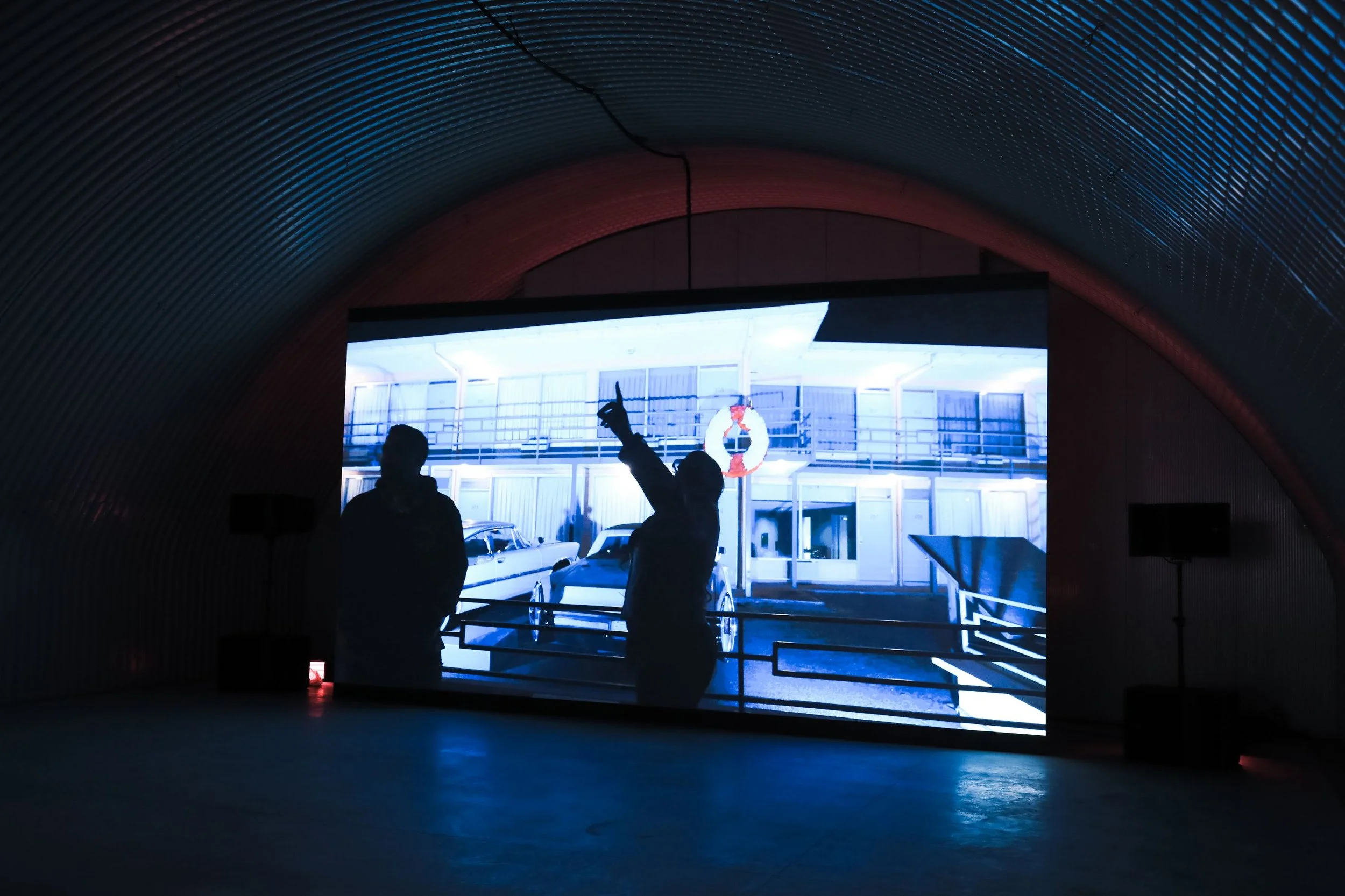
Due000 Contemporary Archive x Hollywood Supertar
You opened your space in Milan in March, with your first exhibition in June, and now you are styling a Nike afterparty. How do the archive and the wardrobe feed each other?
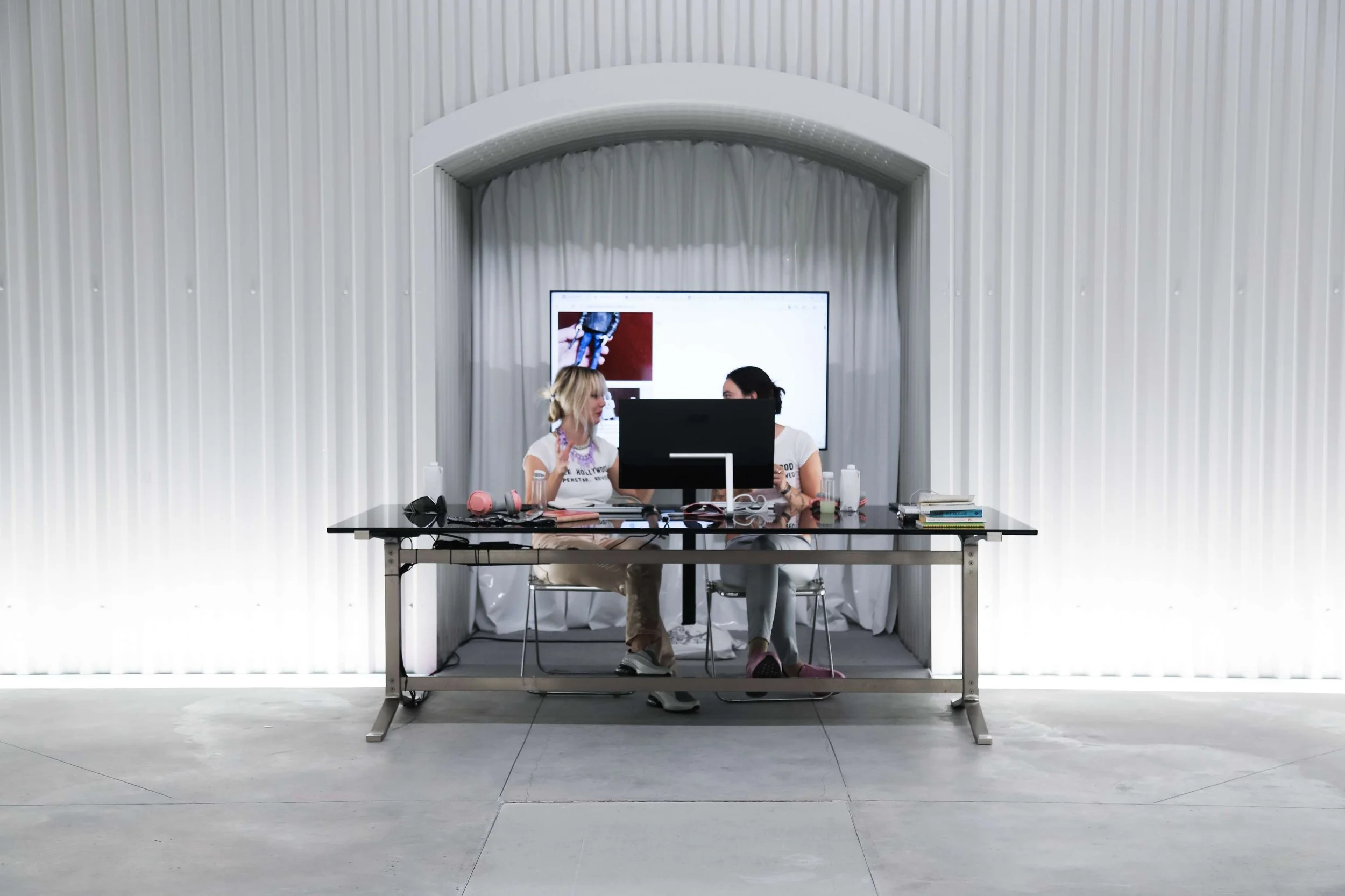
I had the opportunity to style Hollywood Superstar, who are part of the Dolce XOXO exhibition. The research I did is very close to my personal research, because this duo, at this exact moment, is very close to a blogger kind of research in the written art, collecting parts of text and images from the internet. It is very connected to the research I do as well, online and in physical spaces. In general I see clothes more as objects than as ready-to-wear pieces. That is probably what the two projects have in common.
What does the word archive mean for a project that works with the present tense of a generation?
Archive right now is considered differently than maybe ten years ago, when it was more focused on taking down the exact date and period of a piece of art or a rare garment. Now, to me and to the generation, it is connected to a more instinctive way of collecting. Everything can be part of an archive right now, but you have to find your aesthetic. It is more a world, an imaginary, than an archive. The way we consider the archive has literally evolved.
Styling the night of Dolce XOXO means dressing two people for a performance instead of a model. What was the brief you gave yourself?
I was very attracted to the way Hollywood Superstar use their blog, so I looked at the outfits they used to have and the way they express themselves with slogans. To me the gloves, the sunglasses and the chain with all the little keys are pieces that can be slogans as well. So I focused on finding small objects that could integrate with the performance, thinking more about the performance itself than about the outfit alone.
Final question. Which piece in the archive would you never let leave the building, and why?
Nice question. When I opened the space, I felt from the very beginning, when I started collecting pieces with an aesthetic in mind, back in 2020, that I probably had an obsession with clothes, because I felt I could never let any item leave my archive. Now there are some pieces that are literally OG, they have stayed in the archive since the beginning. It is like when you start a project: the first clothes you bought, you will never see them go away. Right now I am trying to change this mindset and be more open, also because my taste is changing. But there is a pair of rare Thom Browne boots that a really close friend gave me: super high leather boots with a unicorn printed on them, Thom Browne, probably 2017. Those are really rare pieces.
@100o111
@renoiterrible
Common Index
@common.index
You are Common Index. What have you made for this event?
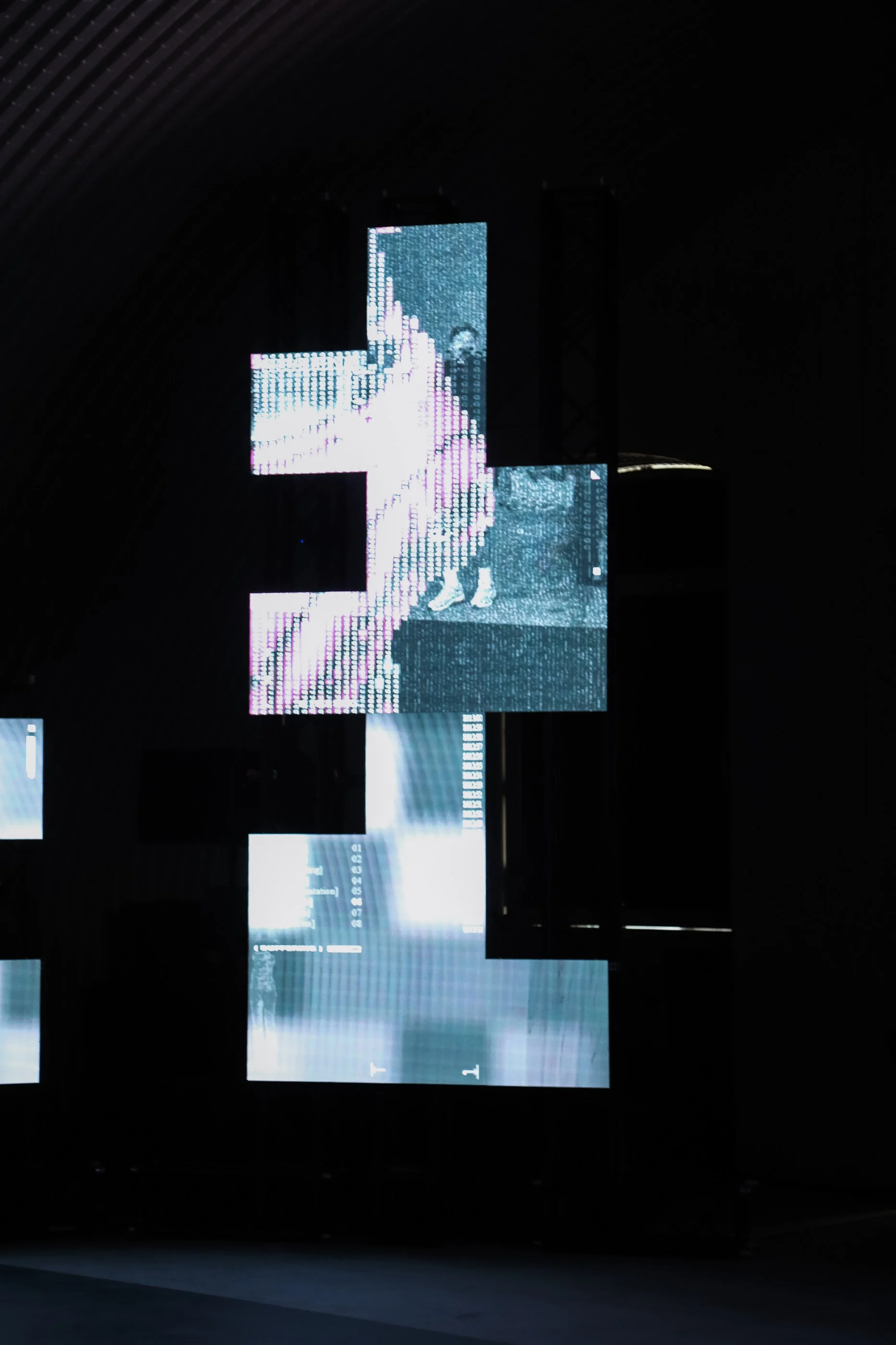
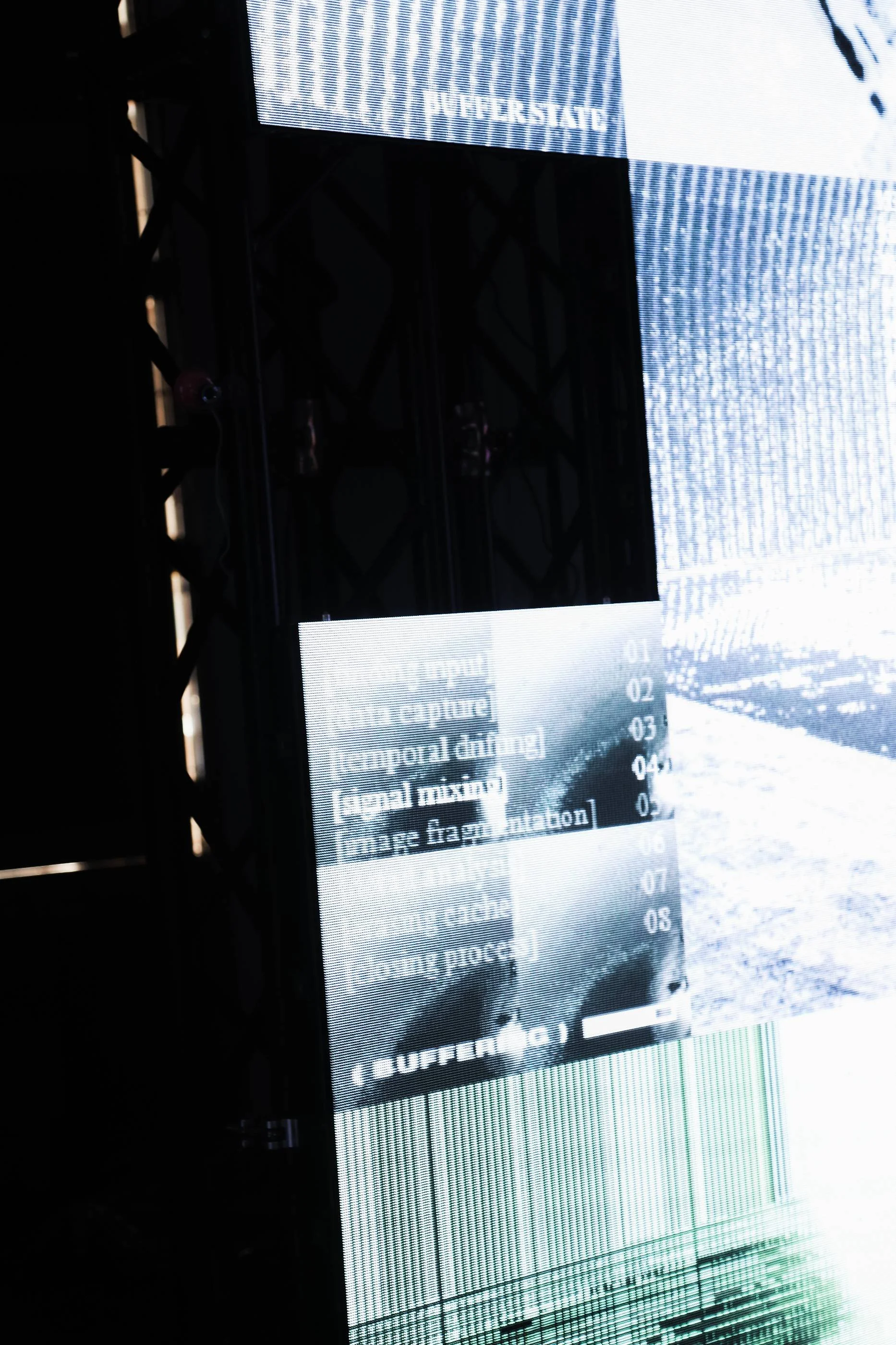
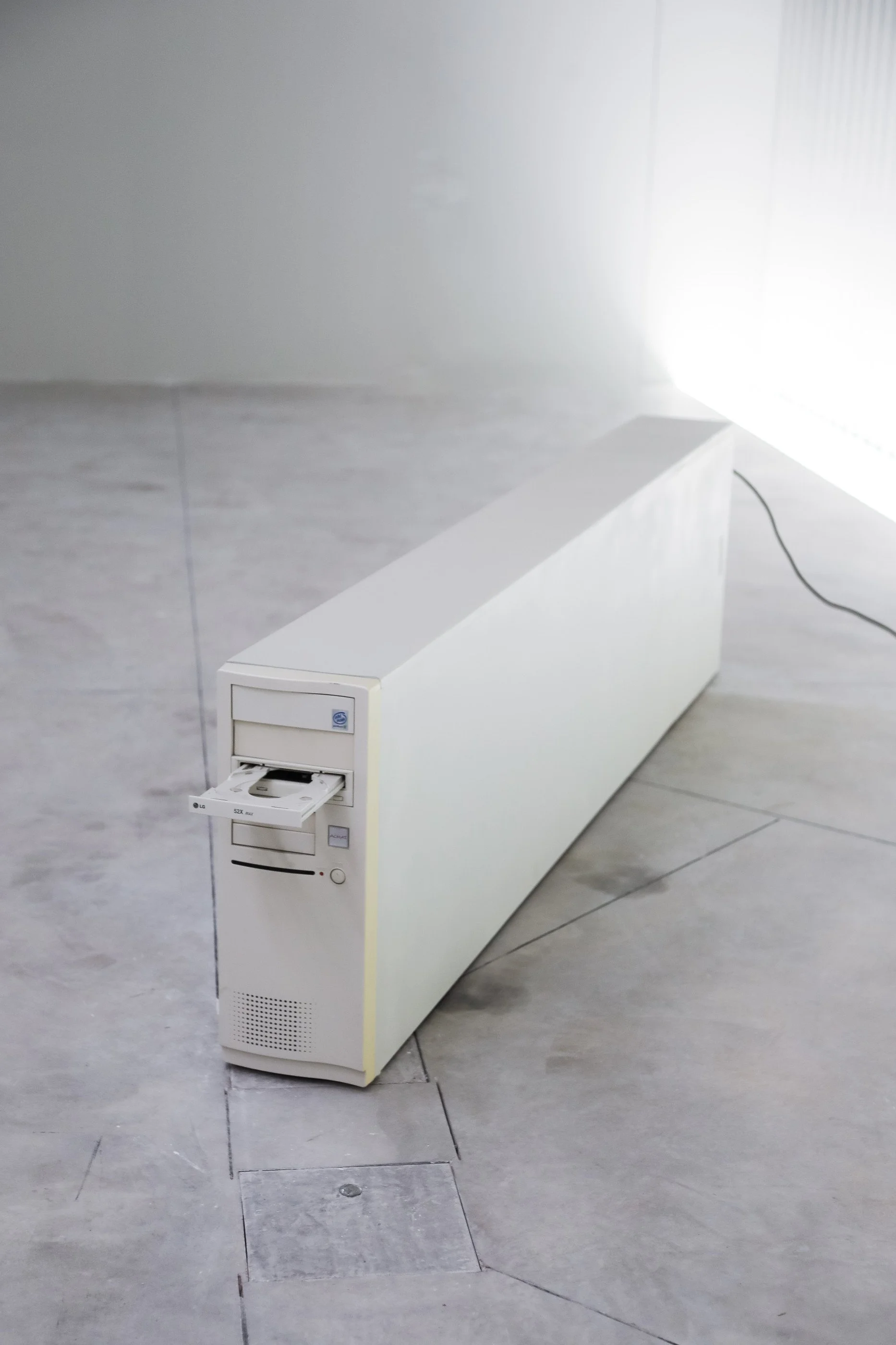
Simone: We made the installation at the entrance, which is called Buffer State. The main inspiration came from the story of the shoe, a shoe that perhaps came out a little too early compared to what the world was like at the time. There was a kind of delay between the moment the product went on the market and the way its story then evolved. So we played on this idea of temporality, these asynchronous times, in a certain sense.
How does that idea take shape in the space?
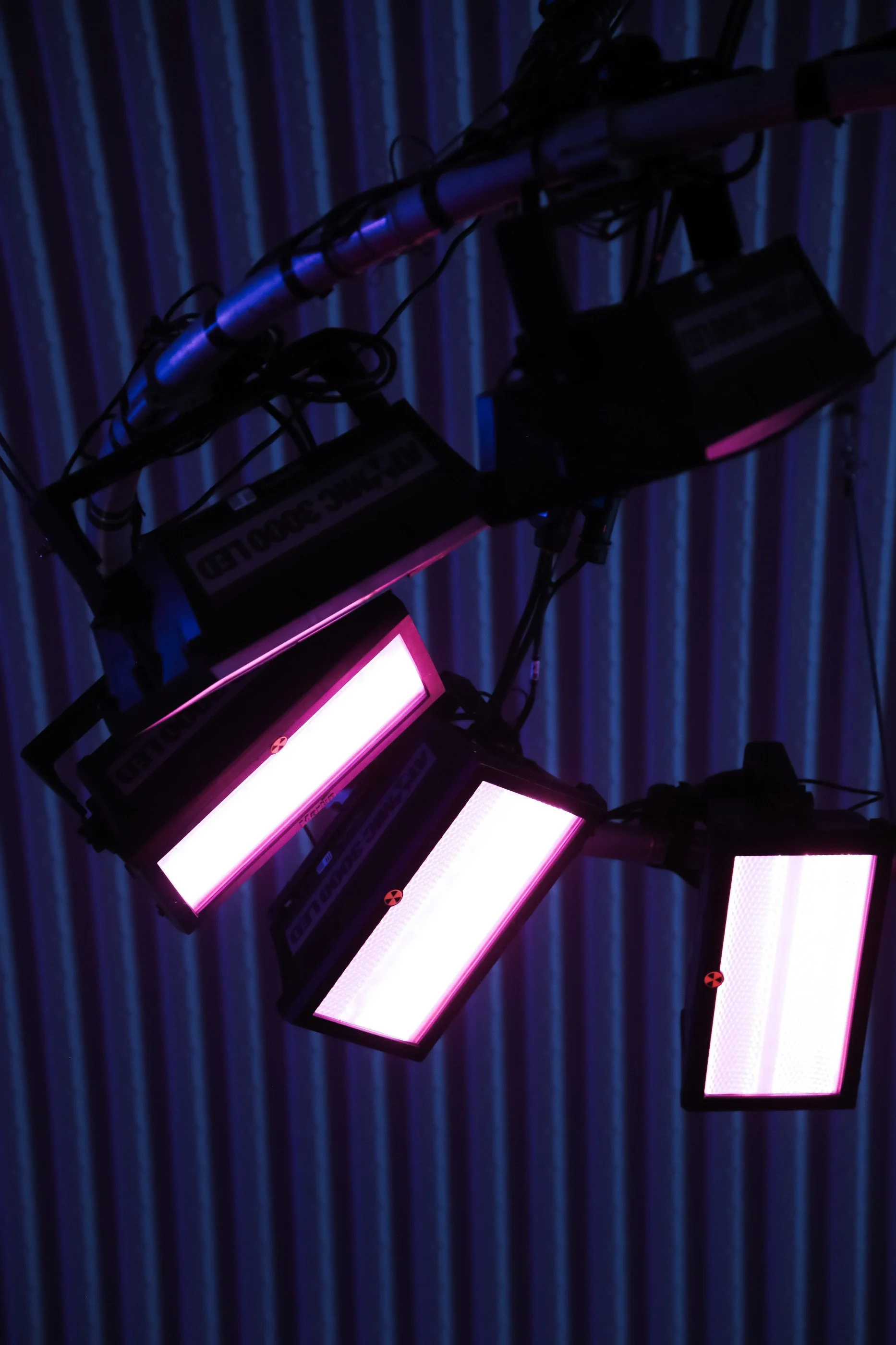
Pietro: As a collective, we talk a lot about themes that touch both technology and everything that concerns people, community and collective being. The idea is to create installations that are never already finished. We avoid putting something there that can only be looked at, touched or interacted with in a closed way. We do something open, that evolves over time. We create a context, more than a finished thing, and a process that evolves. The people who enter the space we have built find themselves in a context where the linearity of time is lost, and so is the space. All this thanks to more than 23 cameras, contemporary and vintage from the year 2000, which capture the space and disperse it on the LED wall we built.
How do people interact with it?
Carlotta: For us the nice thing is how people interact with our installations. What we like is to avoid the canonical interaction, where I go, I touch, I do something. Instead, I am there in that time and in that space, and I see what changes around me. Being there, people see what changes in the installation and actually influence what they see. This is why we created different states of the installation, different visualizations. It is also funny that people do not even understand where they are being filmed, so they find themselves in a space and a time.
Simone: A state of disorientation, temporal and spatial, when you are in the center and you cannot tell where you are being filmed, and you see these asynchronous moments.
On a technical level, how is the work built? What kind of coding do you use?
Pietro: There are two reflections here. We were born as a collective, and we do everything with the resources we have, both time and money, outside our regular work. We have no funds or partnerships that let us say, ok, I need this supercomputer, and get it. So the nice thing is also pushing technology as far as it can go, optimizing everything that is often taken for granted, to make it work for us with what we can really use. It is less about hacking and more about finding the perfect balance for what we want to do. Today we are using TouchDesigner, a node-based generative program. Everything you see is in real time. We work with no static content, apart from a few assets that we were asked to include.
And the hardware?
Pietro: We are using four Raspberry Pi connected to various webcams from the 2000s. At the driver level, both Windows and macOS have dropped compatibility with these webcams, while Linux has kept it. The Raspberry Pi, these micro computers that cost very little, strangely give you many more possibilities than supercomputers that cost a lot of money. We created a local network where everything communicates, and various inputs are collected in a very natural way. We use the video as video input, but we also calculate how many people are in the space at that moment and how much they move. From the difference between frames we know if the environment is moving fast or slow, and all this data is taken and eaten by the program, which develops it in real time, so it is always different.
Simone: Another interesting thing is the theme of the system and its sustainability over time. These webcams work, we are using them for an installation, and on a basic consumer computer they would no longer be usable. It is an interesting reference to how technologies become obsolete even though they actually work.
One last question. In today's era, which we could call post-internet, post-2000s aesthetics, maybe already post-AI, how do you place yourselves, as an idea and as an aesthetic?
Carlotta: It is something we are reflecting on too, and it is very connected to our practice. When we talked about the theme of the event, the early internet, we liked it a lot. We already had other ideas related to the early internet, but the idea of taking technology as a means rather than an end, and as an actual network of collectivity, was already at the very basis of how Common Index was born. So we are reconnecting by trying to bring forward, rather than bring back, this theme of collectivity, of people who can do something together by taking advantage of technology as a means, rather than as a final element in itself. Which is what happens now with AI: I can use it, so I use it, or I use that technology just because it is cool, because it is new, because it just came out.
Simone: Another thing we were saying before: at the beginning of the 2000s it felt like the world was about to become something, there were things that could happen. Today we are in a moment where we feel blocked in an eternal present, where change seems possible only in a negative way. So we want to go back to that attitude and say, ok, in this context, what can I change? By making those steps, different things happen with the elements I already have.
Pietro: And it comes out well when you use a technology beyond the reason it was born for. In English the word is misuse, in a somewhat collateral way. With AI, yes, you can use it for everything it was born for, but there are slightly different ways of using it that make it much more poetic. And technologies born for something else, if used with a concept, both technical and narrative, find a totally new use. For us, experimenting from this point of view is very nice.
@renoiterrible
Forniture Pallotta
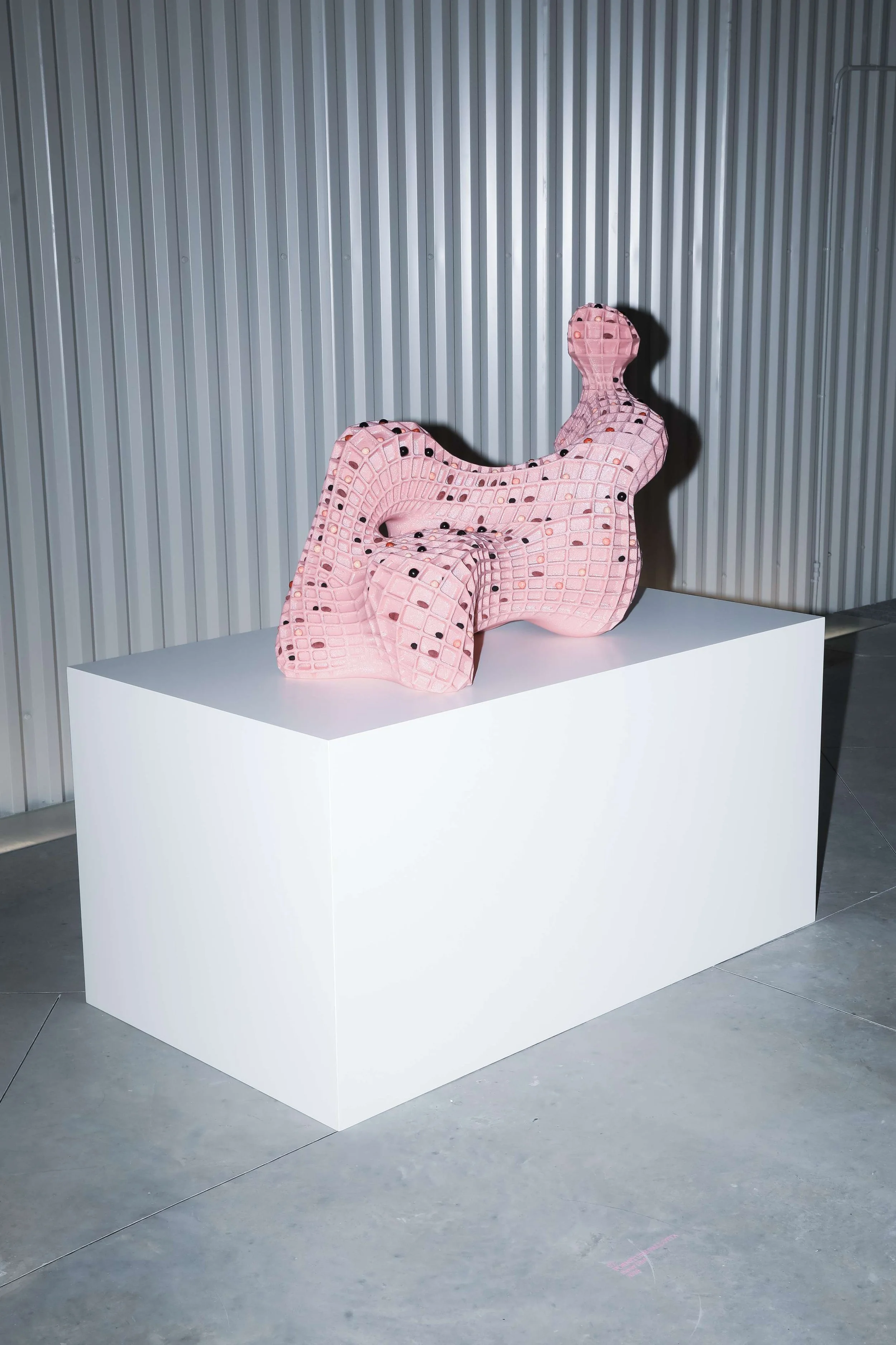
Fifteen years ago you were among the first Food Design students. What did the fashion world need to learn before trusting you?
Fifteen years ago that was a fairly innovative project on Food Design, one of the first. Art was the first to see in perspective what Food Design would become. Today it is appreciated by many, and fashion is now embracing it, considering it’s potential.
Today we have the launch of a sneaker, for a generation that has grown up online, and a pink chromed heart. What does that heart taste like?
Thinking about the emotion it carries, it is a heart with a thousand flavours, which means a unique flavour. The heart we present today is also a heart from other years, so the first thought that comes to mind is bubblegum: it tastes like sugar. But in reality, right now, I would tell you it is a heart with more flavours, more human, a more complete flavour.
We have been told about nostalgia, and also about the opposite of nostalgia, in this exhibition. Has the theme played a part in what you chose?
Not nostalgia. It is more about remembering a flavour, something that was part of a world that no longer exists today. Going back to put your hands into that world and maybe bringing something good from there to here. Something more authentic, working more on concreteness, in real life.
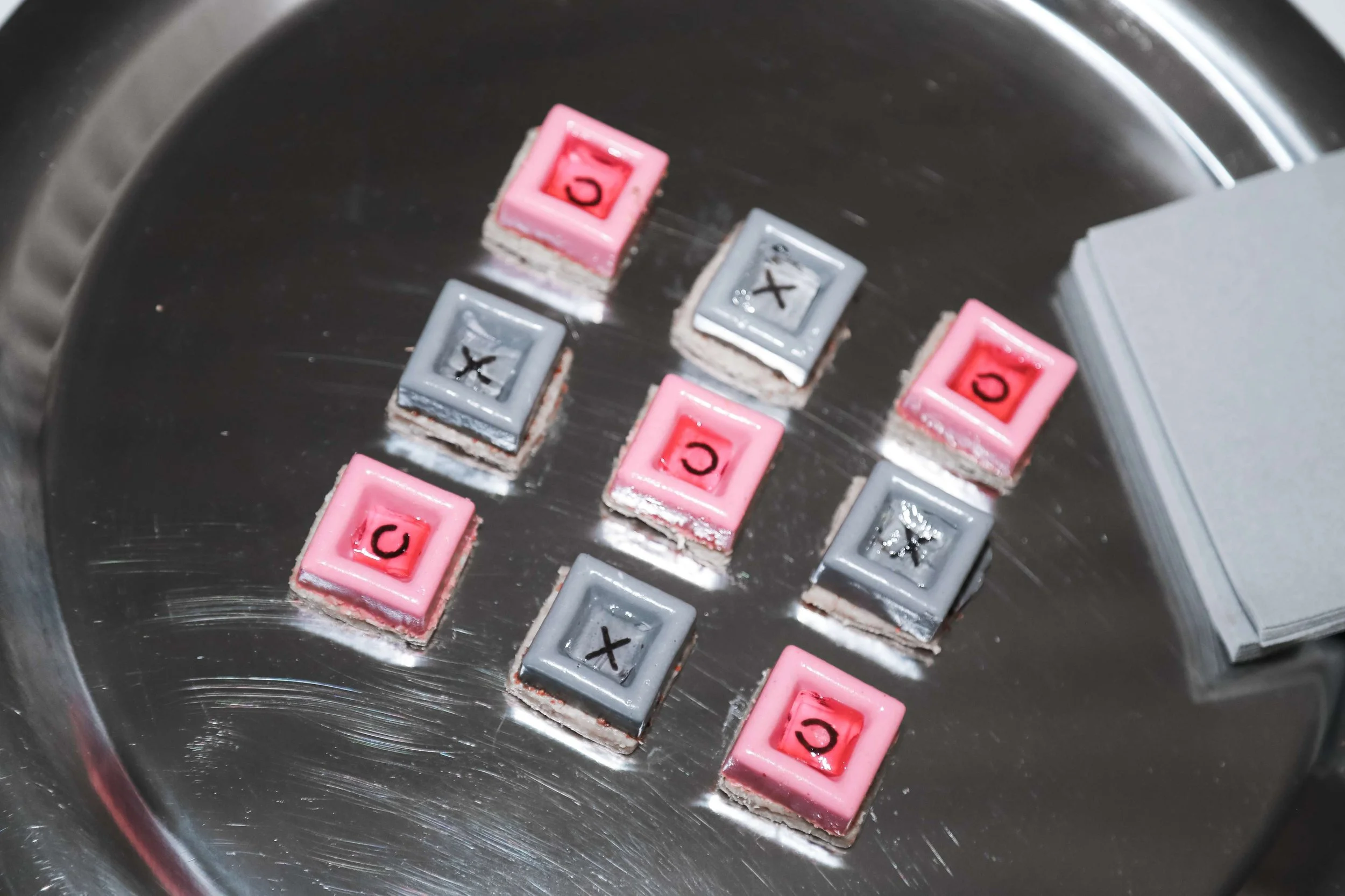
Your new studio at BIM treats the kitchen as an art laboratory. What is the difference between an edible installation and a fantastic buffet?
The edible installation is an experience you are giving. It lets people step away from the nourishment offered in the last ten years by catering in event spaces, where the logic was: I feed people. The moment you install, you also give an experience, you let the person who eats create something more authentic. We always talk about concreteness and authenticity, so you allow people to live food as a different feeling.
And from the project side?
The difference between a buffet, however good or of quality, and an installation is the project itself, how it is born. In one case there is attention to the materials and the shape, but thought in a canonical way, placed on dishes, on flat vessels. When you think of a sculpture, you merge the concept into a language that includes food, but could also include other materials. Food becomes a material, as wood and plexiglass do.
Last question. Which ingredient of the 2000s deserves a comeback?
It makes me think for a moment, because it is not so simple. We carry everything with us, we never forget anything. In our kitchen, all the ingredients that could have been part of those years, we still use today. We even pull out medieval ones to discover new recipes. But if I have to say something: the older pop dyes, probably a bit toxic but colorful. The dyes no longer dye the way they did. They have changed a lot, they are more careful, and the effect is less: white no longer makes white. They turned off the colours, but to keep us safe. Who knows.
Tvdor
What is your practice in general, and what are you currently doing in it?
I'm Tudor Ciurescu, and I like to say I'm based in Europe. I moved from Romania to Switzerland nine years ago to study visual arts at ECAL in Lausanne, both bachelor and master. For the past six or seven years I have also been living in Milan part time, so I like to call myself a millennial migrant. I travel a lot from city to city, which is again very related to my practice, what some people would call post-internet. But when I first started saying my practice was post-internet, that was ten or eleven years ago, when the movement was still very incipient. Nowadays I like to say I do general art, like a doctor who is a generalist. The internet is so embedded in our daily life that everybody is doing post-internet everything, so it is nothing special anymore. I like to say now that my art is more general and more deep. Of course all my works keep a deep connection with the internet, be it memes, be it stories, be it the general vibe of creating symbols that can be seen everywhere and by everybody. You do not have to be from a specific place to get my work. That is also why it matters to me to live in more than one place, to be mobile like the internet, and general.
Thank you. And for this exhibition, was the work already done, or was it made for the show?
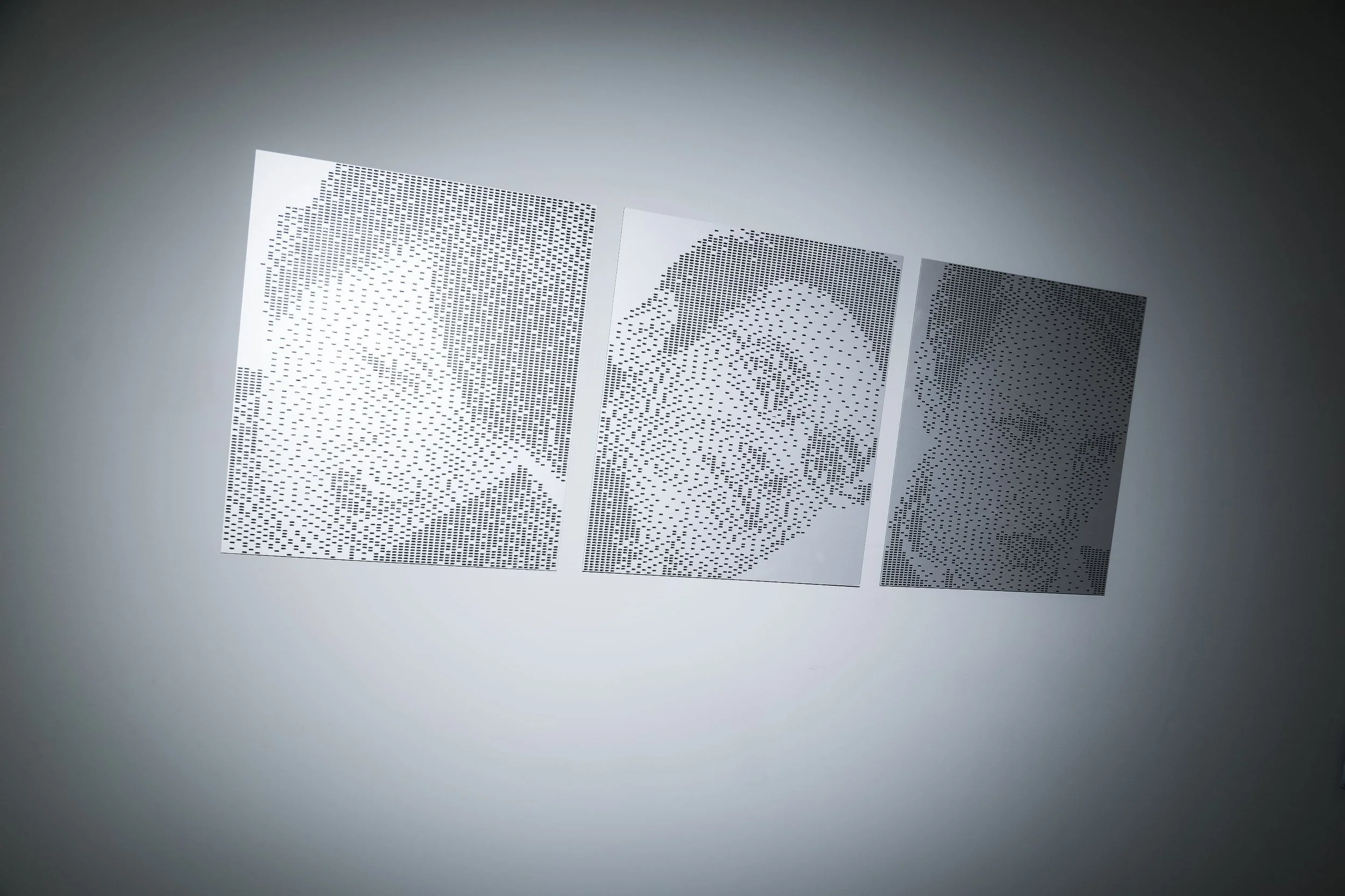
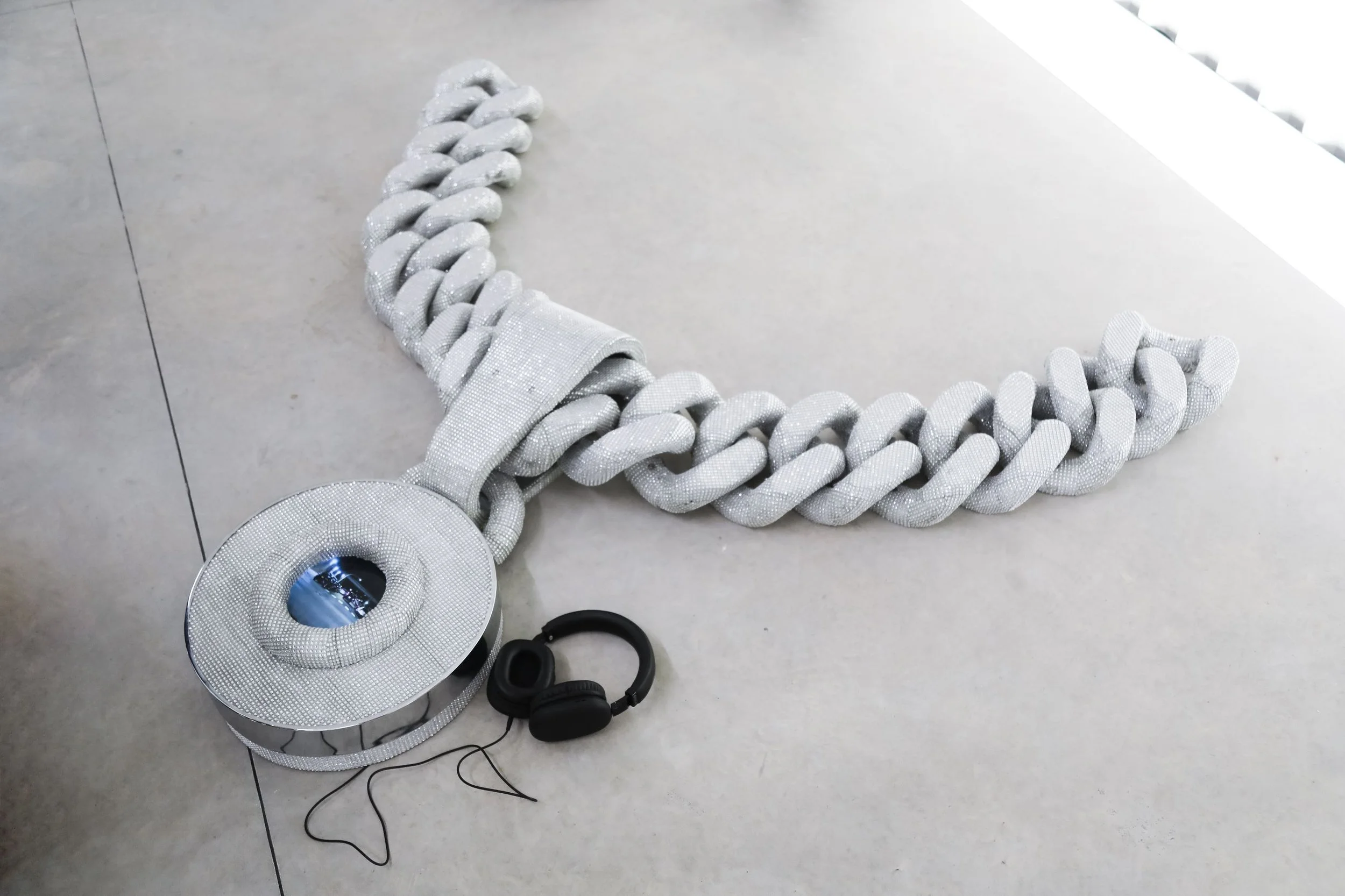
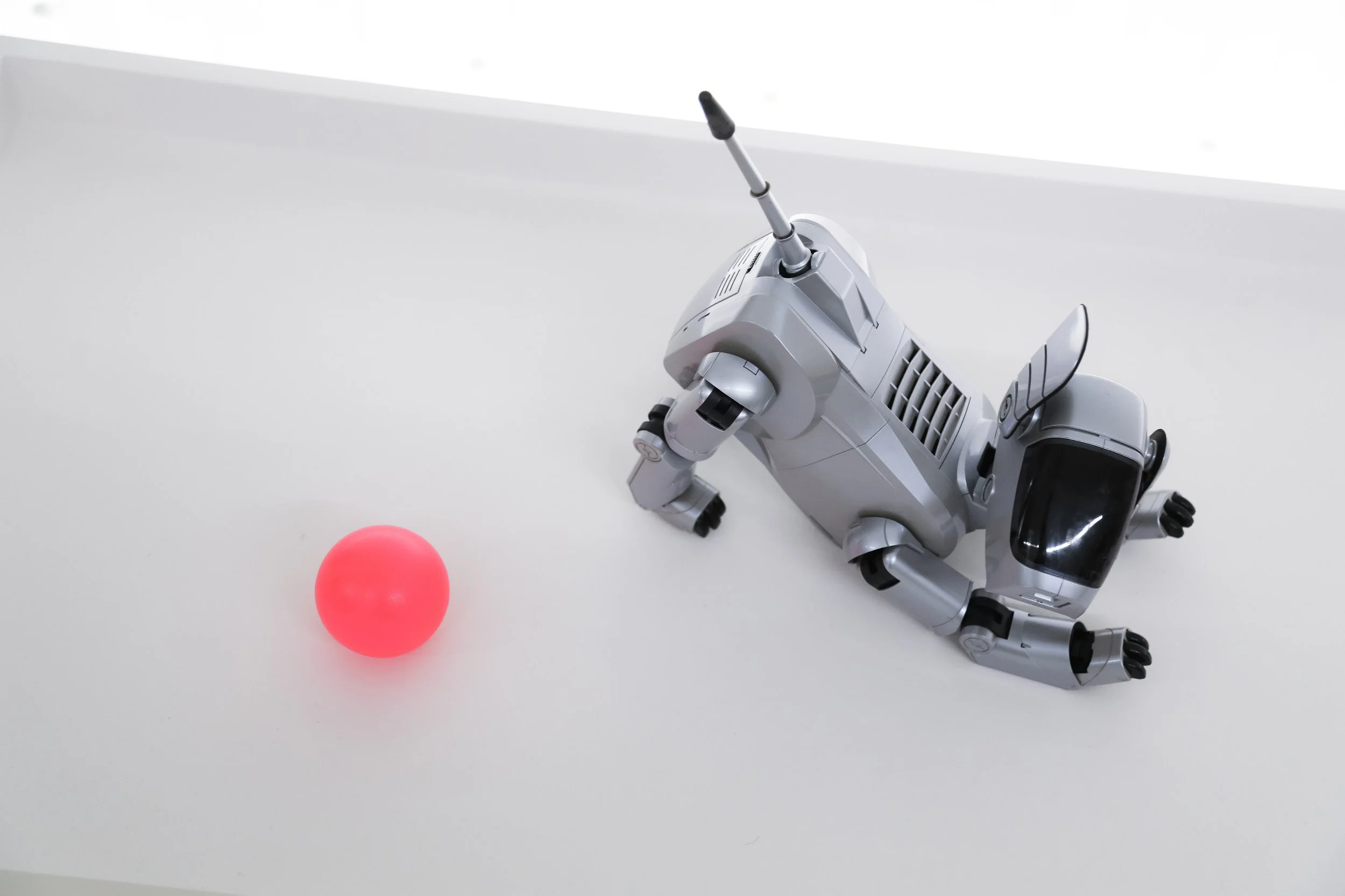
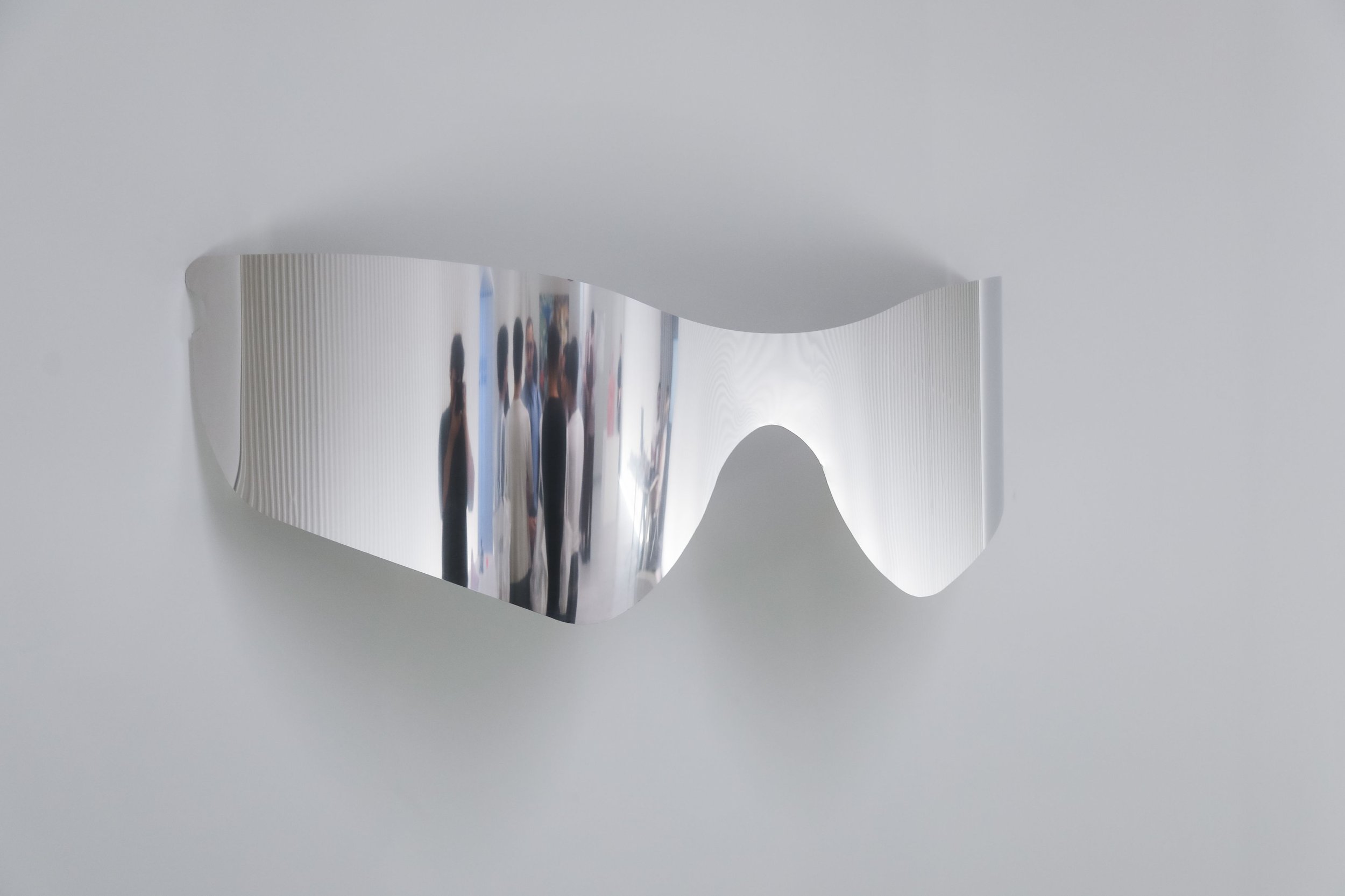
The specific work we are seeing in this show is called Icarus Spectacles. It was made in 2023 for a show at VUNU Gallery, part of Kunsthalle Košice in Slovakia, which was also my first big solo show outside Romania. The work embodies those years through the symbol of these sunglasses, which came from a gas station, sunglasses that were a meme on the internet, a trend. I wanted to embody a symbol that, if you look back at the 2020s a hundred years from now, would be specific to those times. So I chose this sculpture as a unifying symbol for those years.
Very specific to a timeframe. I remember the filters with the sunglasses. Is that the reference?
Exactly.
It makes sense for this exhibition, with a reference to the internet, looking back but looking ahead as well.
And in terms of a more old school reference, I chose Icarus because I thought about how Icarus was reaching the sun and basically needed some sunglasses. That is how I see all this reflection: I made them very reflective, with this mirrored effect, to show how the internet feels, but also how Icarus would feel, in my mind, as he reaches the sun. I always try to work with historical references and contemporary ones, put them together and make them for the future. In a hundred years people will look back and have a bit of both pasts I lived in, the past of the 2020s, but also the later past, like Icarus and all these mythological aspects.
How do you perceive the present time?
It is a hard question for sure. The present is filled with nostalgia, and filled a lot with LARPing. We still do not really know exactly what time we are living in. Specifically now, in 2026, I think we live in nostalgic times, because we have some trouble creating the present that we actually want. Not because of us, but because of the whole system we live in, which makes it harder to create a beautiful present. It is easier to imagine better futures than to create a present. It is a deep question.
I know, but I really wanted to ask you, because I feel that time is important in your work: you looked at the past, and then you looked ahead. So, looking to the future, what are your projects? Are you working on something new?
I have a duo show with Dan Beudean coming up in two weeks in Cluj. In my studio practice I am working to make things more and more handmade, while at the same time still using a lot of AI. In my next works I try to combine new technologies with very old ones: casting bronze, painting, charcoal drawing. In high school I studied engraving, so I try to combine both technologies. I try to make images and objects where you cannot really put your finger on how they were made. The scholars who are interested can figure it out: it is engraving, but it is also AI. There will be no buzzwords in my practice, but for whoever is interested there is a very long process of using analog and digital to make these works. That is what I am working on in my studio practice.
You mentioned AI. In terms of post-internet and post-AI, what do you think about it?
I think it is a new paintbrush, and I think there are ways to make it ethical. I have started creating my own AI bot that uses my own images as references, an Ouroboros type of AI. So it is more ethical.
Tell me more. I know the Ouroboros concept, so is it about loops? Video loops?
No, no. My own bot uses the images from my past works and my past references, so it does not have to steal from other people's work, which is the big problem right now with the current AI models. I am not scared of AI at all. Every time I use it I think of my masters who are dead, and I ask myself what they would do. What would Da Vinci do, what would Brâncuși do, if they had AI? I think they would be super happy. People are scared, and of course it has its own ethical problems, but as creatives we should use it and make it our own. You can make your own AI with your own pictures.
Yes, it is more ethical. Very last question. Can you go a little further and give us more information about this Ouroboros AI? It is very interesting. I am not sure if you can talk about it, maybe it is a new project.
It is not a new project. I started three years ago, right when ChatGPT came out, at the end of 2022. In 2023 I began gathering all my images on hard disks to create this bot, which now holds over a thousand images of my practice, my references, photos I have taken, notes, everything that can feed this Ouroboros: a nonstop creative bot that can create art in my style, or work as a studio assistant, made more ethical. Right now, if I go on ChatGPT and ask for an image reference, the bot uses tiny bits of other people's images to create it. I am trying to reverse that and make the bot use mainly my images. So I become more of a director. I use the AI as a helper for the creative part, but it can also help me with the logistics of the studio, like making crates in the right dimensions. Now that it knows all my work and my practice, it can give good information on how to do it well: I have a show next month, please tell me how many crates I need and when I need to ship. So I work on two sides, the logistics of the studio and the creative part. I think my hand becomes more and more important. Whenever I feel myself getting lazy, I tell myself, no, you have to do it by hand. Then I use it when I need renders for specific projects or ideas. That is my positive thinking about AI: you can make it pretty DIY, pretty punk, and use it for yourself only. You just need a bunch of RAM and some space.
Curated by Countersubject
Photography by Antonio Giancaspro
Interviews by Clarissa Despota
What to read next