Rabin Huissen
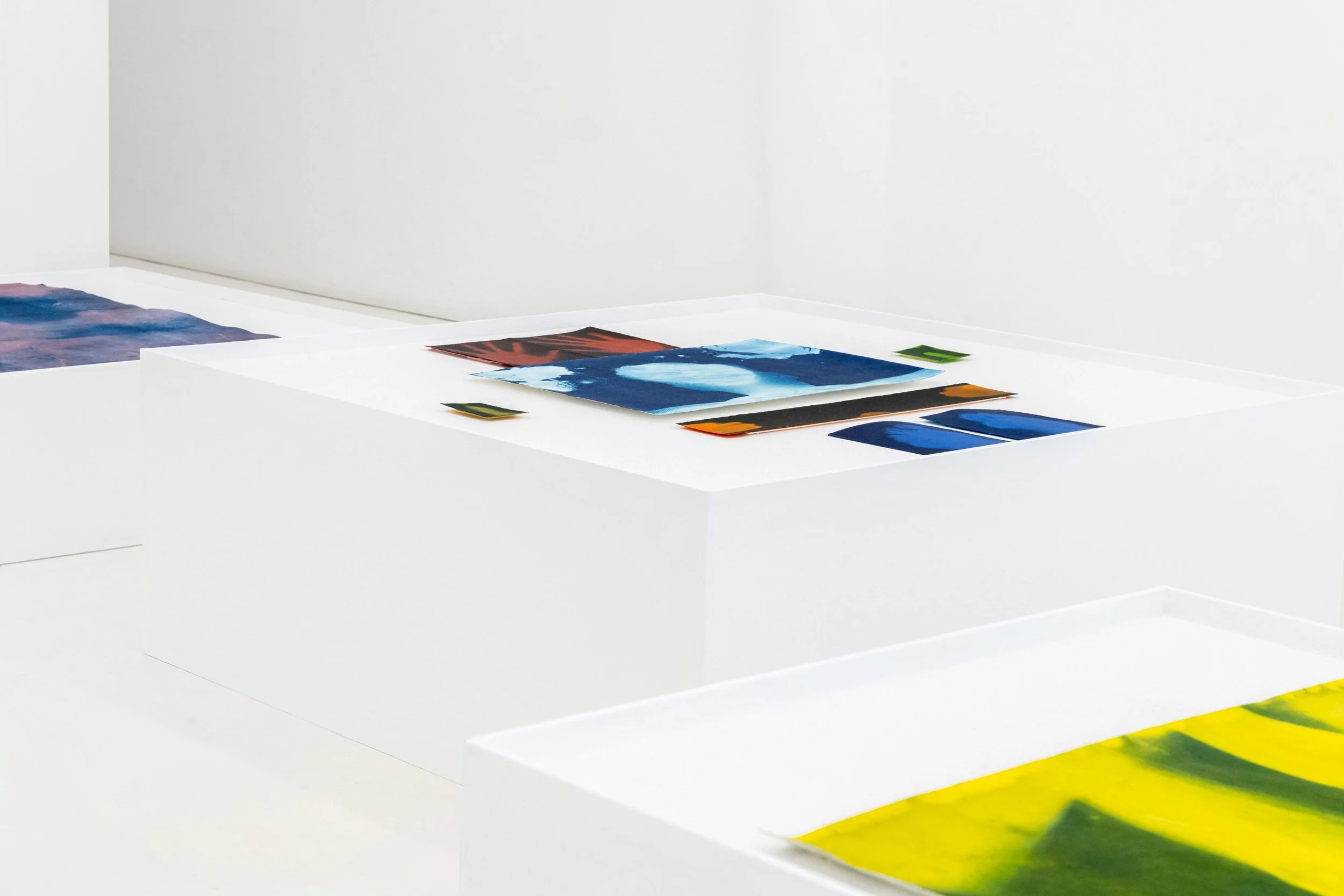
Rabin Huissen’s practice is a ritual in itself, and its instruments are time, memory, and the fragile imprint of the human form. The artist traces the origins of his process back to an early experience with repetition and transformation, where repeating the same action over and over again illustrated that no gesture is ever truly identical. That memory still exists within his meticulous scripts and photogram processes, which attempt to capture passing moments against the steady beat of time.
Ultimately, his work exists at the intersection, which defines presence and absence, with the body acting as both subject and witness: fragile, impermanent, yet capable of leaving traces that outlast physical existence. By surrendering to light, atmosphere, chance, and collaboration, the artist steps away from predictable constructs of authorship and toward something more visceral and uncertain. Whether acted out by himself or carried out through others across different places and encounters, each work becomes an embodied account; a quiet performance between the body, time, and the elemental forces that continue to guide both.

Rabin, your artist biography, explains that your works are products which are born from ‘meticulous rituals’, where you follow a script with instructions you dictate for yourself and others, in order to chronicle movements in time. How do you understand your practice as speaking to the mortality and immortality of the body?
Looking back at the beginnings of my practice, I see that these meticulous rituals and scripts were always a way to gain a foothold in the elusive flow of time. My work finds its origin in a quiet, sensory moment in kindergarten. I remember the sacred concentration of the school circle as we, following the teacher’s exact sequence—the script—dipped our right hands one by one into the cold plaster. I watched twenty-six classmates perform the exact same ritual. What struck me deeply even then was how that liquid mass solidified around each person's skin in turn, while the outcome remained unique for every child. In that fluid act, I now recognize the essence of 'performance': a fleeting moment of presence that vanishes instantly. It is the ultimate expression of our mortality. But the imprint left behind functions as a form of photography: a physical registration of a touch, frozen in time through the interference of matter. My right hand is now grown and sculpted by life, but that plaster cast—which hung in my mother's pantry for years—remains unchanged. It is the catalyst that repeatedly carries me back to that childhood. In Japanese culture, it is believed that objects can acquire a soul; I believe in this too. My work is the ensouled registration of a body that was once there.
By capturing movements in my photograms now, I grant those moments a form of immortality. The script serves as the necessary riverbed. In daily life, we constantly wear masks and roles that surround us like a shell, but within the ritual of the script, those roles fall away. At that moment, a direct dialogue with light and the elements emerges. The photogram records the interference of that encounter; where my physical body is transient, the imprint of that pure, maskless presence remains. Searching for that immutable core, I try to shield the magic of life from oblivion and leave a trace that transcends time.
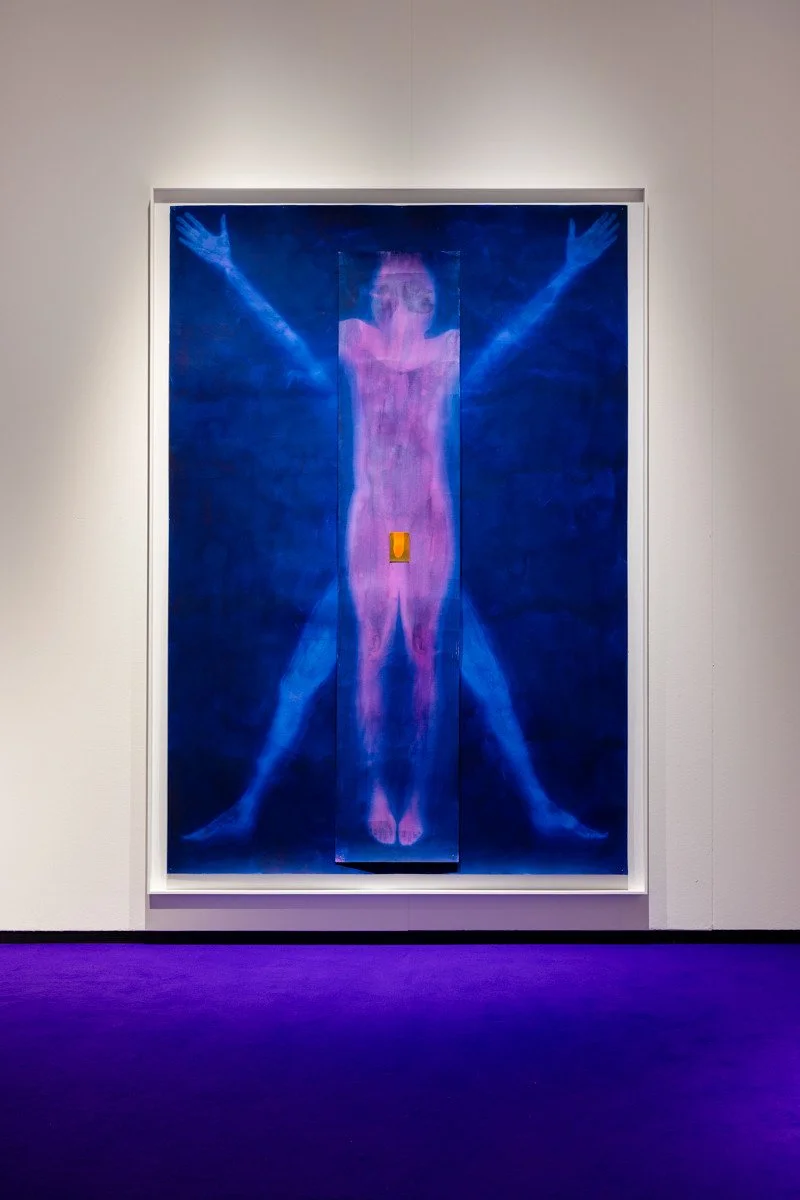
“By capturing movements in my photograms now, I grant those moments a form of immortality. The script serves as the necessary riverbed. In daily life, we constantly wear masks and roles that surround us like a shell, but within the ritual of the script, those roles fall away.”
Do you see the work as resisting the body’s mortality by becoming communal and shareable, or does this diffusion introduce new forms of fragility, loss, and transformation that further complicate ideas of permanence and disappearance?
When my practice is enacted by other bodies, I do not see it so much as a resistance to finitude, but rather as an embrace of vulnerability. My fascination with this began in that kindergarten classroom: twenty-six classmates followed the same script, yet the outcome was unique for every child. My scripts for others—such as my mail art, letters, or postcards—are built on a deep level of care and trust. I am asking for a favour; an action performed by the other that completes the work. Everything happens at a distance, rooted in a mutual trust that builds and deepens our relationship.
I find a foundation for this in the thoughts of the French phenomenological philosopher Merleau-Ponty: the body is the subjective bedrock of our experience. When my work is performed by others, it becomes part of their unique 'lived body.' The instructions are like a musical score, but the performance is a living memory passed on physically. In that process, an echo is created that travels through time, yet also slowly fades.
This diffusion does indeed complicate ideas of permanence: the work is no longer a static object by a single maker, but a pulsating process that 'resurrects' in a different form each time. It emphasizes that beauty lies precisely in the transience of the encounter. The imprint and the DNA of the others that remain are proof of a shared vulnerability; the work survives precisely because it is allowed to be transformed by the touch and the soul of another.
Your process takes the body out of, and back into, the world, and you describe the blueprints as ‘evidences of an intimate body experience, which reflect on a personal encounter based on travelling out of daily life, undressed from social roles or masks/.’ Can you speak further to this?
For me, the creative process is a necessary escape from the noise of daily life. In our society, we constantly wear masks and fulfil social roles that define us but also confine us. When I execute my script and surrender my body to the elements, those roles fall away. In that moment, I am no longer an artist, a citizen, or a son; I am simply a present body in a direct dialogue with light and time.
The creation of these photograms is a process of revelation. By withdrawing into this intimate ritual in various locations around the world, I strip away social expectations and return to a state of pure, raw experience. The blueprint that emerges is the tangible evidence of that maskless encounter. It is a registration of a moment in which I was completely 'free' from everyday structures, without being judged.
Precisely by placing myself outside of society for a moment, I am able to return to the quotidian with a renewed clarity. I carry the experience of that deep, intimate silence back with me. The work functions like an anchor; it reminds me that beneath all those roles and masks lies an essential core of being human—one that is immutable and connects us all.
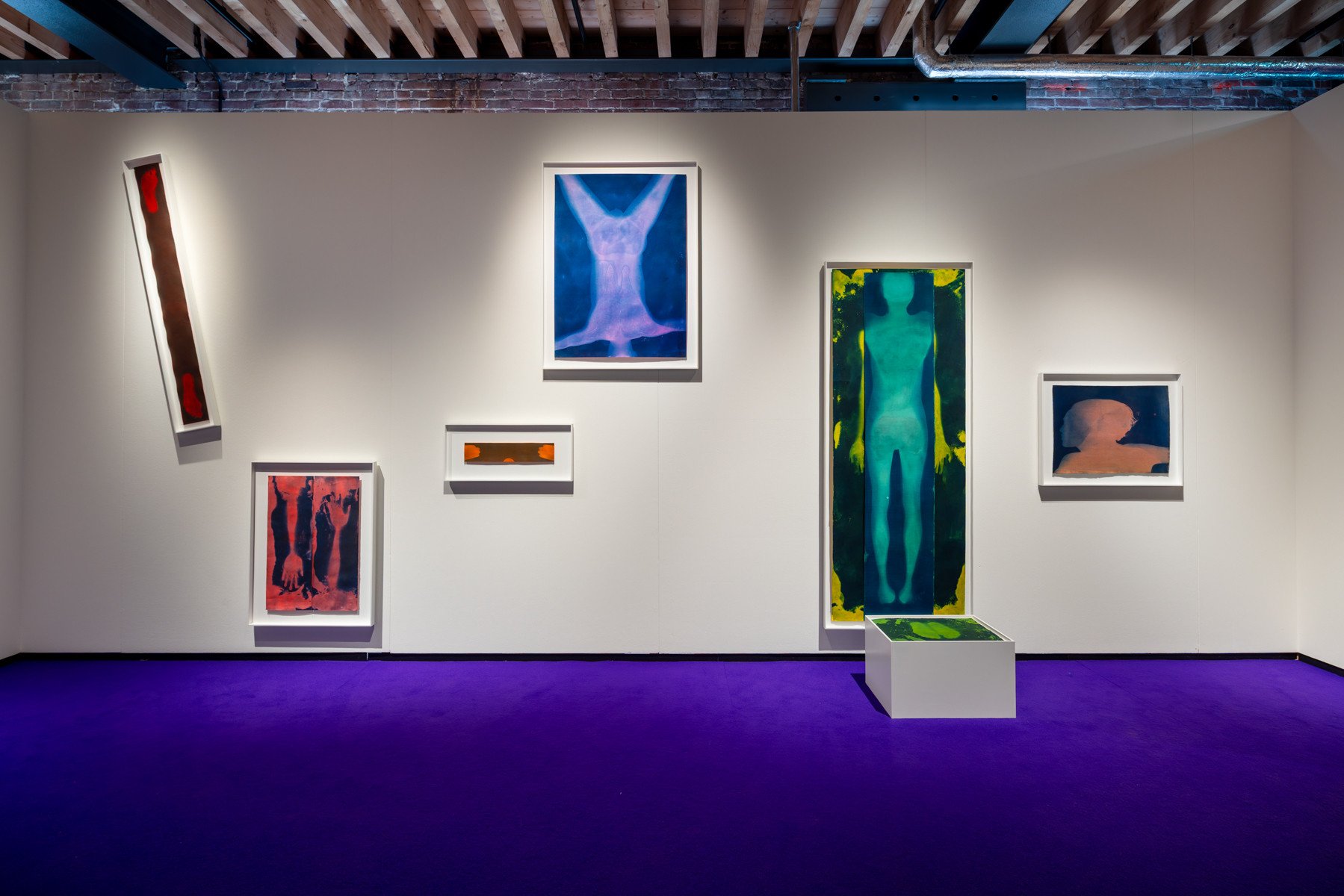
What also really intrigued me is your explanation that ‘at the same time this event was occurring, on that precise point in time, something else was happening to someone else and the work moderates and connects this simultaneity.’ Is there a place for karma in your artistic ideology, or do you appreciate these convergences as carefully handled coincidences?
I believe that fate, destiny, and chance coexist effortlessly. As a Taoist, I see everything as a living network in which all things are interconnected. It intrigues me boundlessly that at the precise moment I create a photogram, something essential is happening to another body somewhere else in the world. My work functions as a moderator of that simultaneity; it is an anchor point that connects these parallel realities.
To me, these convergences are not mere accidents, but cherished synchronicities. I try to accept things as they reveal themselves, without losing myself in the question of 'why.' My photograms do not just record my own presence; they resonate with the invisible energy of those other events occurring at that same moment. In that sense, my artistry is a pursuit of unity and wholeness: a way to demonstrate that, despite geographical distance, we are always in correspondence through time and matter.
Are you more concerned with preserving a single occurrence as a stagnant point in time, or with conceiving conditions for duration?
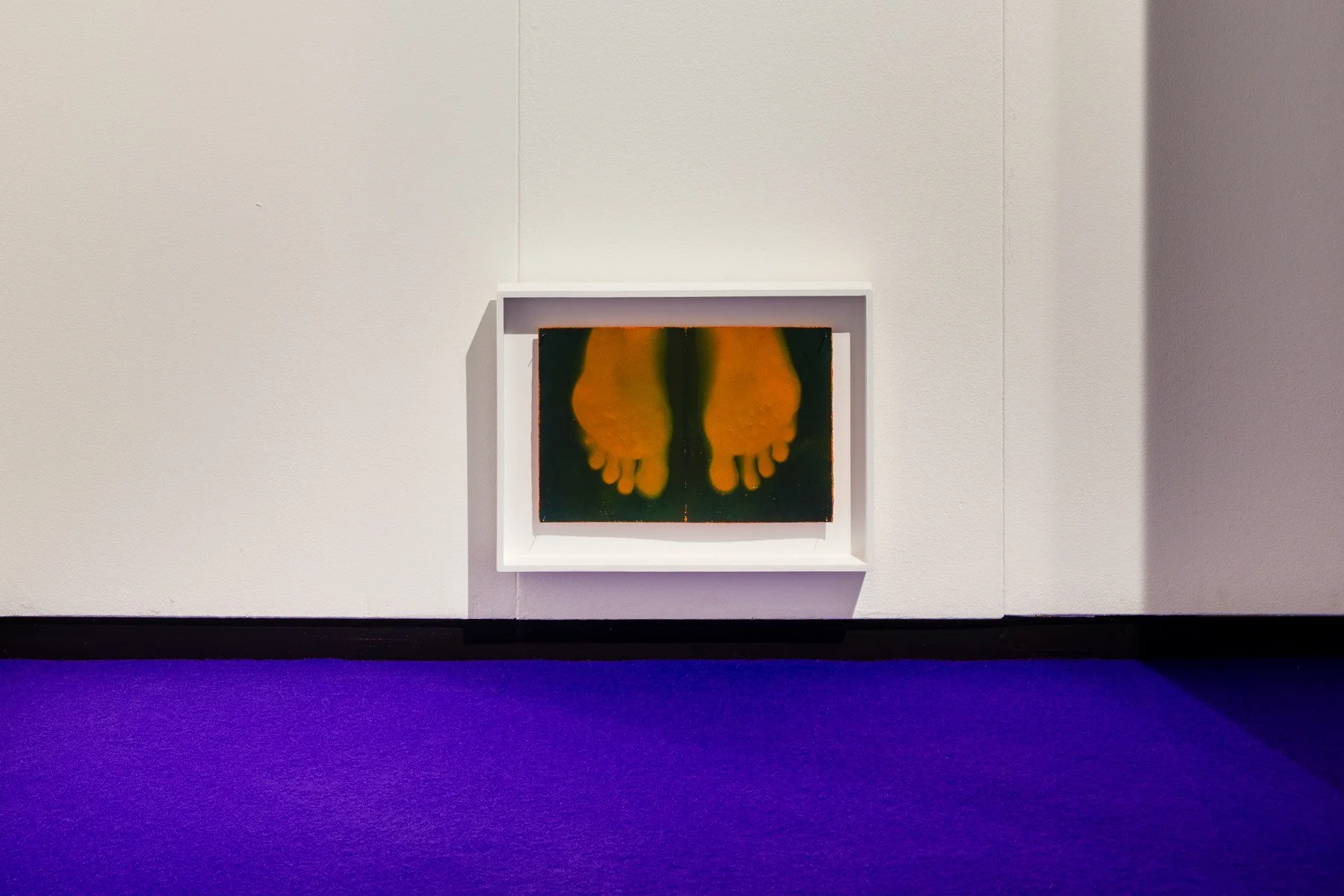
In my practice, I do not strive to freeze a static moment, but rather to create the conditions for duration. I do not see the paper as a dead surface, but as a sensitive skin—a membrane that truly absorbs the invisible factor of time. By immersing it in the emulsion, it becomes a living organ that opens itself to the world.
The paper literally remembers the day. It holds the memory of the interference of the incoming light, the atmospheric tension, and my own physical proximity within its fibres. When I paint the photograms with colours intuitively attuned to that specific day, it feels like applying a new layer to that skin. It is a fusion of chemistry and emotion that transforms the fleeting nature of the moment into a lasting, tangible presence. To me, the artwork is therefore not a still image, but a time capsule that continues to breathe. The paper functions as a physical repository; it does not merely carry the memory of a unique encounter but continuously radiates it in the here and now. It is a remnant that does not just depict the day but embodies it in its very essence.
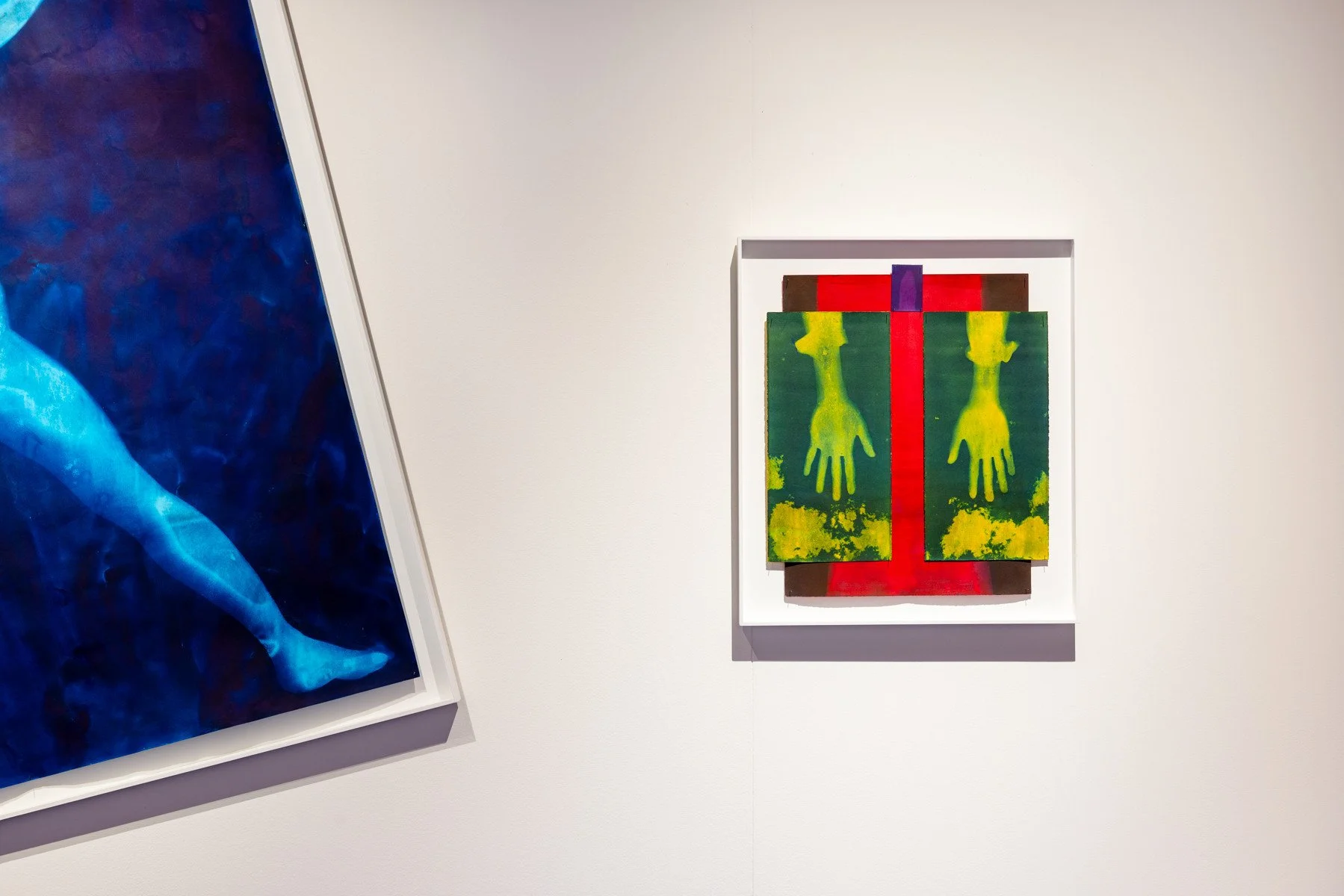
You’ve said that ‘natural conditions such as the sun, the wind, the temperature, sand, dust and water interfere with the process’ and that ‘these conserved moments are then collected and archived in boxes, as a closure of the process.’ Can you speak about the practice of enclosure and disclosure more closely here?
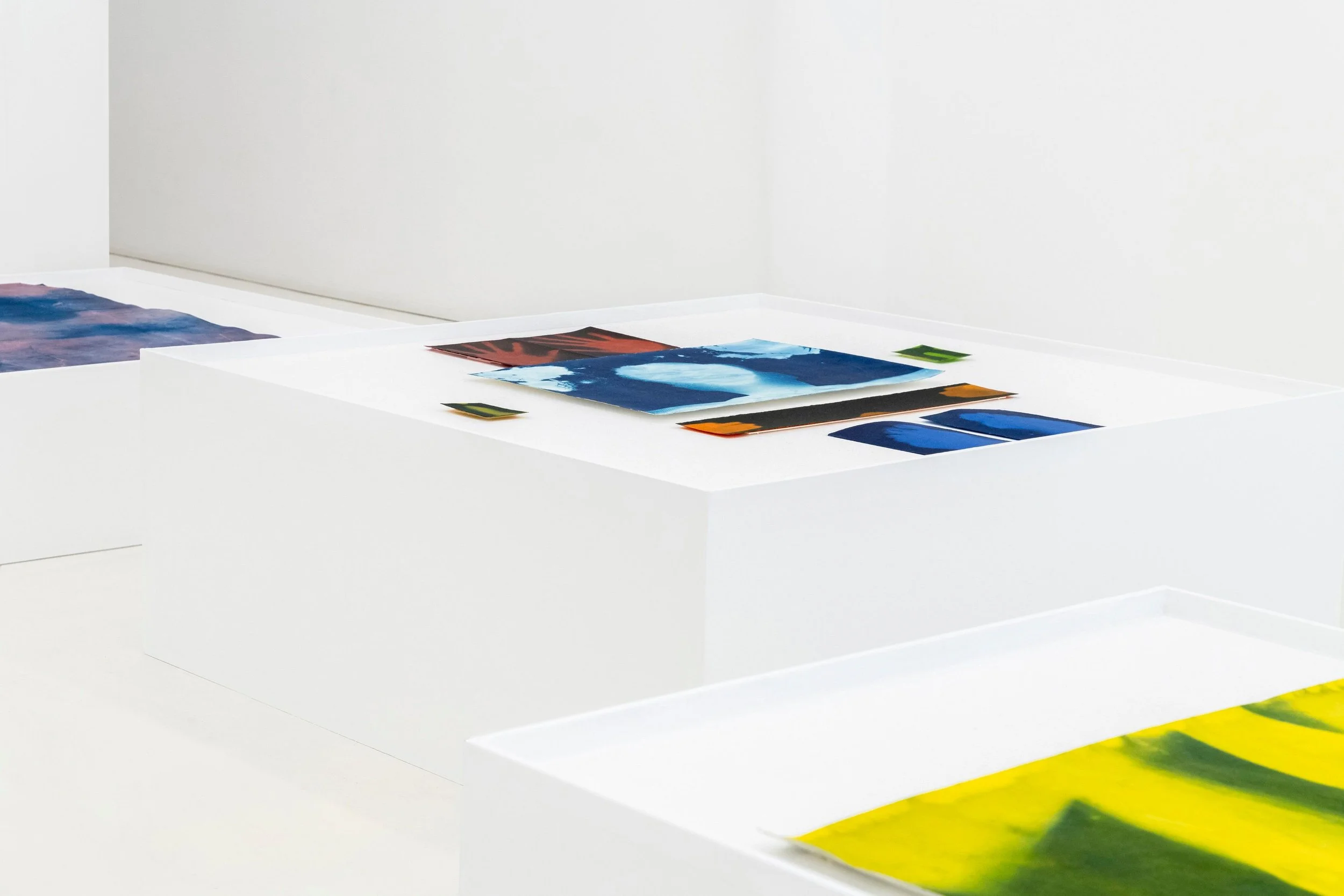
For me, the process of enclosure is the necessary completion of the dialogue with the elements. When I work outdoors, I expose my body and the paper entirely to the sun, the wind, and the dust—a moment of ultimate expansion. Placing them in the white boxes afterwards feels like an act of nurturing.
The box functions as a protective shell; it guards the autonomy of each unique moment and prevents one day from being compared to another. Every day possesses its own unique light and emotional resonance; by enclosing them, I give each moment the space it deserves. Through this chronological timeline, I am building a tangible archive of my personal history. As I age and grow in my artistry, this archive grows organically with me—a unique collection of filled boxes documenting my evolution and the passage of time. The box compels us to give undivided attention to what has been ritually set apart from the rest of the world. It is the place where the extreme openness of the making transitions into the privacy of memory, waiting for the moment when the silence is broken once again.
Does this gesture of conserving these moments of natural interference in boxes, then exhibiting them in cabinets and on tables, indicate a form of enclosure? Or is it better to comprehend it as an intentional pause, a protection from entropy, and a gentle resistance to disappearance?
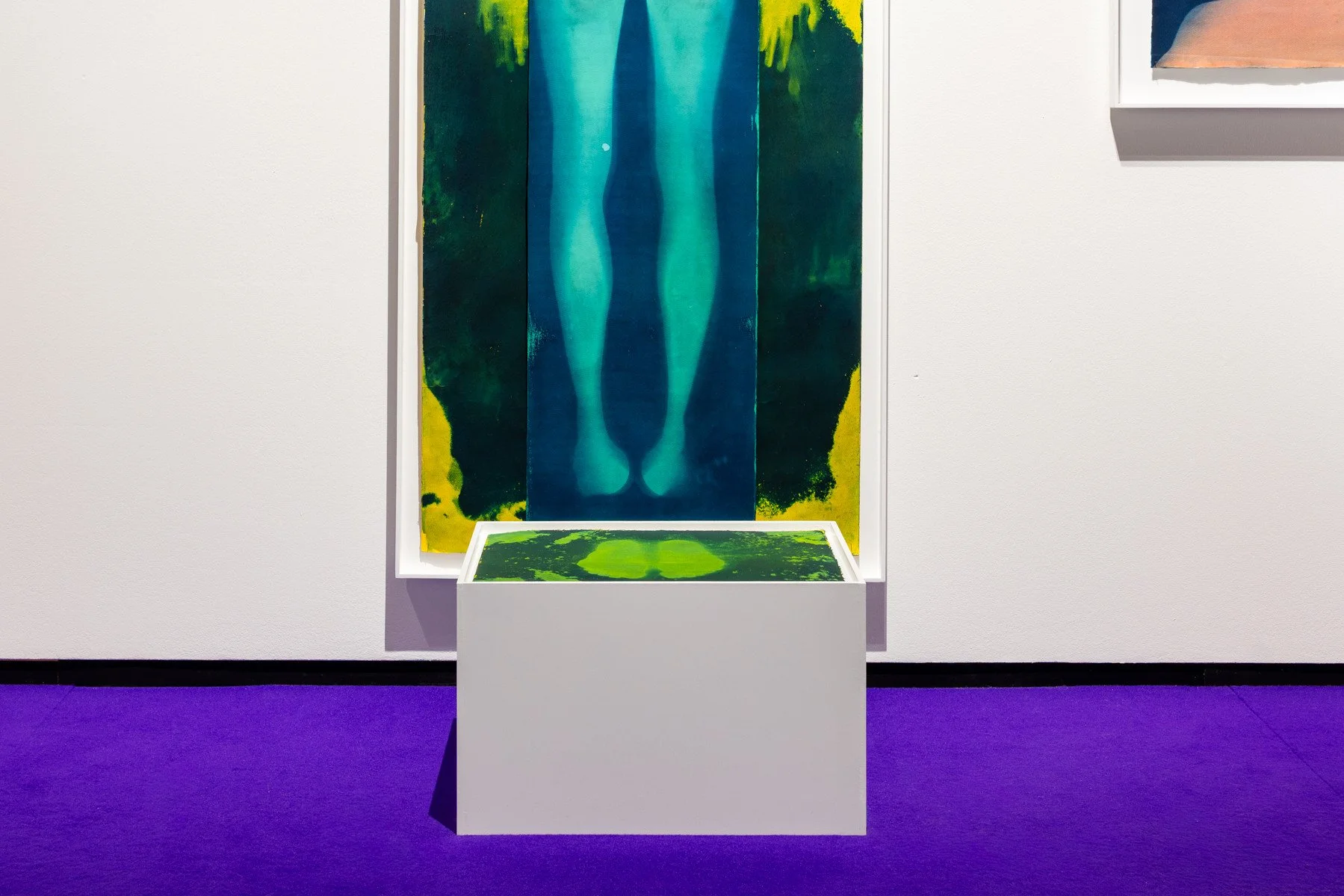
I do not view exhibiting the work on tables, in vitrines, or on walls as a form of enclosure; in a world of constant transience, it is precisely an intentional pause. It is a moment where memory no longer flows away but is held within an intermediate space—a gentle resistance against disappearance. For every presentation, the handmade white boxes are carefully curated based on the concept of the exhibition. In this public space, the work reveals itself through three stages of disclosure; one could see it as three works in one, becoming visible to the viewer layer by layer.
It begins with the selection and composition of the boxes; the stillness they radiate, the notations on the lids, and their physical dimensions already bring the scale of their origin to life in the imagination. The archive on the table thus becomes a living stage—a silence that is only broken once I, a host, or the gallery owner open a box. This choice is purely intuitive, attuned to the person before us and the contents of that specific box. The content is the unfolding of a memory; a gesture we only make if it truly contributes to a conversation, in order to be in contact and search for potential commonalities. Through this, we can become emotionally connected, building a relationship or—at that specific moment—sometimes even allowing it to wind down.
Contrastingly, when these boxes are disclosed to a viewer, what is resurrected? Is it the initial encounter with the elements, or a new, contingent encounter which has been influenced by perception, recollection, and time passing through a different anatomy?
Opening a box triggers a unique awakening where two worlds converge. On one hand, my own memory is resurrected; the light, the day, and the ritual of that time become tangible once more. At the same time, I surrender that moment as soon as the work is confronted with the unique presence of the person standing before me.
By orally clarifying the memory that clings to the work, I function as the conduit to this history. Because I have lived through the moment of creation myself, I am the one who can convey this final phase of the work—its intimacy. My voice becomes the sounding board that breaks the silence of the box; an activation where my original memory merges directly with the history and the 'now' of the other.
It is precisely within that shared vulnerability that we seek recognition. Whether the encounter takes place on tables, in cabinets, or on walls—our histories flow into one another there. The work moderates and connects the wondrous simultaneity of moments occurring in parallel. What truly awakens is a profound awareness: we are no longer separated by time or distance, but connected in a unique, collective presence.
“Opening a box triggers a unique awakening where two worlds converge. On one hand, my own memory is resurrected; the light, the day, and the ritual of that time become tangible once more. At the same time, I surrender that moment as soon as the work is confronted with the unique presence of the person standing before me.”
Is the act of sharing a concealed moment a way of extending the intimate experience into the public realm? Or are you more concerned with inviting the viewer to inhabit a terrain where the secret, itself, exists between a state of presence and absence?
I do not see my practice as simply 'transferring' a private experience into the public sphere, but rather as inviting the viewer into a terrain where the secret is allowed to persist. Sharing a concealed moment is, for me, an act of trust. By opening the box, I bring the intimate experience outward, yet the essence of that moment always resides somewhere between presence and absence.
Precisely because the moment of creation—the sun, the wind, my breath—has passed, an unreachable part remains. That is the secret. When I 'activate' the work by speaking about it, I am not seeking full disclosure, but a symbiotic relationship with the viewer. I share the contours of my experience so that the other can find space within them for their own feelings and memories.
Ultimately, it is about meeting each other on the threshold of that secret. We seek recognition in our own vulnerability and mortality. My work, therefore, is not an explanation of the private, but an invitation to the public to pause together and reflect on the beauty of what is simultaneously present in the object and absent in time.
Photography by
Interview by Sabrina Roman
What to read next