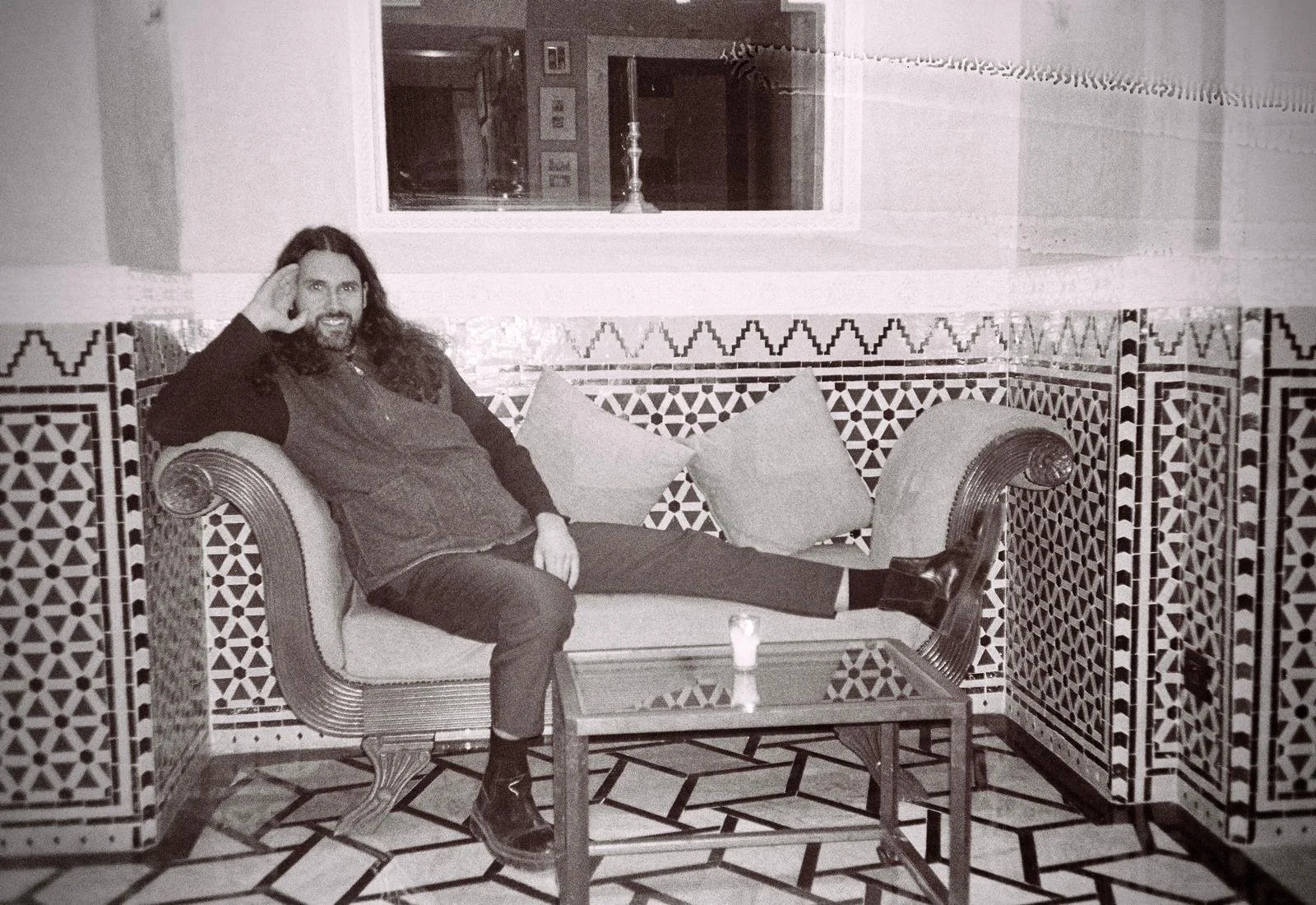
William Victorino
William Victorino's path to sculpture began somewhere else entirely: in paint. For seven years at the Beaux-Arts de la Ville de Paris, he studied figurative painting and life drawing under two mentors, absorbing the physical language of Jackson Pollock and Franz Kline before turning, as a French Brazilian, toward the geometric restraint of concretismo and artists like Hélio Oiticica. It was Claude Rutault, the French conceptualist who built entire protocols around a single painted frame, who gave Victorino permission to ask what a painting could become once it stopped hanging still.
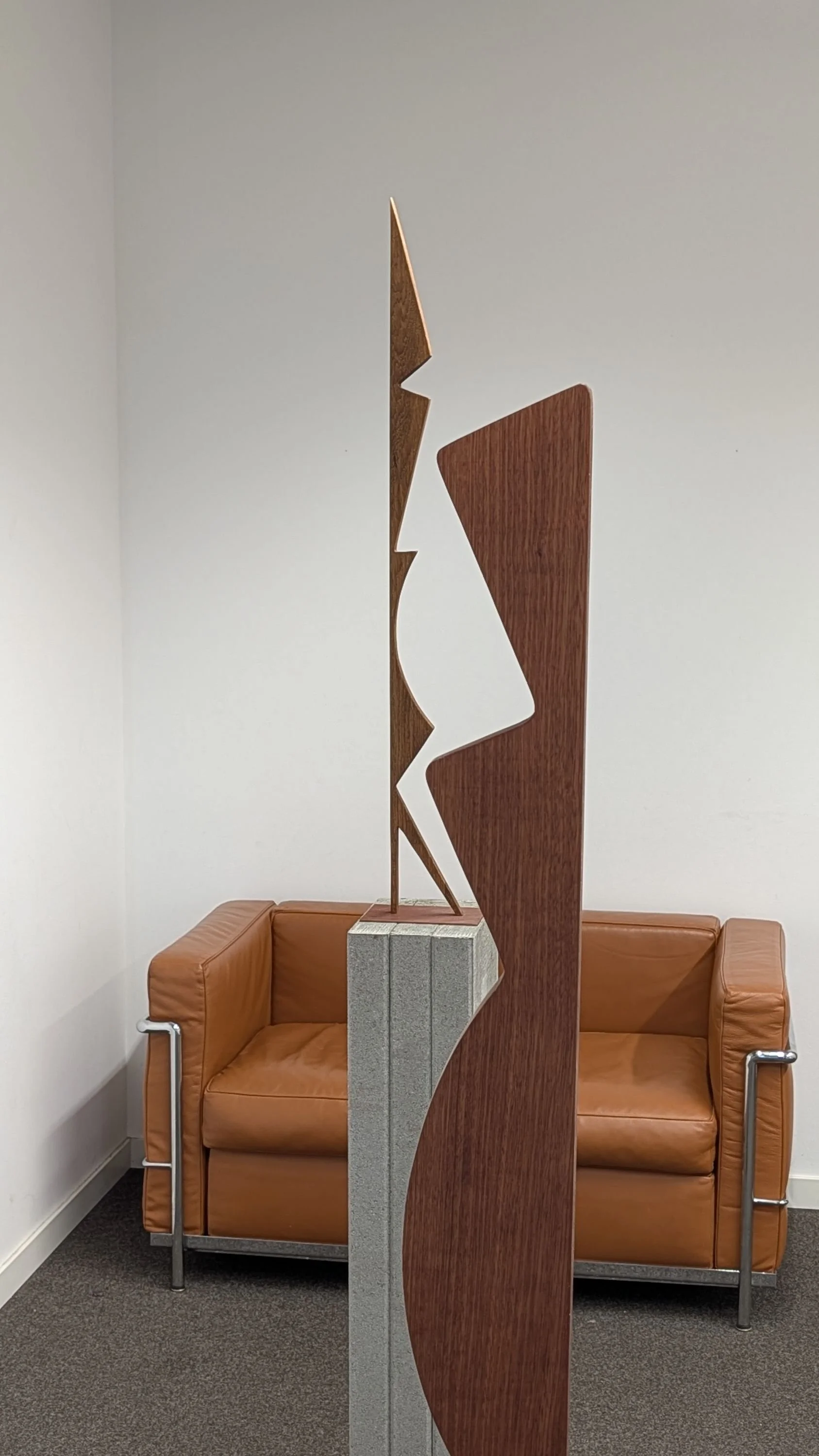
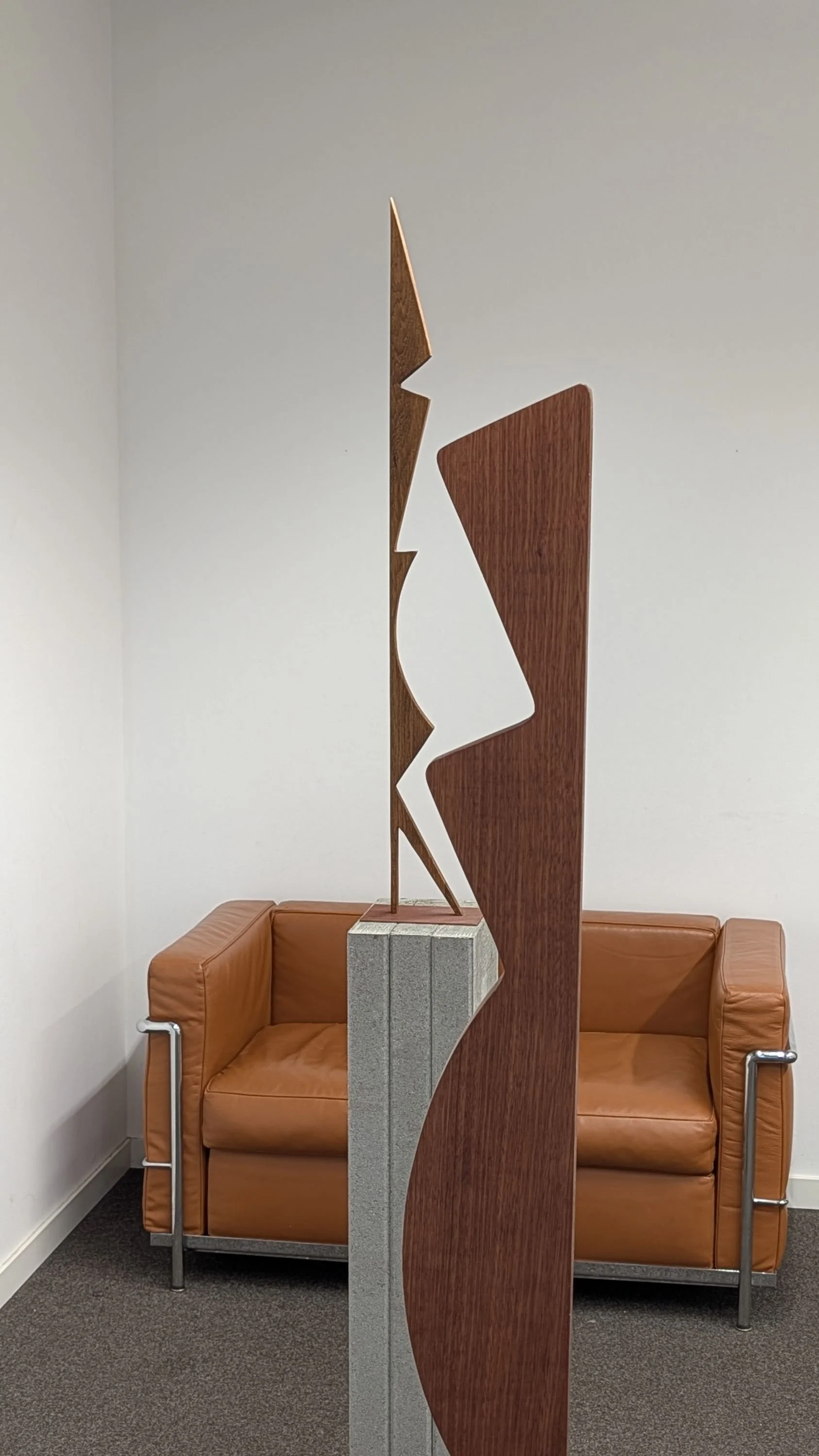
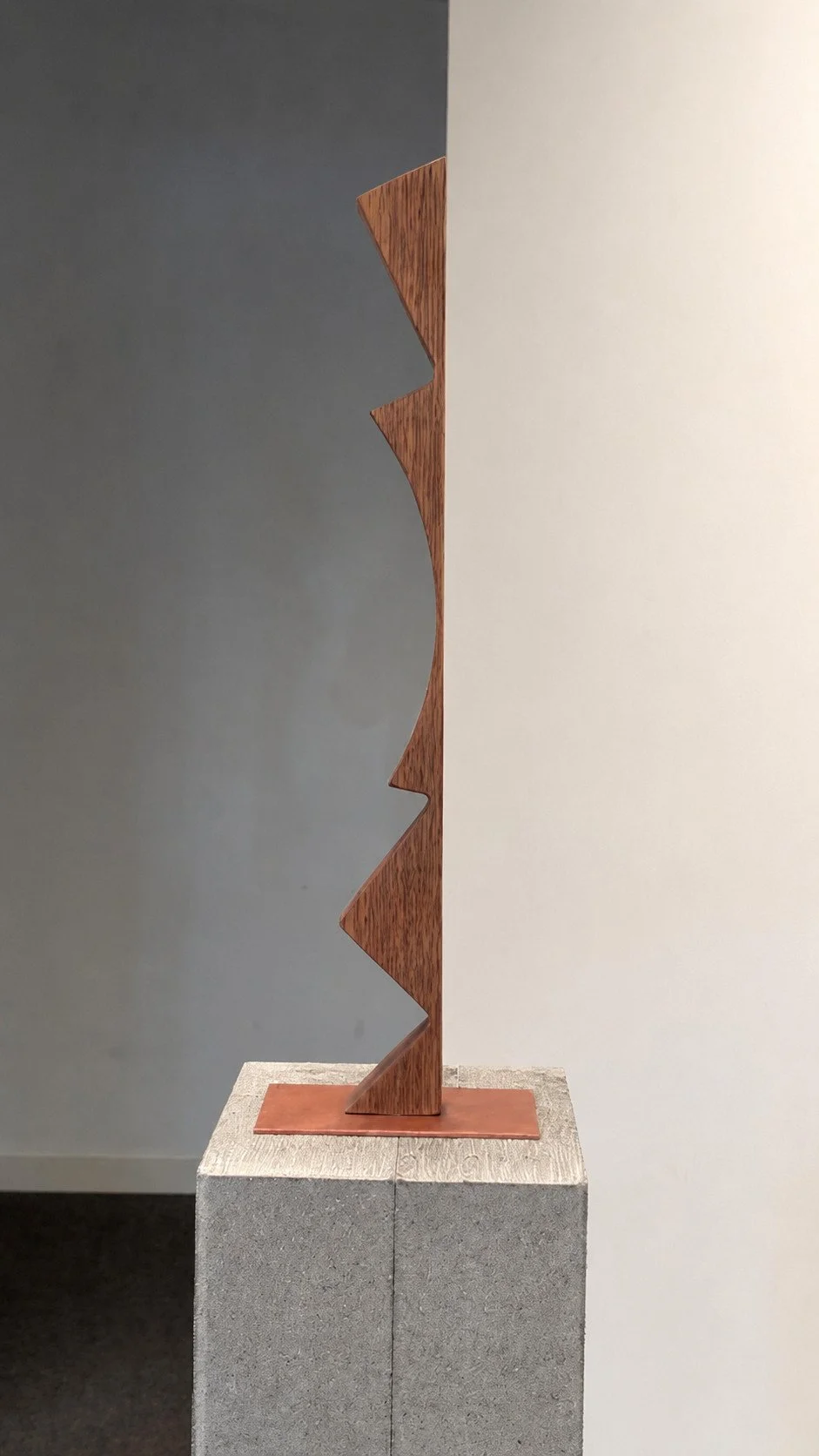
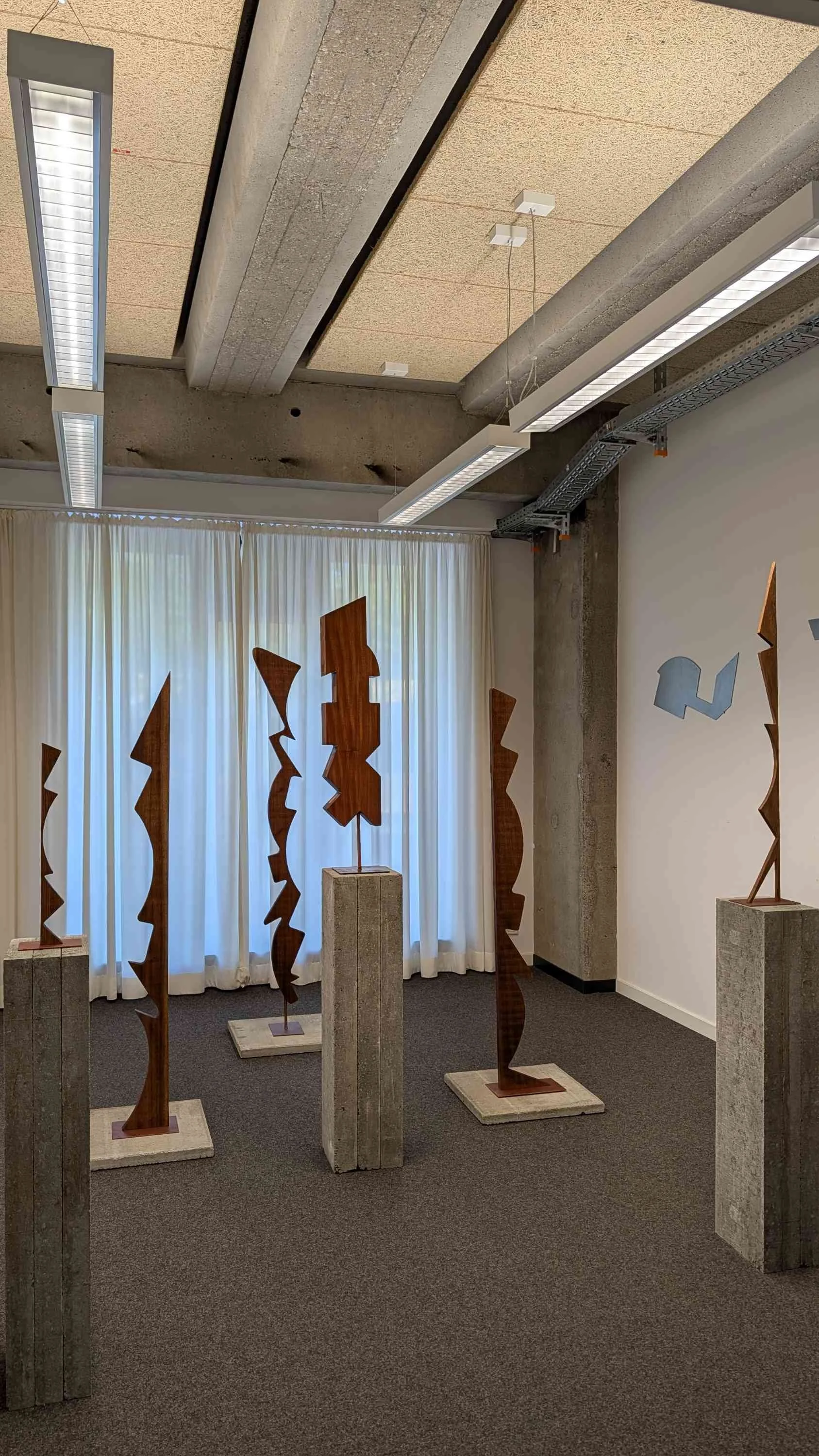
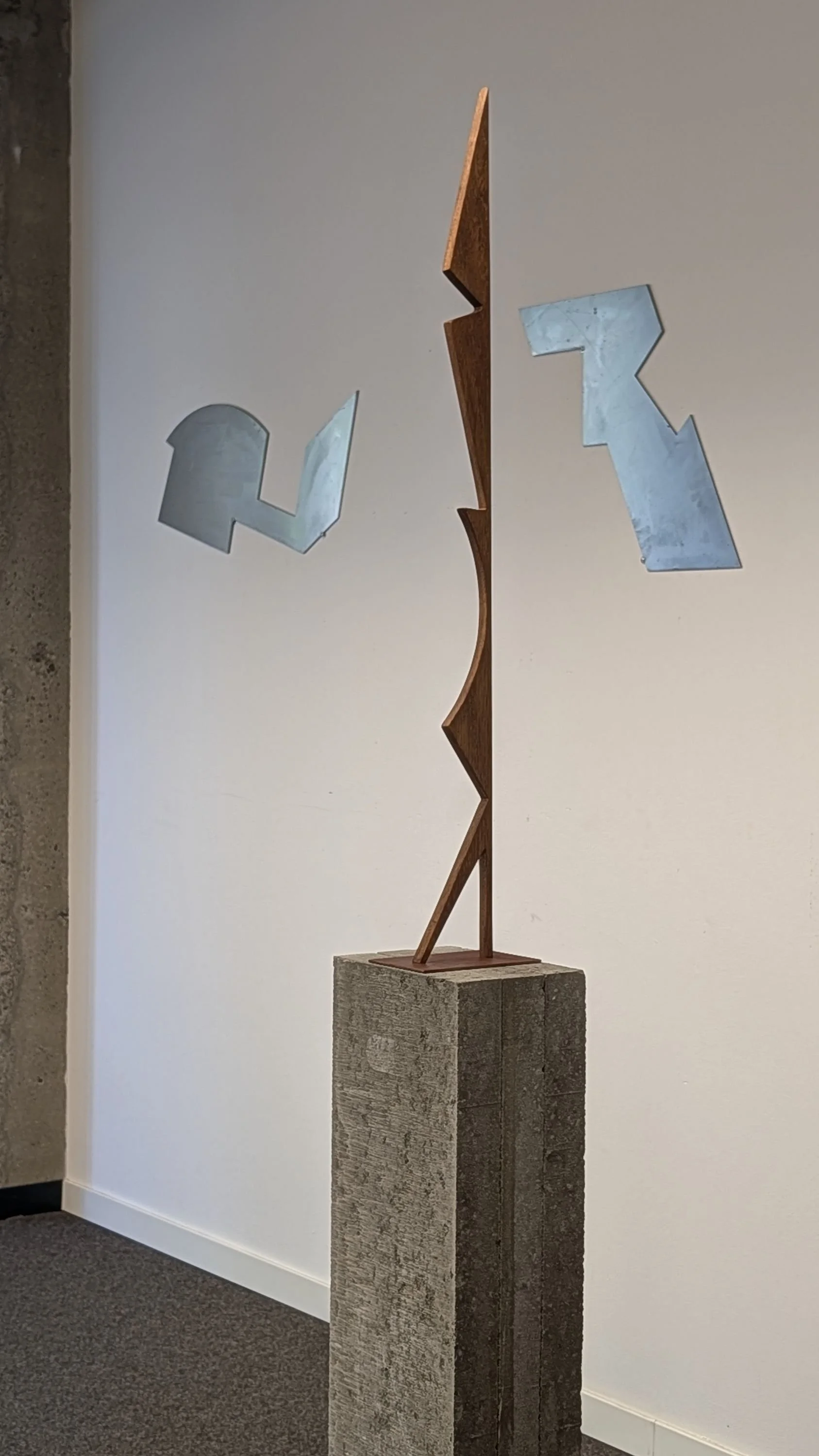
His answer arrived through carpentry. A summer with Les Compagnons du Devoir, France's storied artisan school, taught him to run machines rather than imitate craftsmen, and the square frame he had painted around his canvases for years slowly detached itself, first into steel, then into wood. What remains are fragments of that original border, cut with lines four millimetres wide and sanded until the surface reads like skin. He sources wood the way a chef sources produce: Paraju in Brazil, Dibétou in Morocco, Sipo from Congo when oak in France began to feel exhausted, always local to the place the work is made, never lacquered, never hidden behind glass.
The pieces are built to be handled, collected in fragments, and rebuilt by whoever owns them, a continuation of Rutault's idea that a work belongs less to its maker than to the community that keeps remaking it. Victorino's next ambition is architectural: a sculpture at the scale of a building, turning with the sun.
Let’s start from the beginning. Where do you come from, and what shaped your early interest in art?
I grew up in a family where art was simply part of who we were. My mother was a tattoo artist, my grandmother worked as a designer, and my father was a leather craftsman who made bags and similar pieces. I grew up surrounded by that environment. My mother was also a collector of comics, dystopian worlds and strange, singular artists, and we used to copy them together, almost as a kind of training.
With my grandmother, since I was living in Paris, I had the chance to visit all the museums, and she developed something very strong in me. By the time I was in primary school, I already wanted to be an artist, a painter. It stayed in my mind as a dream. I am French Brazilian, my father is Brazilian and my mother’s side is French. My name is William Victorino, I was born in 1988, and that is how it all started.
You mentioned you do not hold a diploma from an art school. Can you tell us about your actual training?
I followed a two cycle program of drawing and painting that lasted seven years in total, three and then four, at the Beaux-Arts de la Ville de Paris. It is the kind of course you can take without receiving a diploma at the end, but I did it for seven years under two mentors who became my key influences. The first focused mostly on figurative painting, the second on drawing, sketching from live model. My career had not started professionally yet, but those seven years were already shaping the direction I wanted to take.
When we first met, your work was quite different from what you do now. Can you tell us about that earlier period?
The wood sculptures would not exist without the paintings that came before them. When I started, almost twelve years ago now, I was very interested in two currents in art history. The first was abstract expressionism, the New York School, Jackson Pollock, Franz Kline, Willem de Kooning, artists fighting the canvas, working on the floor or on the wall, always with the body confronting the surface. That was my first way of expressing myself through painting. I did a lot of dripping in the beginning, a very physical kind of body painting, fast and almost violent.
Because I am Brazilian, I also became interested in what was happening in Brazil at the same time, the movement called concretismo. The name comes from concrete, and it is connected to Le Corbusier, who was brought to Brazil by Lucio Costa during the building of Brasília, alongside Oscar Niemeyer as the architect. Brazil had developed the famous concrete walls, and local artists, inspired by Le Corbusier, named their own current after that material. Many of the artists from that movement, working after the 1950s, were inspired by the godfathers of abstraction, Kandinsky, Malevich, Mondrian, especially Malevich’s suprematism, built on basic geometric forms like triangles and squares. Brazilian artists such as Hélio Oiticica and Amilcar de Castro started with that kind of classical geometric language and built their own from it.
How did these influences shape the direction your own work took?
My work became a mix of fighting the canvas and looking for the kind of minimalism I saw in the Brazilian movement. Back then I did not feel I had the courage to go fully into minimalism, but I tried, and it was a real struggle.
In that period I became obsessed with a specific format, paintings of 120 by 120 centimetres, a perfect square, and I started building a kind of protocol. I was very inspired by Claude Rutault, a French artist who pushed my boundaries more than anyone. He used to teach very classical art at the Beaux-Arts, and one day he got bored of it. In his kitchen, he created his first protocol: take a frame, paint it, hang it on the wall, then paint it the same colour as the wall. The idea was to invite collectors to follow the protocol themselves rather than simply receive a finished object, almost like buying a certificate instead of a physical piece, in the spirit of Cattelan’s banana. Rutault created around seven hundred protocols and built a community that exchanged them with each other. He published many catalogue, not on what happened in exhibitions but what people were doing with the protocols in their own homes.
Where did that lead your own painting practice?
Before I even knew about Rutault’s protocols, I had a kind of anxiety about the idea of a painting hanging on a wall and simply staying there, never moving again. I wanted to find a way to push my work further. In a way, my paintings became their own protocol, through the structure of how they were built. I always worked with the same format, 120 by 120 centimetres of raw material, steel or wood, and I built a kind of frame into it. At first it was just a border, but eventually I extracted that frame from the painting and it became sculptural. That is how I moved out of painting. The work was no longer only delimited by a border, it became a sculpture I could hang on the wall.
How did you learn the carpentry skills behind that shift?
July and August are dead months in the art world, and I have always wanted to keep learning. My mother lives in the south of France, where there are a lot of carpenters, and I realised that if I wanted to move into sculpture, I needed to learn a traditional way of crafting wood. I trained with with “Les Compagnons du devoir” in Paris the most famous school for artisan training, taking their shortest course, three months, then worked for a company over the summer. That company built wooden walls instead of concrete ones, and suddenly I was moving panels of seven or fifteen metres with a team, building a wall in two hours because the wood was already cut and just needed to be assembled. That changed the scale I saw my own work at.
I never wanted to become an artisan myself. Reaching that level takes a lifetime, and my father, as a leather craftsman, was someone who directed the work rather than only producing it himself. What drew me to carpentry was learning the machines used today, and that is how I kept pushing the frame I had extracted from my paintings further, first into sculpture, then into the moving, magnet based pieces I showed, including a piece two and a half metres wide made entirely of magnetised parts.
Around that time you also started working with architects and designers. How did that come about?
For about ten years I worked with architects and interior designers, and that was how I supported myself and built a kind of career, before I stopped to focus more on my own practice. Spending years placing paintings into space, thinking about how a piece had to fit a room, combined with my anxiety about static work and my move toward sculpture, changed how I saw my own pieces. A sculpture asks you to think about the space around it in a different way.
There was also a point where I wanted to work outside the studio. My painting is mostly intellectual, built from my mind, but my drawing practice includes live sketches from models, men or women, where I deconstruct the body. I called my grandmother, who is a designer, and told her I wanted to work outside but did not know how. She told me simply to take watercolours and a notebook and go draw, since watercolour dries in seconds. I started with small sketches, first in Brazil, then larger, and I always photographed the places I was drawing. The lines are abstract, but they come from landscape, nature and architecture together, in the same way the Impressionists started painting outdoors once paint tubes were invented in the nineteenth century, after centuries of charcoal sketches and studio based colour work.
How did that interest in architecture come through in the larger sculptures?
I became genuinely obsessed with architecture, studying it on my own at Bibliothèque de la Cité de l’architecture a beautiful library in Paris, that houses an exact replica of the nave vault of Saint-Savin the largest Romanesque wall paintings preserved in France. In the large magnet based sculpture, I used industrial forms taken from architecture, the kind of industrial roof or wall components you could buy in any shop, then reshaped them with machines until they became the forms I wanted. They are not readymade, because I craft and change them myself. I also pay tribute to artists who influenced me along the way, Jean Nouvel, Oscar Niemeyer, Jean Arp, Victor Vasarely, Lygia Pape and Rubem Valentim by doing forms inspired by them.
What is the idea behind the wood sculptures specifically?
The wood sculptures are fragments of the frame, and they only exist because of everything that came before them, the painting, the watercolours, all the parts of me that keep learning and stay curious without limits. The idea is to invite the public to rebuild the frame with their eyes. You step inside it, and through perspective, you reconstruct the frame yourself. Unlike photography or video, which are limited by their own frame, a fragment from my paintings becoming a sculpture invites people to interact with it directly, to enter it. It continues to exist without me, and if someone collects several fragments, they can rebuild their own frame from them. That continuation, beyond me, is something I find very important, and it connects back to the idea of community in Rutault’s protocols.
It is interesting that you mention concretismo, since I can see both that and nature reflected in your work, the brutalist reference and then the wood, which feels closer to something we are part of every day. Where do you source the wood you use?
I have worked with a supplier in Paris for many years who brings wood from all over the world, including French wood that is certified and not cut at scale, since it is a large company. My idea is always to use a wood that feels exotic but is local to the place I am working in. When I went to Brazil, I used Paraju. When I did a big project in Morocco, I used a local wood there, known as Dibétou. In France, I started with oak, which you can find almost everywhere, in Italy and beyond, but it began to feel boring since it is so commonly used. My supplier then recommended Sipo, which comes from Congo. It has a particular quality, even once the oil I use to nourish it has dried, it still reflects light, with orange and red tones moving toward deep browns. I do not apply anything else to it, no lacquer, nothing, it stays completely natural, and that matters a great deal to me. That sipo wood is what I used in the piece from the show.
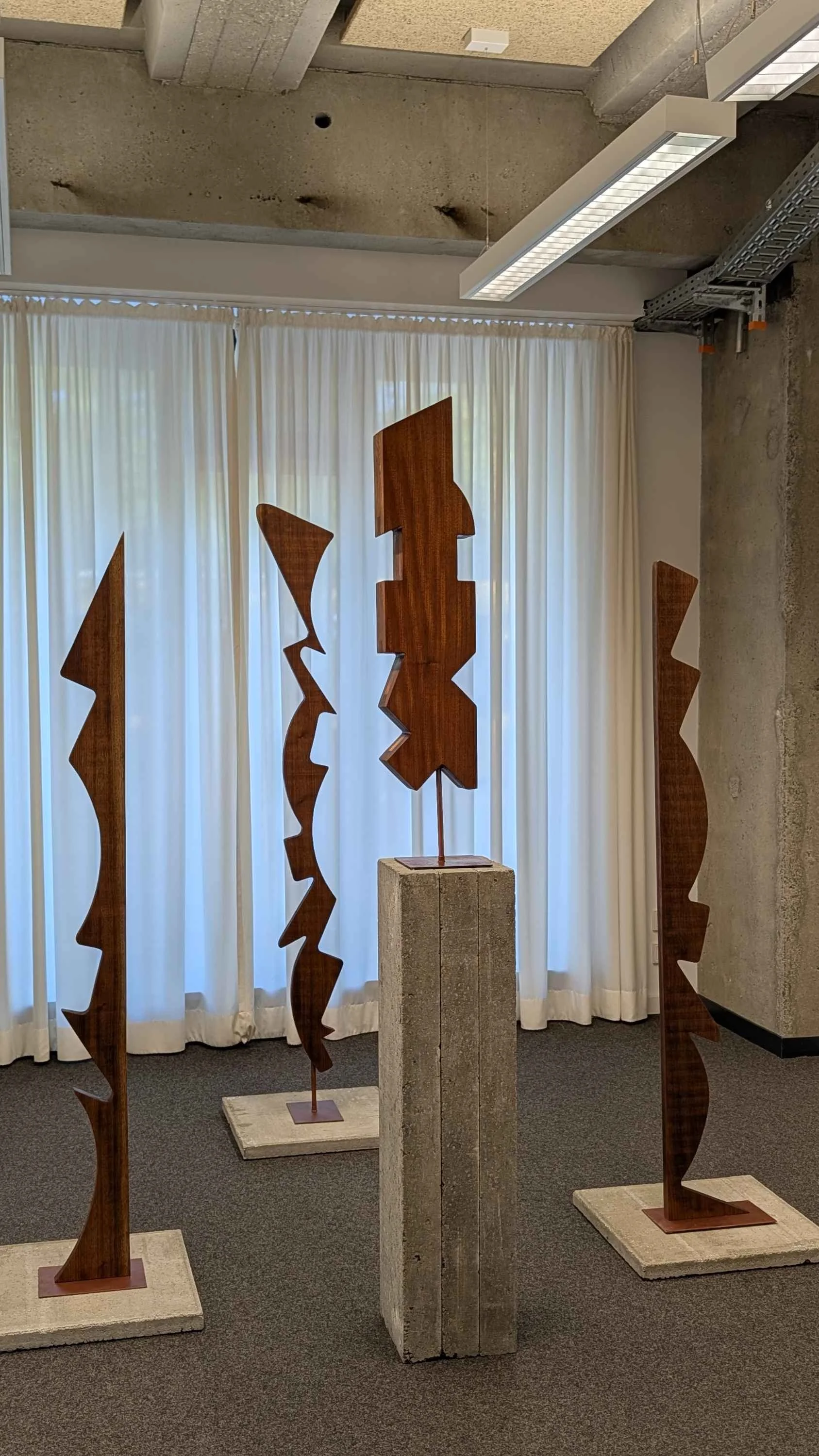
It is also fascinating that you select different woods from different countries and combine them in a way that feels connected to the work.
What I like is that you end up with remaining pieces you did not plan for, results you never had the idea of in advance. It pushes the boundary as an artist, because I am used to thinking about forms, but here the forms are ones I never thought of myself. It is a continuation.
When it comes to crafting the wood, did you train yourself in the south of France?
Not exactly. What matters most to me, and this goes back to my carpentry training, is that I never wanted to cut wood the traditional way, like an artisan. I will never reach the qualification or the ability of someone who trained their whole life for that. For me, it makes more sense to use modern machines and push them as far as they can go, while still operating them myself. I cannot show you here, but in the show you could see lines cut into the wood that are only four millimetres wide. I like pushing past what is supposedly possible to do by hand, to the point where the machine itself sometimes breaks the piece, which I find interesting rather than discouraging. I always try to push past the limit of what feels achievable.
After the machine work comes the sanding, which takes a long time and matters enormously to me, because I want the wood to feel like skin when you touch it. I am still far from the level of a real artisan, but I push the sanding as far as I can to get close to that quality.
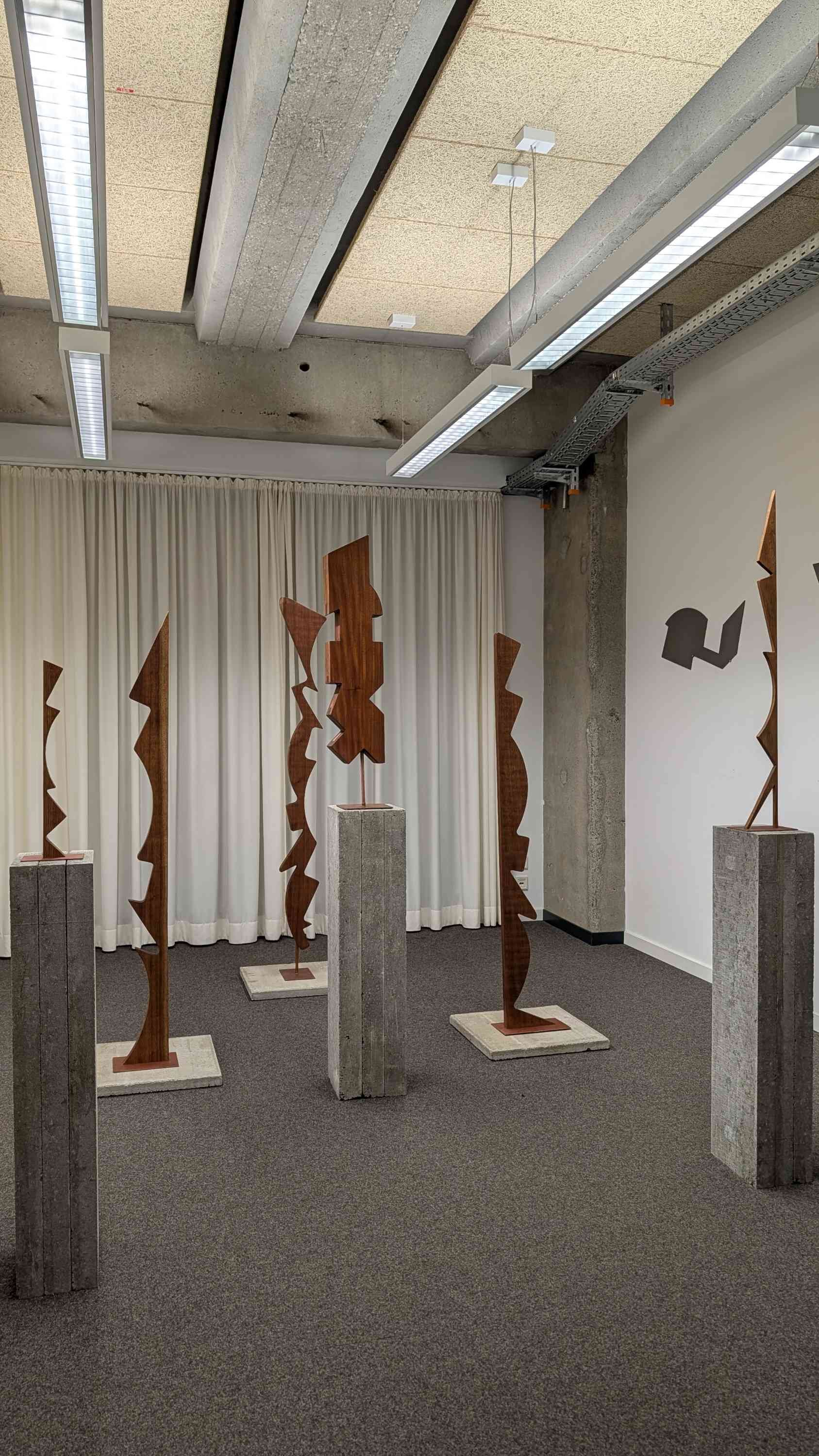
So you want the touch and the feeling of the wood to carry something almost human?
It is closer to how design works. When you build something to be used, a chair to sit on, a table to eat at, you want the craft to be perfect. I am not a designer, I am an artist, but I want people to feel that my sculptures carry that same quality. You can touch my work. I do not want it behind glass. Wood has a real sensuality, and it matters to me that people can touch it the way they would touch skin.
Are there designers or artists working with materials in a similar way that you admire?
There are too many names to mention, plenty of very established designers and plenty of young ones, and the goal is always the same regardless of how known someone is, the best quality of design, something you can touch, the best leather, the best steel, the best wood, the best craftsmanship. I love the work of Kostas Lambridis, Greek, who reworks everyday chairs you might collect anywhere. It is not quite Art Povera, but he builds his own structures from them. He is an artist as much as a designer, even though you cannot actually sit on his chairs, and there seem to be no limits to what he creates, always starting from something as ordinary as a chair or a table.
Now that you have told me more about how you turn a frame from your paintings into a sculpture, are you considering working with different materials?
I have a list of materials I want to work with, including some that are tricky. Since I am still, in a way, early in my career, I want to control the whole process of producing my work myself. I get bored quickly, and once I have made something, it is almost dead to me, I cannot redo it, I need to move on to the next project. Eventually I would like to reach a point where I am recognised for a certain kind of art, can sell it, see it in institutions, and have people work alongside me so I do not have to do everything myself. But what matters most to me is the moment of creation. As soon as the public sees a piece, it stops being mine, it becomes an episode of my life that is finished, and I move to the next one.
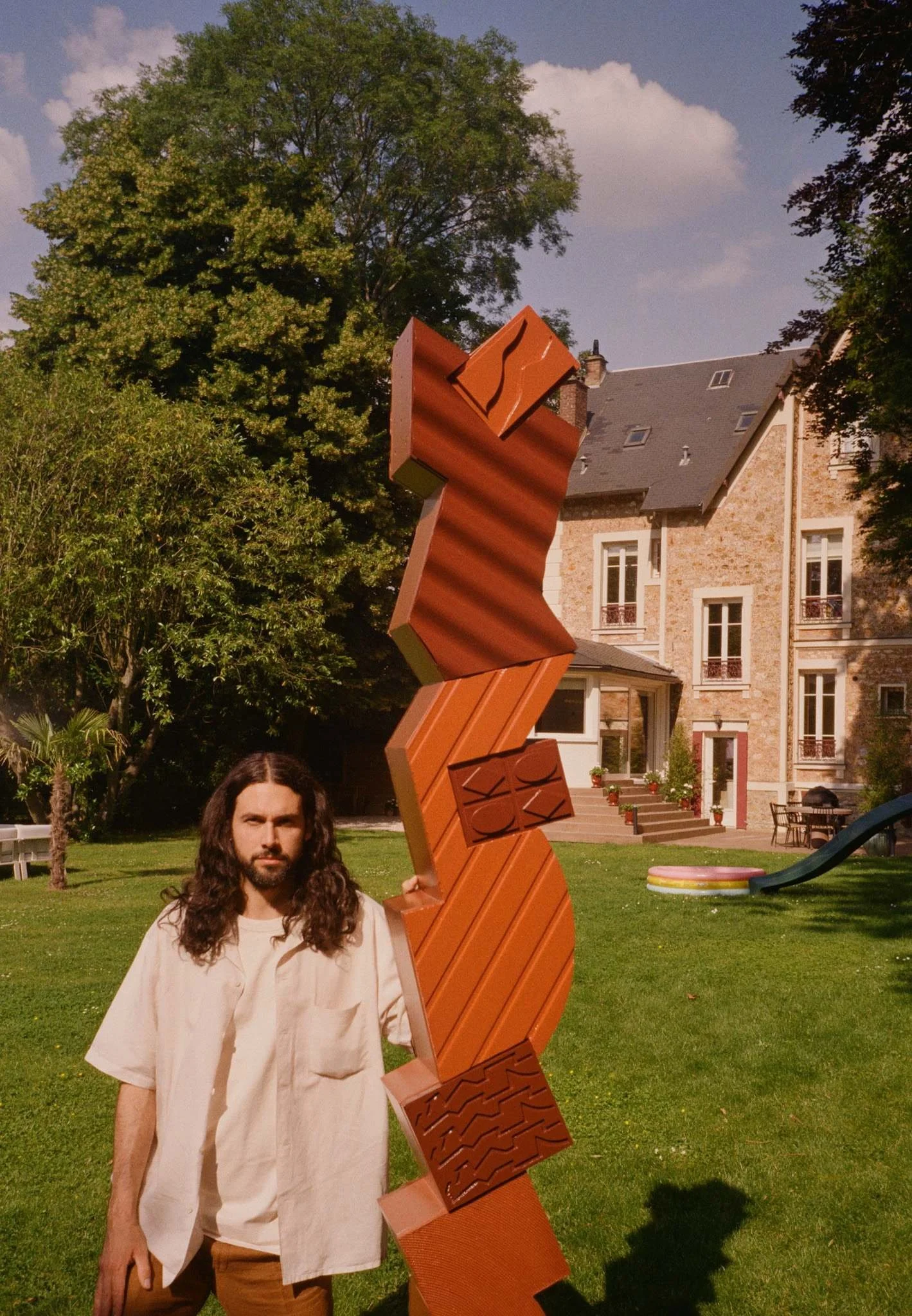
I am open to collaborating more. For the large sculpture in the garden, there was welding involved, and I cannot weld myself. I learned a little recently but never really wanted to do it on my own, since it has to be done so precisely that you do not want to risk getting it wrong. I worked with around four different suppliers on that piece, and I would like to keep developing that kind of collaboration.
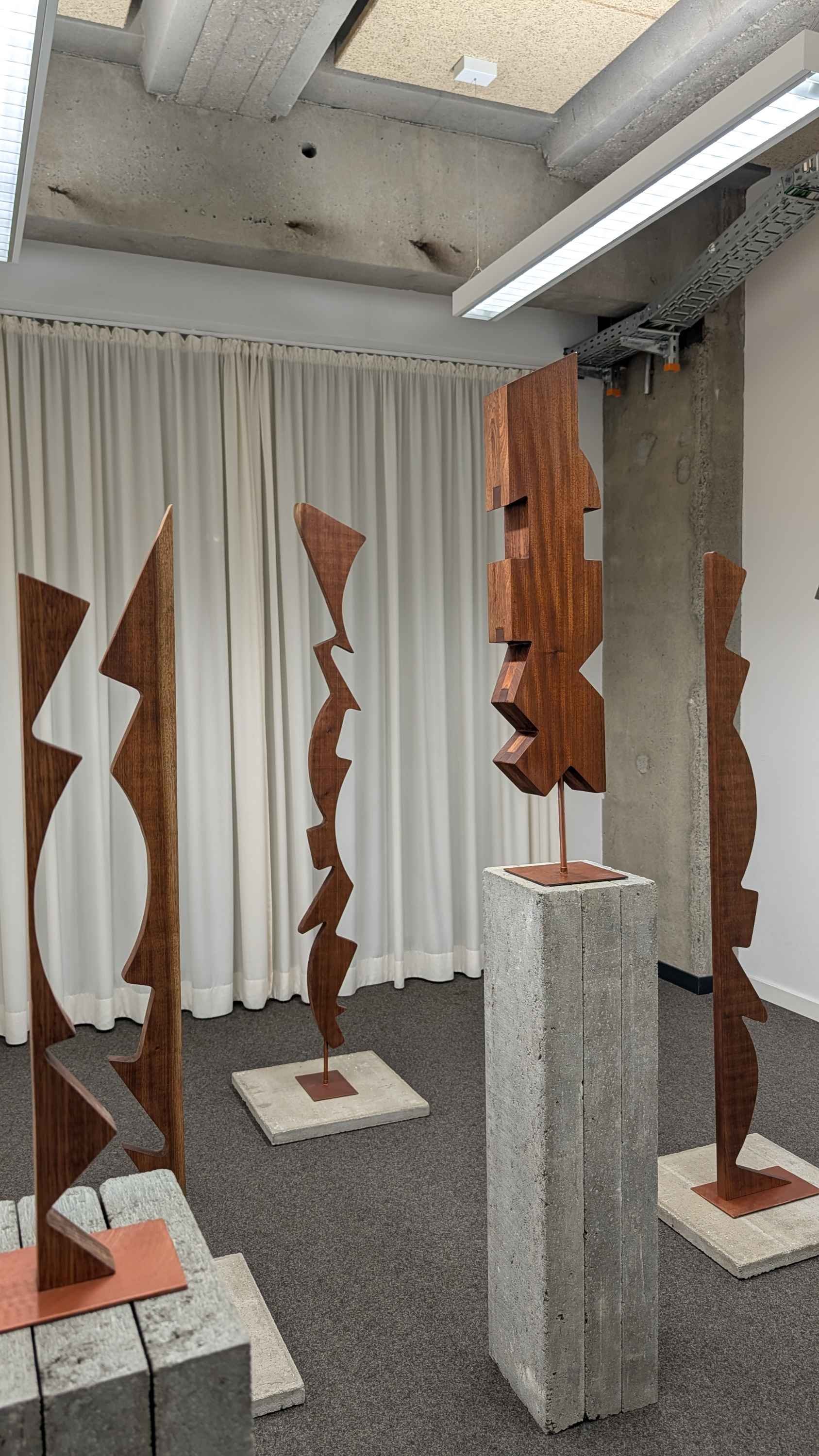
So this is really the beginning of new collaborations for you, with you as the founder of the protocol, while others help it evolve?
Exactly, that is the idea, but it requires a certain visibility and large shows to make that happen, so that is what I am working toward now.
What about the size of your sculptures? Are you planning to go bigger, smaller, or stay where you are?
This might sound a little bold, but my goal is to take the sculpture you saw in the garden and build it at the scale of an actual building, with forms running through the middle of it, like windows cut into the shapes. Picture one of my sculptures, but as a building.
There was a period when I worked on paintings designed to interact with light, completely black until daylight or artificial light hit them and changed their colour, so without light there was no artwork at all. I want to bring that idea into the building, with pieces in the centre that rotate through three hundred and sixty degrees. Since the sun moves east to west, for six months residents on one side would get the sun and for six months residents on the other side would, with the moving pieces meaning the building never settles into one fixed state, it keeps changing. It is a very ambitious idea, and I may never manage to build it in my lifetime, but I want to try.
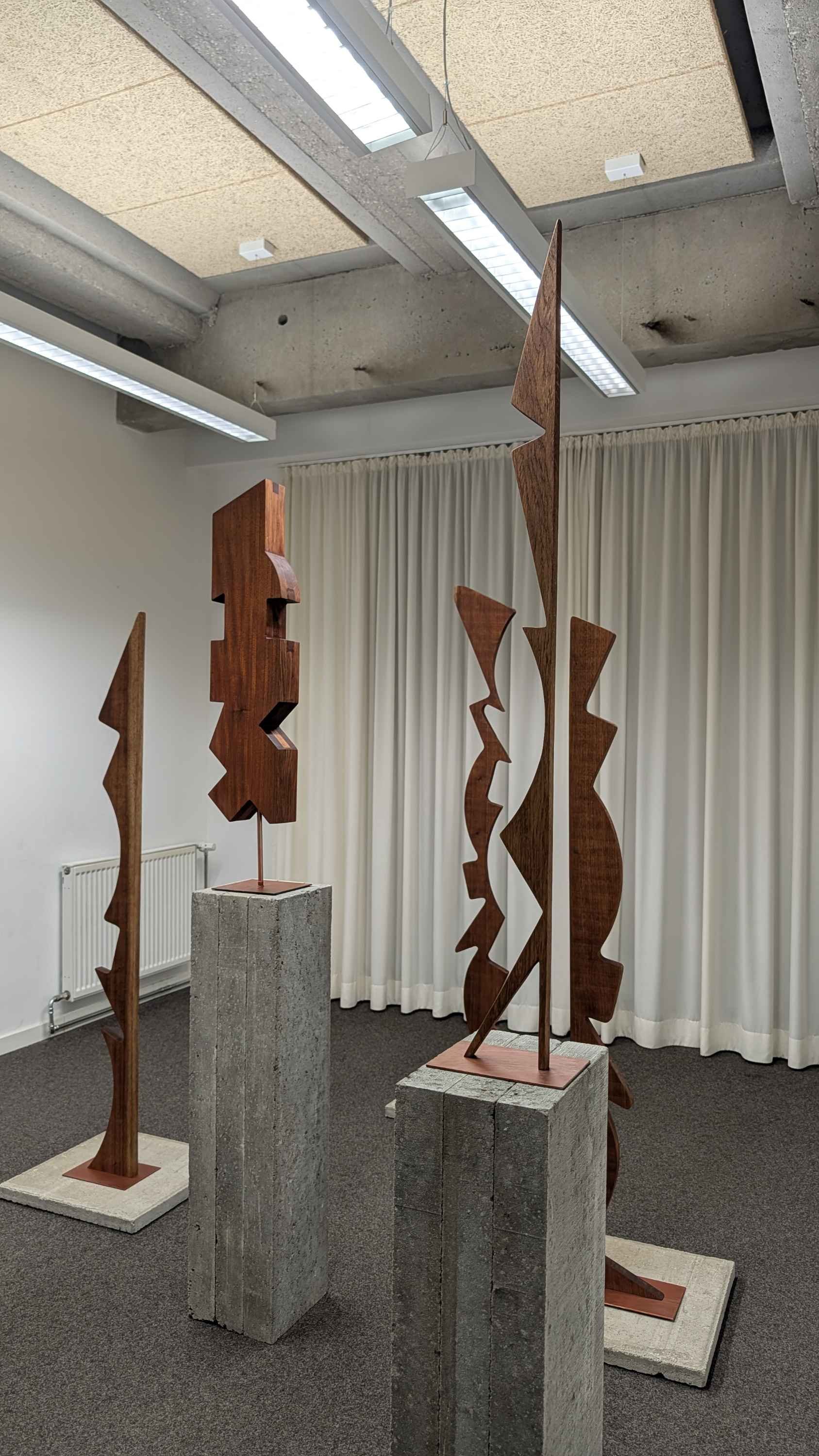
I remember you also mentioning that you want to keep your work accessible, with bigger pieces for someone like an architect and smaller, more accessible pieces for others. Is that still the idea?
You are completely right. The art world works in a way you cannot fully control. If you enter the market, at some point your work is going to be worth something, and I am not talking about millions, but eventually some people will not be able to afford it. I do not like that, because I want art to stay accessible to everyone. That is why I am working with materials that let me keep a high quality while staying light enough to transport and strong enough to last, so people can touch and move the pieces over the years without them losing strength, and so the work stays affordable. The idea is that people can collect fragments and rebuild their own frame from them, or build something else entirely, which is really the point, pushing past what I imagined when I started, toward whatever someone else decides to do with it.
What materials are you planning to work with for what comes next?
The next project will be mainly aluminium, with wood involved as well, so a mix of the two.
Before we close, is there anything else you would like to add?
Just one thing. What I am drawn to is not really “natural” in a strict sense, it is more a way of seeing things, raw material that has not been overly modified. Even wood, once cut from a tree, is already a chemical combination of elements, the same as concrete, which many artists and architects describe as the most natural material there is. But concrete is only as good as how it is made. In Africa, for example, houses are built from mud using traditional methods, and in Morocco, during the recent earthquake, the buildings made from poor quality concrete collapsed while the ones built from earth, using that traditional combination of raw elements, held. So yes to natural, but really to the raw kind, since steel or glass are also combinations, a kind of chemical process in their own right. I know what you mean by raw, and that is closer to what I am drawn to.
Interview by Donald Gjoka
What to read next