'Strange Rules' Mat Dryhurst and Holly Herndon at Palazzo Diedo Venice

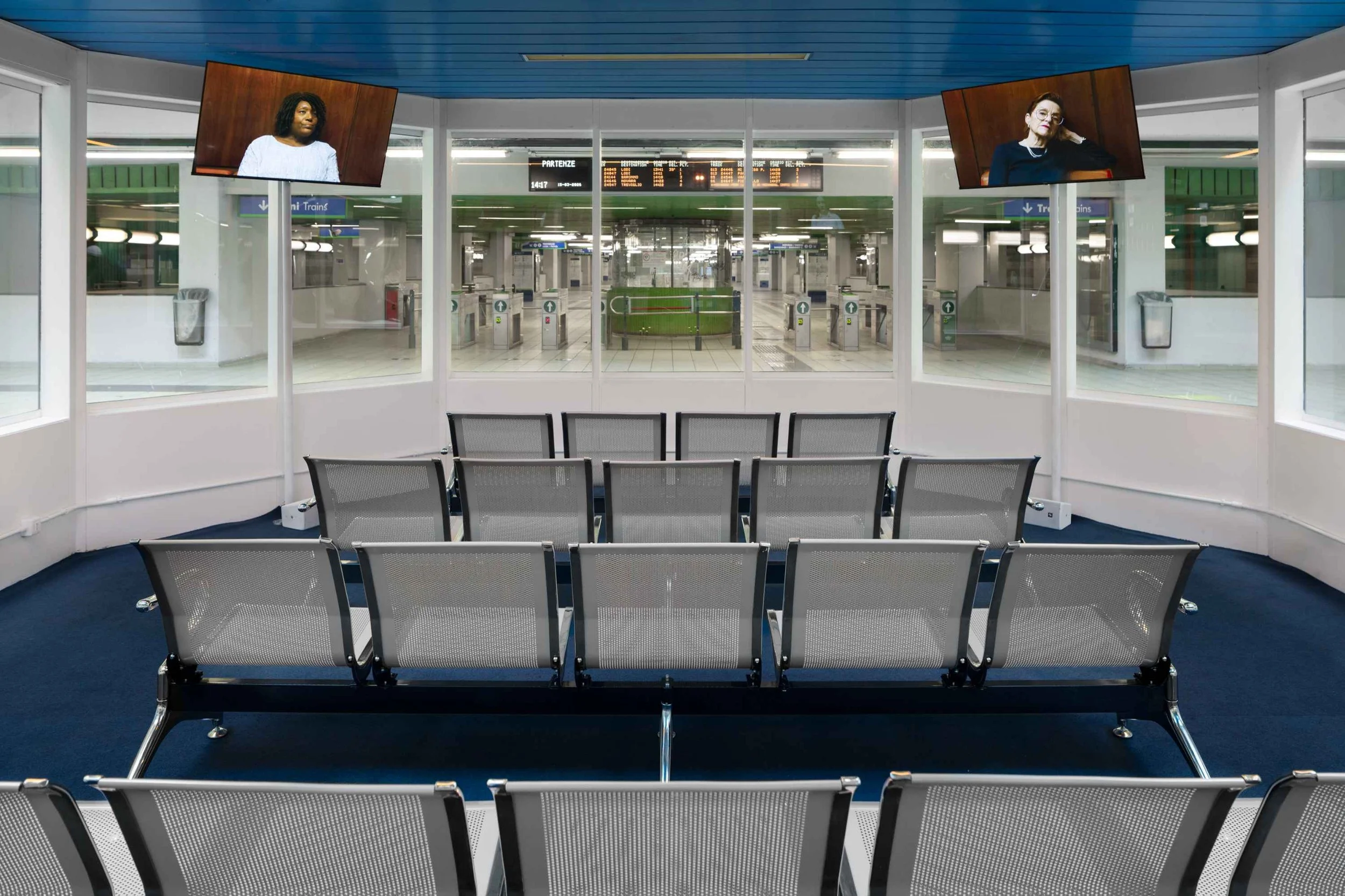
Mat Dryhurst together with Holly Herndon, Hans Ulrich Obrist, and Adriana Rispoli, he has co-curated Strange Rules at Palazzo Diedo in Venice: the first space in Italy dedicated to a sustained curatorial and theoretical reflection on Protocol Art, and one of the more genuinely ambitious projects to coincide with the 61st Venice Biennale. At the exhibition's centre sits the Attention Guild, a new commission by Dryhurstand Herndon in collaboration with architecture studio SUB. It is a parliament: humans speak on the ground floor; above them, agents debate, forming a mirror assembly fed by the same stream of anonymously gathered conversation. Everything said in the space contributes to the missions of their studio. Nothing is scenographic.
What distinguishes Dryhurst's position is a refusal to treat deployment as someone else's problem. The Do Not Train registry, built through Spawning, was adopted by major companies not because it had institutional backing but because it worked. Holly persists because people can engage with it in technical, not only critical, terms. The protocol art thesis rests on that word: works. The Attention Guild also proposes an economy. Context and compute, in Dryhurst's framing, are the two currencies of an agentic future. Agents contribute idle hours to a shared mission; in return, they receive access to years of accumulated knowledge. Less a transaction than a structure, closer to the Hanseatic League or BitTorrent than to anything the gallery world has built before.

Could you explain us the core idea of the concept and vision behind the Attention Guild installation?
The installation is called the Attention Guild. Over time, Holly and I have been building software protocols that are very opinionated about how spaces function. This work builds on projects we did with the Serpentine and with KW, where we were developing what we call read-write public spaces: environments you both receive from and contribute to. Previously, we were doing that through the training of a model; now we are doing it through the building of a network, through software. There is a very continuous ideological path running through all of it.
The core idea is that we are building a kind of parliament: humans discuss on the ground level, and agents debate above them, forming a mirror parliament. We designed the structure with close collaborators in Berlin. Everything said in the space is captured anonymously and fed into context for the agents, which have been assigned four missions connected to the work of our studio. Anything said in the space can contribute to those missions.
And what is the broader ambition behind deploying this as a live protocol?
The grander ambition is to deploy this as an actual protocol in the world. The thesis is that we are all, sooner or later, going to have agents working on our behalf, and we are deeply interested in what the economy of that looks like. The two things we have isolated as having value in that economy are context (meaning specialised knowledge) and compute, meaning raw computational power.
So, what we have set up at the studio is an environment fully configured for agents. If someone is interested in a mission we are working on, they can assign their agents to it. When those agents are not busy doing their own tasks (say, for two hours a day) they contribute to our mission, giving us compute. In return, we give them context. If you are writing a book or making an art project and you wonder what Holly and I might think about it, your agent can go and listen to every relevant exchange we have had over the past six months. It is an exchange, a gift economy of sorts. It reminds me of the early web, of BitTorrent trackers, those ideas of sharing and mutual contribution that you can now revive within an agentic landscape.
Obviously, there are limits. I am not going to expose a private conversation Holly has about our family budget. But when it comes to the work itself, the whole point has always been for people to engage with it: not just what the work does, but all the references that fed into it, all the meetings where something clicked. With agents, you can offer that depth of context in a way that simply was not possible before.

““The division between artist, engineer, and scientist, I think it is already gone. We are all the two-headed worms now.””
What kind of research and references informed the installation specifically?
A lot of it centered on parliamentary configurations. We were looking at a wide range of those, but also at a reference that comes more from Holly's background: sacred harp singing. In sacred harp, people sing in a square, everyone facing each other, all in the same space together. We wanted the parliament to carry that quality, that horizontal arrangement where no one is elevated above anyone else.
Then for the agents above, we were drawn to images of doubling and inversion: the upside-down city in Ghost in the Shell, the strange phenomenon where clouds at a certain point reflect a city beneath them if the light and mist are just right, so it looks like two cities staring back at each other. Inception catches some of that feeling too. And on the material side, Nicholas and I were looking at very old Venetian and Hanseatic League parliaments that often feature very dark, almost oil-black wood. I am personally obsessed with the Hanseatic League. If you go to Gdansk (Danzig, one of the great ports of the League), you find these thick, dark wooden buildings that have a particular gravity to them. That language came in there, and it is also part of what led to the name Attention Guild, which connects to thinking I have been doing around guild structures for about ten years now.

Do you work with a team to build both the artistic and the software components?
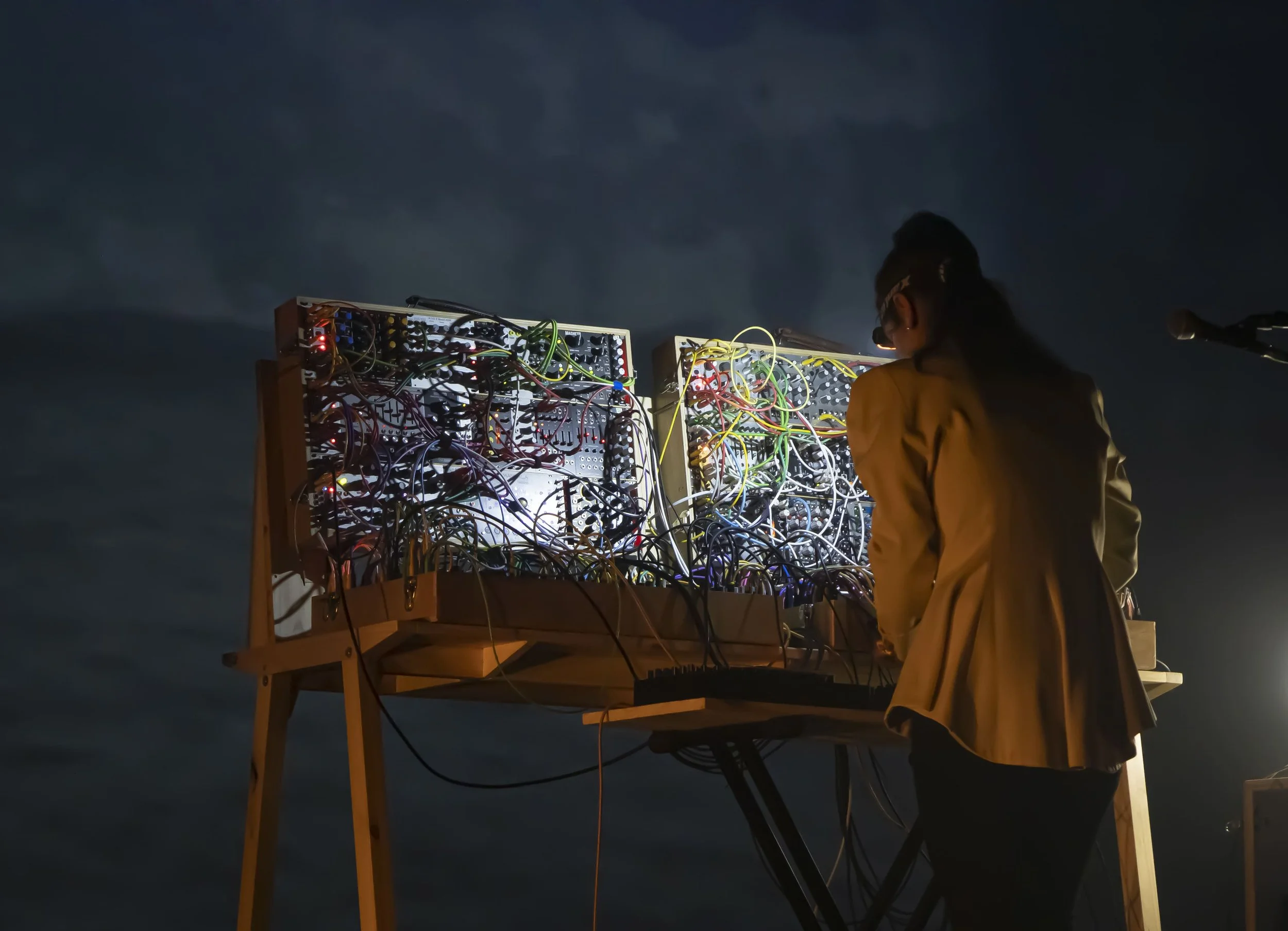
It is mostly Holly and I running things. On the audio side, we work with Ian Berman, who is a genuinely gifted sound designer and has been essential in getting the generative music component right. On the software development side, I work closely with Jordan Meyer, who is based in the States and who I actually co-founded a company with called Spawning. Jordan is an elite machine learning developer. I can take things only so far, as when you are dealing with automated software systems, moving one thing tends to move something else, and getting everything into a stable state, especially a state ready for public deployment, is where Jordan's expertise is decisive.
More broadly, all of our projects at this scale are collaborative in ways that might not be immediately visible. Working with the architecture team on sub, for example: people might assume that one element came purely from them and another purely from us. That is not the case at all. We basically assemble groups of people who are genuinely collaborating. At the end of the day, all I care about is that the final result is the best it can possibly be.
You mentioned that in a couple of weeks you plan to take everything gathered during these days and launch it as a live protocol. What does that moment look like?
The protocol is essentially done; we are in a testing phase. Whether it is a couple of weeks or a month, I am not certain, but the goal is to have it live in the world soon. This connects to what we call the protocol art thesis: we want to deploy software that actually functions. We have had experience with that before. With Spawning, we built the Do Not Train registry, which was used by major companies. It started as an art project and it works, which is why it has had the influence it has had. Holly+ worked too, and that is why people keep engaging with it, referencing it, building on it.
The burden we place on ourselves is that if we are going to hold to this thesis, we have to make things that work. In an art context, that is actually a somewhat provocative position, because art has traditionally been conceived as existing outside the market, in a kind of autonomous sphere. But for us, representing this idea properly means deploying real software and having it engage people who genuinely know what they are talking about. I do not think it is enough anymore to gesture at things. When nineteen-year-olds go straight to the App Store, that is the world we are in.

How did you find a common ground working with Hans Ulrich Obrist and Holly on the curatorial dimension?
Holly and I are, at this point, basically the same person; we have been together for twenty years, so working together is effortless. With Hans, we have now had a collaboration running for many years, and I cannot speak highly enough of him. He has an extraordinary capacity for information, an intelligence that is very rare. He has done so much and seen so much, and yet when you are in the room with him, working through this material, he is genuinely excited. For someone with that breadth of experience to be excited by what we are doing is an honour. And beyond that, to invest so much time and trust in this process: it is remarkable. I hope we continue working together for a very long time, because people like that are rare.
There is a work in the show featuring a planarian worm with two heads, you mentioned this relates to research by Michael Levin. Can you say more about that?
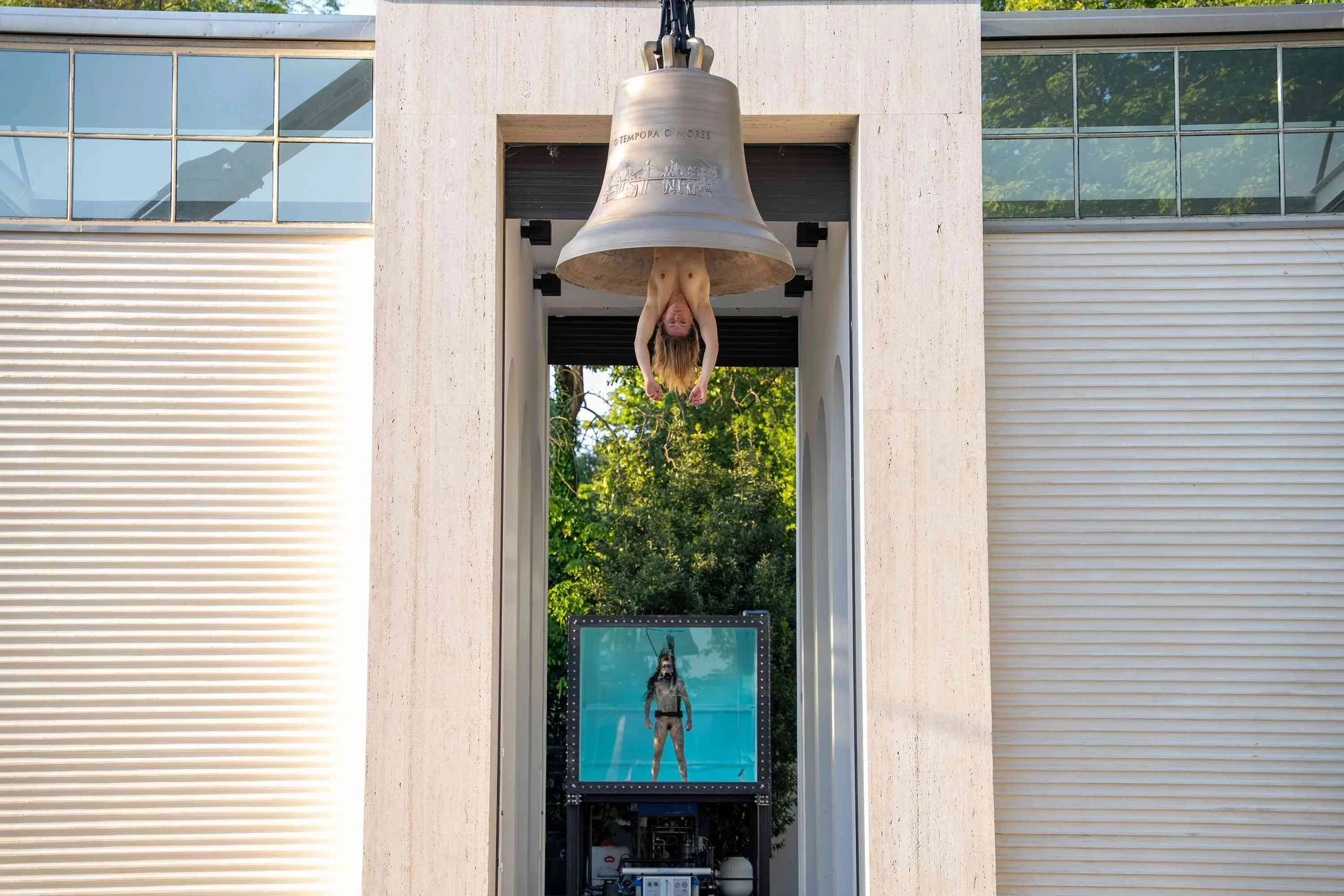
I would strongly recommend looking into Michael Levin. The experiment we are showing is one of the foundational planarian worm experiments in which he persuades worms to grow two heads. What is so fascinating about his work is his theory of the cognitive light cone. From a hard science perspective, he asks: what is the fundamental difference between us and a dog, or between us and a worm? He argues that the answer is not what we typically assume. A rock is not very persuadable: you can break it, but it does not grow new things. As you increase complexity, you increase persuadability. And who we are, at a cellular level, is far more complicated than our everyday notion of an individual suggests. Our cells collaborate, grow things, pursue their own agendas in ways we have no control over. We are like miniature universes of billions of cells. It is an ideological act to call that one person.

And what does that mean for something like cancer, you suggested there might be a different way to approach it?
Exactly. The logical extension of Levin's work is to ask: if we are a strange community of cells, maybe we can engage with that community differently. Rather than trying to kill a cancer cell, why not talk to it? Not in words it cannot understand, but perhaps through bioelectricity or other methods, essentially saying: you are on a path toward this, but what if you went that way instead? The two-headed worm is mythologically monstrous, and I understand why it makes people uncomfortable. But on the other hand, the ability to program and interact with life at that level could be something genuinely beautiful. What could we learn about ourselves once we are open to that possibility? It is not a kitsch transhumanist fantasy about growing a third arm. It is more that through these kinds of protocol-based methods, we begin to understand more about what we are and what our potential is. I find his work extraordinarily beautiful, and it is a great honour to be trusted to exhibit it.

What were the criteria behind the selection of the other artists in the exhibition?
It grew out of a provocation. We started with the question: do you believe that the most consequential cultural actors of our time are the people building platforms like Instagram, or the people posting to them? Not one person, across over a hundred conversations that Hans and I had in preparation for this, said the people posting. And from that, the question becomes: if you accept that, does it make sense for artists (who claim cultural influence and relevance) to be building and engaging with those protocols? And everyone said yes. I have genuinely never heard a coherent counter-argument.
From that position, you go out and find that there are already many artists working in this vein. Terra0 has been developing protocols for years; they now own a forest they are trying to teach to govern itself. Trevor Paglen has been studying psychological manipulation and state surveillance for a long time; protocols are the core of what he investigates, even if he does not always frame it that way. Simon Denny has been working in this space for years. Harold Cohen, whose work we have upstairs, was the first person to seriously train machines to create images, and in 1981 he wrote that what he was making was a protocol, and the art was the protocol.
Avery Singer, I know less from the art world and more from the events where people gather to discuss exactly these questions. Primavera De Filippi has been working in this realm for a decade, writing on protocolism and, as a lawyer, working literally on IP protocols.
The sense I get, in many cases, is that when this thesis is presented to practitioners who have been engaged in the art world for a long time, there is something relieving about it. It gives language to a frustration many of them carry. They are tired of pretending that the twentieth century is still operative, tired of playing by algorithmic rules they have no purchase on. And when you acknowledge that those rules are where the real power sits: it is the strange rules, not the pictures made within them, that determine what culture does, and something opens up. We are not going away from images or objects. But we should at least reach a clear-eyed conclusion about what is actually shaping the terrain.
What is coming up next for you and Holly?
We have a show opening at K21 in Düsseldorf next month, which is a new iteration of the KW Berlin collaboration; we are reimagining that exhibition for the Düsseldorf context. Then there is a very large show in the States next year that I cannot speak about yet, but it is going to be a genuinely new body of work, not simply a continuation of what we have been doing. And on top of that, we are in discussion about several new read-write public spaces; we have now built three of them, and I would love to build one that is permanent somewhere. We are pushing hard on that. A lot is happening.
““It is an exchange, a gift economy of sorts. It reminds me of the early web, of BitTorrent trackers, those ideas of sharing and mutual contribution that you can now revive within an agentic landscape.””

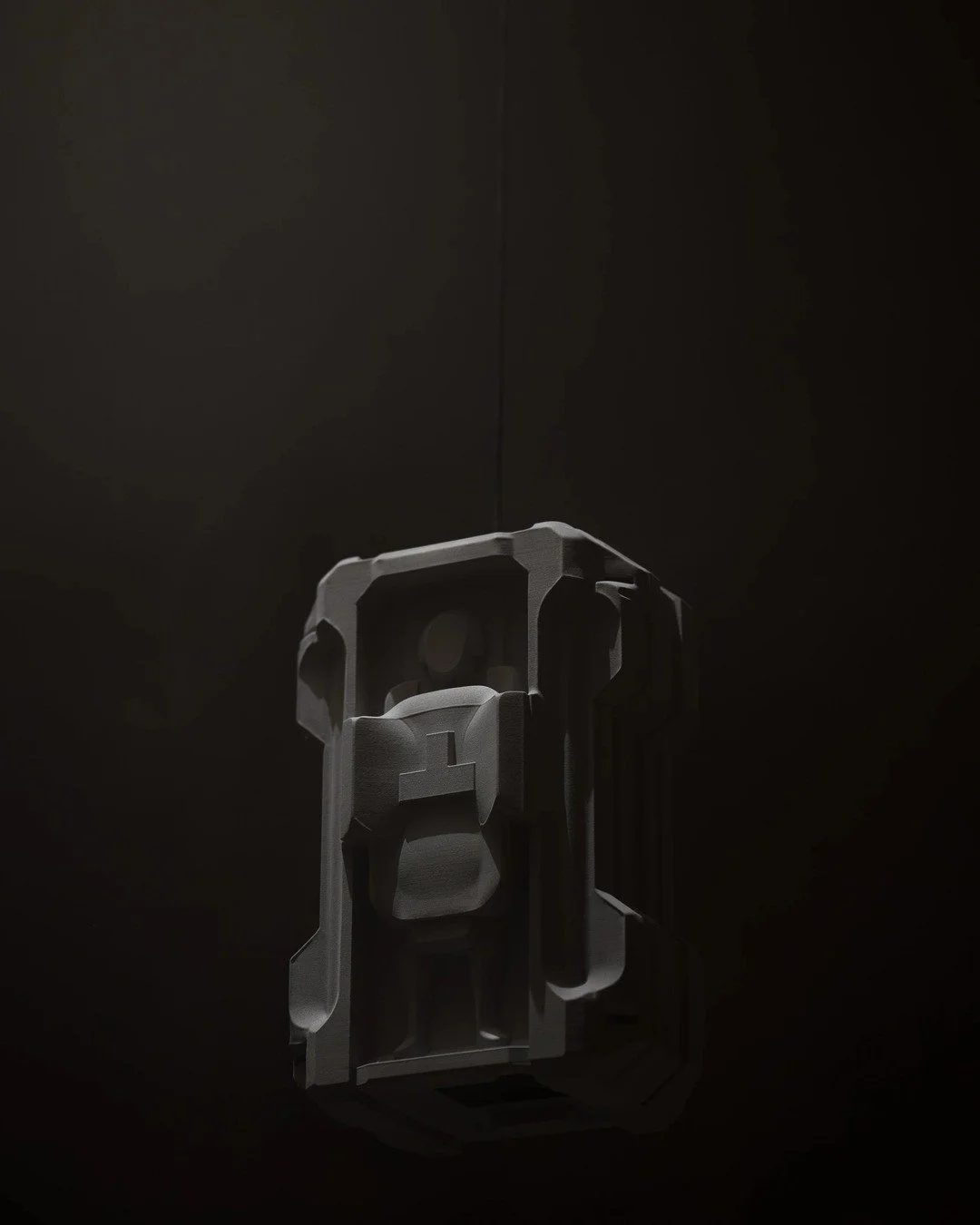
Can you tell us about the benches and Holly's printed work: there is something in the forms that reads almost like cars or bodies? What is the process behind that?
It comes from one of my heroes, and he has become something of a hero for the whole curatorial team. Hans actually met with him in San Francisco. His name is Kenneth Stanley, a computer scientist who in the early 2000s developed something called the NEAT algorithm (Neuroevolution of Augmenting Topologies), which is an evolutionary computation algorithm. You give it an image, and it can mutate eight variations of that image.
To demonstrate the algorithm, Stanley and his lab built a project called Picbreeder. It shows you eight images; you click the one that interests you; that image mutates into eight new ones; you click again, and so on, indefinitely. As you do this, you begin to get forms and shapes that start to mimic things found in nature, it is psychologically fascinating. What happened in this particular piece is that Stanley was clicking through, trying to make a face, and he ended up making a car. He tried to make a human and got a car instead. From that observation, he realised that setting a specific goal or objective can actually limit you.
And how does that connect to the broader field of open-endedness in machine learning?
That observation launched a whole field, which Stanley and others call open-endedness. The argument is: if all great things happen in ways that cannot be planned, why are we training machines to make specific plans? Why are we not allowing them to abstract the way we do? What I find beautiful about Stanley's work, and Joel Lehmann's, and others working in this space, is that at the very top end of machine learning research, people are asking exactly the same questions we ask in art. Probably always have been.
When Stanley talks about the need for machines to go on open-ended exploration without over-optimising or knowing in advance what the outcome will be, he sounds like the MoMA. That is what the MoMA is supposed to do. You invite an artist for reasons you cannot fully articulate, and afterwards it makes sense. So, I do not see any conflict between AI research and the arts. I think Stanley and Michael Levin are better artists than most people who go to art school. I do not care whether they call themselves artists. The division between artist, engineer, and scientist, I think it is already gone. There is a lot of latency in cultural institutions that are still defining themselves by industrial structures that have completely mutated. We are all the two-headed worms now.

STRANGE RULES curated by da Mat Dryhurst, Holly Herndon e Hans Ulrich Obrist with Adriana Rispoli.
Artists: Joshua Citarella, Harold Cohen, Primavera De Filippi, Simon Denny with Venkatesh Rao, Stephanie Dinkins, Fabien Giraud, He Zike, Holly Herndon & Mat Dryhurst, Lynn Hershman Leeson, Ho Tzu Nyen, New Models, Ayoung Kim, Agnieszka Kurant, Michael Levin, Trevor Paglen, Philippe Parreno, Lorenzo Senni, Avery Singer, Ken Stanley, sub, terra0.
May 4 – November 22 2026
Palazzo Diedo, Venice
Interview by Donald Gjoka
What to read next