Claudia Pagès Rabal
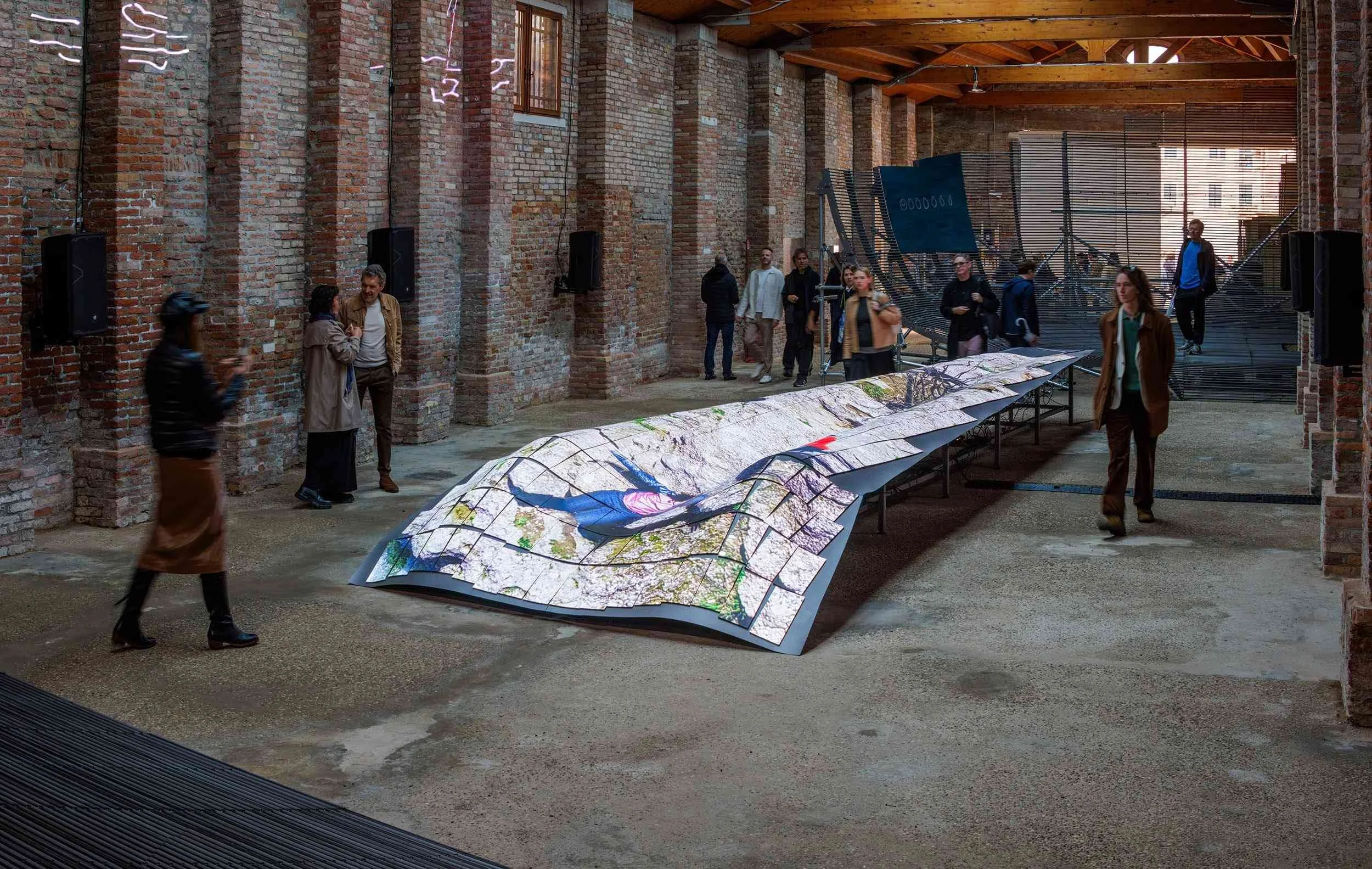
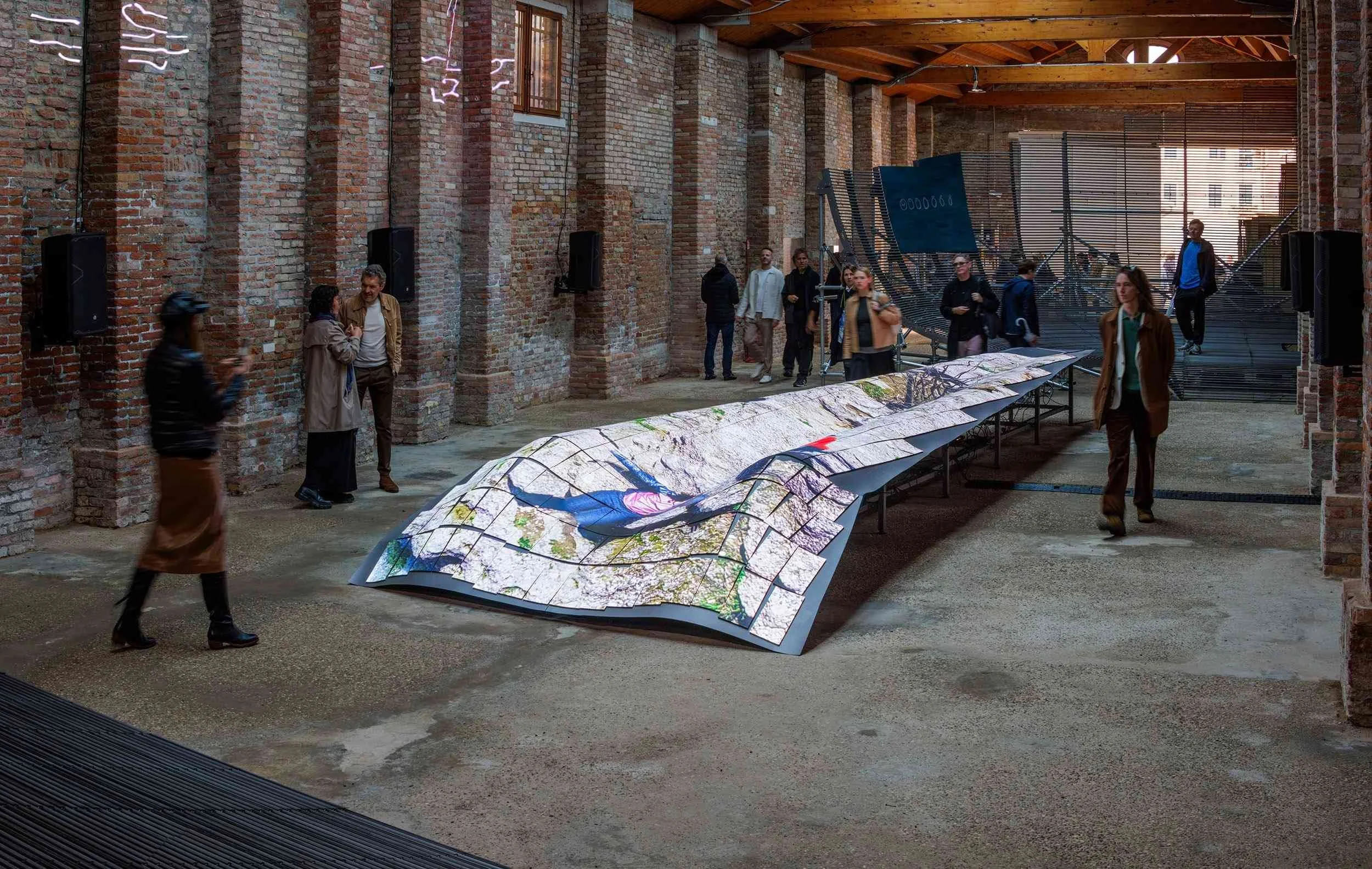
Presented at the 61st Venice Biennale as a collateral event organized by the Institut Ramon Llull, Paper Tears by Claudia Pagès Rabal is a manifold installation that examines how watermarks have functioned as tools of power and institutional authority throughout history. Located in the historic Docks Cantieri Cucchini, the exhibition creates a quantum space where past and present collide.
Curated by Elise Lammer, the project draws from 15th-century watermarks found in the Museu Molí Paperer de Capellades. These motifs were produced during a pivotal era of Mediterranean trade decline and colonial expansion into the Atlantic. Pagès Rabal reimagines these records as a series of mobile, light-drawn gestures that navigate the tensions between historical regulation and contemporary resistance.
The installation is further enriched by an enveloping soundtrack produced with nara is neus. By engaging with the territory as a palimpsest, Paper Tears questions dominant narratives of space and history, asking how the infrastructures of the past continue to frame the restrictive borders and systemic violence defining the modern Mediterranean.


The title Paper Tears suggests both physical fragility and a deeper emotional wounding. Much like a watermark, does your work function as a narrative that persists beneath the surface, acting as «an idea, an emotion, or a tension that resists direct expression but remains present»?
I hope my work has the effect of tears or leaves a mark. I believe that exhibitions don't just stay in the galleries, but live on in conversations that arise later. Like the aquifers where I've recorded, or the watermarks, which have parts that remain latent, and others that brutally capture.
In your previous projects, you have examined territories as palimpsests: do you feel this manifold logic is the linguistic and structural framework for this project as well?
There is definitely an interest in overwriting, or in opening up signifiers. Temporal discontinuity is at the core of the project. Mixing past events with present ones, current forms of language that will lose their meaning in the future. It is a piece rooted in the present moment in which we find ourselves. In previous projects, I sought out marks and graffiti on architecture and ruins. This time, I have worked with the territory and the landscape to present them topographically on the screen located in the center of the exhibition.

How significant is the physicality of the material to you, given that in this installation the watermark has been severed from its tactile, translucent origin on paper, and remodeled into a laser projection?
Watermarks are negative images, visible only when held up to the light; they possess this naive appearance because they are made with a wire line. In Paper Tears, I wanted to use the laser pointer to project these images onto the walls, transforming these files into mobile graffiti on the walls. The laser light is just a pointer that draws a line, so it maintained the linear design of the watermarks while also introducing a sense of violence to the materiality, since if the pointer were to hit a piece of paper for too long, it would burn it.
My approach to using LED screens is also very material and sculptural as I make them myself. I treat the screens as video-sculptures that I mold in metal, adapting the screens that I later cable and program. I shoot my videos while preparing their carcasses, and I always think them as sculptures-images that need bodies around. I’m interested in LEDs because they are image-matter; they have pixels that die, that decay. In Paper Tears, I played with the blackness of the screens when they are turned off.
The installation features an enveloping soundtrack where individual voices oscillate between a collective and a singular narration. What kind of collective are you invoking here?
I wrote the script with different perspectives, generations, and geographic locations in mind. References that make sense to some, a mix of Spanglish that is funny and leads to mistranslations. Each character has their own concerns: unique, particular, and universal in the political and the quantum; the boycott of a supermarket, language and euphemism, how the news and work affect the body. And, at the same time, they are all in dialogue. I worked on the melodies of the parts that are little songs, thinking about the language embedded in the collective, just as songs do.

How did your collaboration with nara is neus come about, and which aspects of their research did you feel were particularly aligned with your own work?
I’ve been working with nara is neus for several years now; we met during a rehearsal for a play I was working on, and we instantly clicked. For my projects, I always start by composing the musical structure, using simple elements and guitars. I make a demo with the lyrics and melodies, and then I pass it on to nara is neus, who polishes them and produces them in a fantastic way. I think nara is neus’s personal project is incredible; her concerts draw you into a cinematic landscape that transports me to a thousand different places.
Is the installation conceived as a habitable sculptural structure that can also be viewed from above? How does this dual perspective change the viewer’s relationship with the space and the work?
I conceived the exhibition in layers, like channels. The lasers are positioned on the cornices, the screen reflects the skylight of the space, and together with the architecture firm GOIG (Miquel Mariné and Pol Esteve), we designed two platforms that transform the space into a half-pipe, a skate park, fully integrated into the space with the grace and delicacy characteristic of GOIG’s work, and which viewers can climb onto. I wanted to conceive the exhibition as a quantum space, from which to view all the elements from different points of view.
The exhibition is set within the Docks Cantieri Cucchini in San Pietro di Castello, a space that historically served as a squero (the traditional Venetian shipyard for vessels). How does the heritage of this site impact the presentation of your work?
The entire show revolves around the flow of water and the symbols that move within it. Also, while I was drawing the screen, I went to the Maritime Museum in Barcelona to look at drawings of ship structures, and it was from those drawings that I developed its form.

Recently, you’ve used counter-cartography as a way to question dominant narratives of space and history. Since Paper Tears focuses on a decisive shift in trade routes and power, do you see this project as a continuation of that mission? How does this historical shift help us understand the continuity of power infrastructures we see in the present day?
My most recent works are based on the Silk Road, exploring the ruins and architecture of my immediate surroundings, where I use these routes to examine the social policies that shaped the region in the past, a history that has shaped the world we live in today. Paper Tears focuses on 15th-century watermarks because that was a time of expulsions and violence, which led to a decline in paper production and the need to import paper from Italy. Examining these circulation records is a way of mapping these events. Placing this archive and its events in dialogue with the present traces the inventions and narratives we live by, the invention of the other, and the partitioning of the Mediterranean. How have we reached a point where the Mediterranean Sea has become a sea of death, where every year our governments drown and kill hundreds of people?

Interview by Alessia Imprescia
What to read next